Manual 02877 723PLUS Hardware Manual
Woodward 1
Chapter 1.
General Information
Introduction
This manual describes the Woodward 723PLUS Digital Control hardware,
9906-619 (low voltage), 9906-620 (high voltage), and 9906-700 (modified
actuator filtering, low voltage).
Application
The 723PLUS Digital Control can be programmed to suit applications requiring
two magnetic pickups (MPUs) or proximity switches (e.g. for torsional filtering) as
the hardware includes two speed inputs. It also includes four analog inputs, three
analog outputs, eight discrete inputs and three discrete outputs, all of which can
be programmed to satisfy the application. The control can be used in load
sharing systems as it contains circuitry and connections to support this.
The two LON
®
* channels can be used to support Woodward LonTalk
®
* or
LinkNet
®
input/output nodes control functions.
*—LON and LonTalk are trademarks of Echelon Corporation.
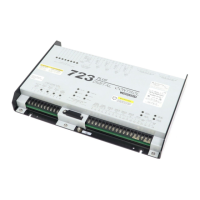
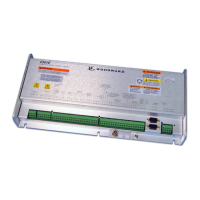
The 723PLUS control (Figure 1-1) consists of a single printed circuit board in a
sheet-metal chassis. Connections are via three terminal strips and three 9-pin
subminiature D connectors.
Control Options
The 723PLUS control requires the following power supply input voltages, with 40
watts as the nominal power consumption at rated voltage:
18–40 Vdc (24 or 32 Vdc nominal)
90–150 Vdc (125 Vdc nominal)
Discrete input voltages provide on/off command signals to the electronic control.
Each discrete input requires 10 mA at its 24 Vdc nominal voltage rating (for 24
volt switching logic).
Other control options are:
proximity switch input for speed signal frequencies below 100 Hz (see
NOTE)
0–1 mA for meter drivers
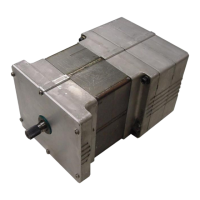
tandem actuator outputs
dual actuator outputs (0–200 mA)
The control may be used with either proximity switches (see NOTE) or magnetic
pickups. The minimum frequency for steady state speed control is 30 Hz. For
more information see Control Specifications (inside back cover).
EU Directive compliant applications are not currently able to use
proximity switches due to the sensitivity of the switches.








 To Next Page