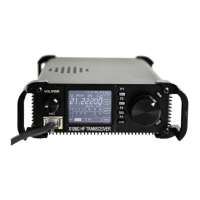
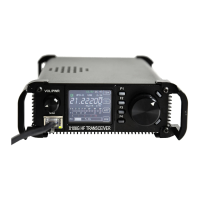
The Xiegu G106 is a 5W portable QRP (low-power) transceiver designed with an SDR (Software Defined Radio) circuit structure, utilizing 16-bit CODEC sampling for superior performance. It supports USB, LSB, CW, and AM modes for transmission and reception across all amateur frequency bands from 3.8MHz to 29.7MHz. Additionally, it features WFM (87-108MHz) receiving for local FM broadcasts and continuous shortwave full-range receiving. The G106 is equipped with a CW digital filter offering three bandwidths (500Hz, 250Hz, 50Hz) to enhance connectivity with other radio stations. For data communication, it supports amateur data communication and computer online control, with an optional DE-19 digital adapter enabling FT8 communication when connected to a computer. Its compact and robust structure makes it an ideal entry-level portable SDR transceiver for CW and FT8 enthusiasts.
Important Technical Specifications:
- Receiving Frequency: 0.551~30MHz, 87~108MHz (WFM)
- Transmitting Frequency:
- 3.5~3.9MHz
- 5.3515~5.3665MHz
- 7.0~7.2MHz
- 10.1~10.15MHz
- 14.0~14.35MHz
- 18.068~18.168MHz
- 21.0~21.45MHz
- 24.89~24.99MHz
- 28.0~29.7MHz
- Operating Mode: USB/LSB/CW/AM, WFM (receive only)
- Receiving Sensitivity:
- CW: 0.25uV @10dB S/N
- SSB: 0.5uV @10dB S/N
- AM: 10uV @10dB S/N
- Frequency Stability: ±1.5ppm within 30 minutes after power on @25°C; 1ppm/hour
- Transmitting Power: ≥5W @13.8V DC
- Transmitting Spurious Suppression: ≥50dB
- Audio Output Power: 0.3W
- Operating Voltage: 9~16V DC
- Standby Current: 0.37A @Max
- Transmitting Current: 2.8A @Max
- Dimensions: 12040135 mm
- Weight: About 720g (only host)
Usage Features:
The G106 features a black and white dot matrix display for user-friendly status information, offering good visibility even in outdoor sunlight.
- Volume Knob (1): Increases/decreases volume. Short-press to switch between built-in and hand microphone speakers.
- Hand Microphone Interface (2): For external hand microphone connection.
- Display (3): Black and white dot matrix display.
- T/R Indicator (4): Status indicator.
- Main Knob (5): Changes current frequency value.
- Multi-function Buttons (6): Short-press to execute corresponding functions displayed on the screen.
- Power Button/Screen Backlight Brightness (7): Long-press to power on/off. Short-press after power on to toggle display backlight.
- MODE Button (8): Short-press to switch between working modes. Long-press to turn on/off the preamplifier.
- Band Switch Button/Lock (9, 10): In HF band, short-press to switch frequency bands. In WFM mode, short-press to switch between stored FM radio stations. Pressing both buttons simultaneously locks/unlocks all buttons and knobs (except power and volume).
End Interfaces:
- Antenna Interface (11): BNC interface with 50Ω impedance.
- KEY Interface (12): 3.5mm stereo socket (3-wire) for manual or automatic key.
- ACC Interface (13): 8-pin Mini-Din interface.
- Ground Nut (14): For grounding cable.
- COM Interfaces (15): Communication interface.
- DCIN External DC Power Interface (16): 5.5*2.5mm DC power socket for 9-16V DC input.
Basic Operation:
- Power On/Off: Short-press the power button to power on. Long-press for about 2s to power off.
- Screen Backlight: Short-press the power button in power-on state to turn off/on backlight.
- Adjust Volume: Turn the volume knob. Short-press to switch speaker output.
- Operating Frequency Band and Mode Selection:
- Press the MODE button to switch modes (USB, LSB, CW, AM, WFM).
- Press BAND left/right buttons to switch frequency bands (1.8MHz, 3.5MHz, 7MHz, 10MHz, 14MHz, 18MHz, 21MHz, 24MHz, 28MHz).
- Set Operation Frequency:
- TS Step Selection: Long-press BAND left/right buttons for 2s to step up/down.
- Adjust Frequency: Short-press BAND buttons to select desired band, then turn main knob to set frequency.
- Operate Preamplifier: Long-press MODE button to turn on/off. "P" logo appears on display when on. Turn off if external signal is strong or environmental interference is high to prevent receiver overloading.
- Transmit in CW Mode:
- Insert morse key plug into KEY port.
- Turn on QSK function in menu and set appropriate rate.
- Press morse key for CW communication.
- CWF Function (Menu 2/5): Select filter bandwidth (500Hz, 250Hz, 50Hz) using main knob. Press SAVE.
- CWT Function (Menu 2/5): Select CW receiving sidetone frequency using main knob. Press SAVE.
- If QSK is disabled, only CW sidetone will be heard, no external transmission.
- CW Related Parameters: KS (automatic key rate), KM (manual/auto mode), IMB (IAMBIC mode), QSK (QSK switch).
- Lock Button: Press and hold both BAND buttons for about 2s to lock all buttons and knobs (except power and volume). A lock sign will appear. Long-press again to unlock.
- FM Radio Operation:
- Call multi-function menu [5/5], select WFM.
- Buttons:
</>: Automatically search for and store radio stations.QUIT: Exit FM radio.- Main Knob: Manually adjust radio frequency.
- BAND left/right: Switch between stored stations.
- Adjust volume knob.
- Channel Storage and Clearing:
- Store Channel: Select frequency/mode. Call menu [1/5], select MW. Turn main knob to select empty channel (icon "E"). Press SAVE. If channel is not empty, current frequency overwrites previous.
- Delete Channel: In channel mode, select channel. Call menu [1/5], select MC, then "CLR". Press SAVE.
- Set Startup Display Information:
- Call menu [3/5], select CSN.
- Editing Interface Buttons: QUIT (give up/exit), BACK (delete last character), SAVE (save/exit).
- Turn main knob to choose character, press main knob to select. Press SAVE to save.
- Set Display Mode:
- Call menu [4/5], select DIS. Three modes: SCOPE+S (spectrum + S table), SCOPE (spectrum only), BIG SCOPE (large format spectrum).
- Turn main knob to select, press SAVE. Interface switches after ~5s.
- Tips: Short-press main knob to quickly return to spectrum display if bottom menu is shown.
- Enable/Disable Keypad Tone: Call menu [4/5], select BP, press BP button again.
- View Software Version Information: Call menu [4/5], select VER. Displays firmware version. Press any button to exit.
Connection with XPA125B and Computer:
The G106 can be connected to a computer and an XPA125B power amplifier/antenna tuner via the DE-19 adapter for data communication and power expansion.
- Complete connections as shown in the diagram.
- Install the CH342 port driver (or use an online driver tool).
- Select "XIEGU G90" in the data communication software.
- Choose the sound card virtualized by DE-19 for sound input/output (different devices for input/output).
- Note: Using other C-IV compatible models may result in some instructions not being responded to.
ACC Interface Wave Band Voltage Data:
The ACC interface provides wave band data for four frequency bands, allowing peripheral devices to automatically switch wave bands or identify band information.
| Wave Band |
Voltage |
Wave Band |
Voltage |
Wave Band |
Voltage |
Wave Band |
Voltage |
| / |
/ |
7MHz |
920mV |
18MHz |
1610mV |
28MHz |
2300mV |
| 3.5MHz |
460mV |
10MHz |
1150mV |
21MHz |
1840mV |
/ |
/ |
| 5.0MHz |
690mV |
14MHz |
1380mV |
24MHz |
2070mV |
/ |
/ |
Maintenance Features:
- External Power Supply: Use a 9-16V DC power supply with at least 3A load capacity. Connect according to the provided diagram to avoid reverse polarity. The white-core line connects to the positive pole, and the metal-shielded line to the negative pole.
- EMC Ferrite Bead: Install a ferrite bead on power lines, close to the power plug, to prevent external disturbances and radio-frequency interference.
- Warranty: The limited warranty does not cover damage caused by incorrect external power connection or abnormal power voltage.
Optional Supporting Products:
- DE-19: External USB communication adapter for G90, G90S, G106, used for computer control and data communication.
- XPA125B: 100W power amplifier and antenna tuner AIO.
- L4001 Cable: Dedicated control cable for connecting XPA125B (applicable to X6100, G106).

 Need help?
 General

 To Next Page