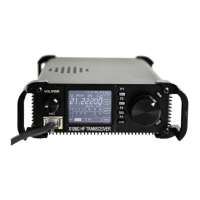
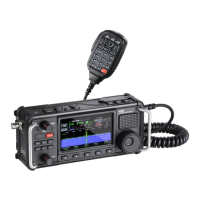
Long press the MFC to bring up 6 choices that may be selected for basic use when the MFC is
rotated: Rotate the tuning control to select the desired choice from the six. Press MFC or the ‘CMP’
button to save the selection. The choices are:
100 KHZ frequency step size. This allows quickly adjusting the received frequency in 100 KHZ
steps with the tuning control. This 100 KHZ step size is fixed. This is the initial, default setting for
the MFC. Note that you can also just press the tuning control to set the tuning step size to 100
KHZ.
Squelch level setting. This brings up the squelch level setting where the tuning control can
select the desired squelch setting. If squelch is enabled, there will be a small ‘SQL’ icon on the
display. Pressing the tuning control saves the squelch setting,
PO Level … quickly adjust the power output level with the tune control. Then press the tune
control to save the power setting.
Key Speed … use the tune control to set the CW keying speed. Press the tune control to save
the setting.
FFT Scale … use the tune control to set the base line of the FFT display up or down. Note a
setting of 1 is the auto scale setting.
RF Gain … thereafter the MFC will be used to set the G90’s RF gain from 1 to 100%. Note that a
long press of the ‘AGC’ button also allows access to the RF Gain setting.
The usual use for this control is for tuning the G90’s frequency.
o Rotate it to select the desired frequency.
o Pressing the control cycles the tuning rate from 10 HZ, 100 HZ, 1 KHZ, 10KHZ and 100
KHZ per click of the tuning knob. from left to right.
o Pressing the FUNC button and then pressing the TUNING control reverses this to be from
right to left for the next push of the tuning knob..
A long press of this control allows setting up the tuning RIT. Then use the Tuning control to dial
in the RIT plus or minus KHZ offset desired. Press the Tuning control to save this value. If RIT is
active, a small display of “R-nnn” is added to the display just under the normal signal dBm
display. The “nnn” is the +/- RIT offset, in khz.
In many other functions being used, a press of the tuning knob will complete the other function
Use the Mode Left or Right buttons to scroll through the six supported modes.
Use the Band Left or Right button to scroll through the ten supported amateur frequency bands.
Note: the band buttons may also be used in the System Menu operation.



 To Next Page
 Loading...