General Description
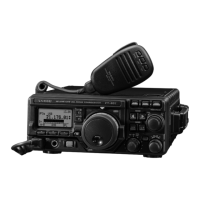
The FT-890 is a high-performance trans-
ceiver providing up to 100 watts transmitter
power output on all
HF
amateur radio bands
in CW, SSB and
FM
modes, and up to 25 watts
carrier in AM mode. The receiver tunes all
frequencies between 100 kHz and 30 MHz in
10-Hz steps.
Modular circuit design employs surface-
mount components on composite epoxy
boards for high reliability and serviceability.
Two direct digital synthesizers
(DDSs) and a
magnetic rotary encoder provide silent, silky-
smooth tuning, pure local signals and very fast
t/r changeover important for QSK CW. Fre-
quency accuracy and stability are assured by
driving both DDSs from a single master oscil-
lator, and the optional TCXO-3 temperature-
compensated crystal oscillator is available for
enhanced
+
2-ppm stability from -10 to +50 OC.
The low-noise, high-performance receiver
front end uses a parallel pair of
high-IDSS FETs
in a constant-gain, grounded gate RF ampli-
fier,
feeding an active double-balanced quad
FET ring mixer. The RF amplifier can be by-
passed for direct feed to the mixer (by the IPO
button), and a 12-dB attenuator can be inserted
for clear copy of even very strong signals.
Interference rejection is facilitated by the
unique "up-down-up" conversion scheme,
which provides both IF shift and an IF notch
filter. The optional
YF-I01 crystal filter can be
installed to provide enhanced SSB and AM-
narrow skirt selectivity.
Four microprocessors in the
IT-890 are pro-
grammed to provide the simplest possible
control interface for the operator. Two inde-
pendent
(A/B) VFOs for each band (20 total)
hold their own frequencies and modes, as well
as clarifier offsets and repeater shifts, when
used. Thirty-two memories store all of this
data for both VFOs, giving a total of 84 inde-
pendent sets of frequency, mode and other
selections. Of course all memories can be
freely tuned and scanned, but two special
memories also let you limit the
tuning/scan-
ning range between their stored frequencies.
Other valuable features include an effective
noise blanker, all-mode squelch, 4-function
multimeter, and an AF speech compressor
with adjustable IF passband-shift, which lets
you tailor SSB and AM transmitter audio to
your own voice characteristics. Special fea-
tures for CW include a built-in iambic memory
keyer with dot-dash memory and a choice of
500- or 250-Hz narrow IF crystal filters.
For serious voice contesting, the same DVS-
2 digital voice recorder option introduced with
the
FT-1000 can also be used with the FT-890,
providing continuous-loop receiver recording
and pushbutton transmission of multiple
voice messages to help keep you at your peak
QSO-rate throughout the contest.
The
IT-890 weighs under
6
kg, and with its
top-panel heatsink, runs cool all the time. An
internal thermally switched fan allows full
transmitter output without any rear panel pro-
trusions, giving easy access to rear panel con-
nectors and controls. A choice of automatic
antenna tuners is available for the
FT-890, each
with its own microprocessor and 31 memories
which automatically store most recent antenna
matching settings for nearly instant recall
while changing operating frequency. The
ATU-2 can be mounted right inside the trans-
ceiver, or the FC-800 can be installed remotely
at the antenna feedpoint. Each antenna tuner
is
controlled from the front panel of the FT-890.
Other accessories include the FP-800 AC
Power Supply with Loudspeaker; the SP-6 Ex-
ternal Loudspeaker with audio filters and op-
tional LL-5 Phone Patch; the MMB-20 Mobile
Mounting Bracket; the
YH-77ST Headset; and
the
MD-1~8 Desktop and MH-1~8 Hand Mi-
crophones.
Before connecting the power cord, you
should read the
Installation
section carefully,
heeding the warnings in that
section to avoid
damage to the set. After installation, please
take time to work through the
Operation
chap-
ter, referring to the fold-out panel diagrams at
the back of the manual as necessary for details.
This manual is intended to be read while sit-
ting in front of the FT-890, so you can try out
each control and feature as they are described.



 To Next Page
 Loading...