Need help?
Do you have a question about the Yamaha CS-5 and is the answer not in the manual?
General advice on installation, cleaning, connections, and volume settings for safe operation.
Controls the external input signal for sound processing and integration.
Voltage controlled oscillator for generating core pitch and waveforms.
Low-frequency oscillator for creating periodic sound parameter changes.
Manual control for altering the pitch during musical performance.
Explains pitch, tone (waveform), and volume as fundamental sound properties.
Describes how sound characteristics change over time, known as envelope.
Discusses sound waveforms as combinations of sine waves and their harmonics.
Produces sound sources with sawtooth and square waveforms.
Shapes tone by filtering harmonic spectrum using cut-off frequency.
Controls volume using envelope generator for temporal change.
Instructions for connecting the power cord to an AC outlet.
Connects the synthesizer to amplifiers or other audio equipment.
Connects external devices and enables multi-system synthesizer operation.
Steps for initial setup and configuration before sound creation.
Operation of the power switch to turn the synthesizer on.
Process for determining and creating original sounds using synthesizer controls.
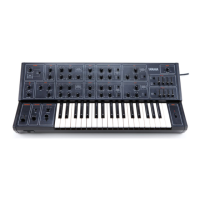
Details the monophonic keyboard, its key range, and priority.
Manual control for altering the pitch during musical performance.
Adjusts VCO tuning, octave range, modulation, and portamento.
Modulates the pulse width of square waves for sonic effects.
Controls LFO speed, waveforms, and sampling for modulation.
Selects sound sources like sawtooth, square waves, and external/noise inputs.
Connects external signals and utilizes noise as a sound source.
Utilizes HPF, BPF, LPF filters, cut-off frequency, and resonance for tone shaping.
Applies LFO and EG modulation to the VCF cut-off frequency.
Sets initial level, EG depth, and LFO modulation for volume control.
Adjusts the attack and decay times for the sound envelope.
Sets the stable sound level maintained while keys are held.
Adjusts the time for sound to fade out after keys are released.
Connects external signals and selects input source (EXT/NOISE).
Adjusts signal level for triggering EG functions.
Links multiple synthesizers using control voltage and trigger signals.
Steps for initial setup and configuration.
Process for determining and creating original sounds.
Selects sound sources and sets keyboard range.
Shapes tone via harmonic structure and temporal coloration.
Lists all synthesizer controls and their functions.
Details external input/output connections and their specifications.
Provides power source, dimensions, weight, and finish details.
Diagnoses and resolves issues where no sound is produced.
Addresses issues where sound is abnormal or controls malfunction.
 General
| Polyphony | Monophonic |
|---|---|
| Filter | Resonance |
| Envelope Generator | ADSR |
| Envelopes | 1 |
| LFO | 1 |
| Keyboard | 37 keys |
| Year Released | 1977 |
| Type | Analog |
| Oscillator | VCO |
| Waveforms | Sawtooth, Square |
| Output | Audio Output |

 To Next Page