Need help?
Do you have a question about the Yamaha F15B and is the answer not in the manual?
Records for outboard motor identification, including serial number.
Information on emission control for North American models and approval labels.
Explains CARB star labels for emission standards, indicating emission reduction levels.
Essential safety precautions for operating the outboard motor and boat.
Highlights critical warning and caution labels found on the engine for safe operation.
Outlines fundamental rules of the road for safe boating and navigation on waterways.
Detailed instructions for safe and correct gasoline refueling procedures.
Specifies recommended engine oil types, API ratings, and quantities for the outboard motor.
Details the specifications for the required battery capacity and type for electric start models.
Guidance on selecting the correct propeller for optimal performance and motor longevity.
Explains the safety feature that prevents starting the engine while in gear.
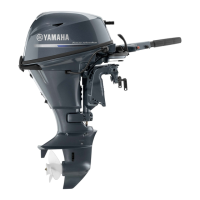
Identifies and illustrates the primary external parts of the outboard motor.
Explains the operation of the gear shift lever for selecting neutral, forward, and reverse.
Details the function of the choke knob for enriching the fuel mixture during starting.
Describes the function of the starter button for initiating the engine start sequence.
Explains tiller handle functions including steering, throttle grip, and indicator.
Explains the function of the friction knob for adjusting throttle grip resistance.
Describes the function of the engine stop button to immediately shut off the engine.
Explains the emergency stop lanyard system for preventing runaway boats.
Details the operation of the power tilt switch for adjusting engine angle.
Operation of remote control lever, including neutral interlock and throttle adjustment.
Explains the overall warning system and its indicators.
Details the overheat warning system, including speed reduction and buzzer alerts.
Describes the low oil pressure warning system, including speed reduction and buzzer alerts.
Guidance on the correct installation of the outboard motor onto the boat.
Instructions for properly mounting the outboard motor on the boat's transom.
Explains the importance of correct mounting height for efficiency and preventing damage.
Details the procedure for securely clamping the outboard motor to the transom.
Procedures for the initial break-in period to ensure engine longevity and performance.
Lists critical checks to perform before starting the engine for safe operation.
Instructions for checking the fuel level, leaks, and connections before operation.
Instructions for checking the engine oil level using the dipstick.
Guidance on checking throttle, shift, steering, and starter/stop switches for proper function.
Checks for engine mounting integrity and propeller condition.
Procedures for safely filling the fuel tank, including additive recommendations.
Detailed steps for starting the engine using the tiller control system.
Detailed steps for starting the engine using the remote control system.
Instructions on warming up the engine to ensure proper operation and longevity.
Explains how to shift between forward, neutral, and reverse gears.
Procedures for safely stopping the outboard motor.
Detailed instructions on how to adjust the trim angle using the manual tilt system.
Steps for manually tilting the outboard motor into the up and down positions.
Guidance on operating the outboard motor in shallow water conditions.
Advice for operating the motor in different water conditions like salt and turbid water.
Provides detailed technical specifications for the outboard motor, including dimensions and performance.
Guidelines for safely transporting and storing the outboard motor to prevent damage.
Instructions and precautions for trailering the outboard motor.
Procedures for long-term storage of the outboard motor to prevent damage.
Essential procedures for flushing the cooling system and fogging the engine for rust prevention.
Important safety and maintenance procedures for the outboard motor's battery.
An overview of scheduled maintenance tasks and their intervals.
A comprehensive chart outlining required maintenance tasks and their frequency.
Illustrates key points for greasing the outboard motor with water-resistant grease.
Procedures for inspecting, cleaning, and adjusting spark plugs for optimal engine performance.
Instructions for inspecting the fuel system for leaks, cracks, and damage.
Steps for inspecting the fuel filter for debris and ensuring proper reassembly.
Guide to adjusting the engine's idling speed to the specified level.
Detailed steps for draining and refilling the engine oil.
Instructions for inspecting the timing belt for signs of wear or damage.
Procedure for replacing a blown fuse on electric start models.
Instructions for checking the power tilt system for oil leaks and proper switch operation.
Guidance on inspecting the propeller for wear, damage, and shaft issues.
Step-by-step guide on how to safely remove the propeller.
Step-by-step guide on how to correctly install the propeller.
Detailed instructions for draining and refilling the gear case oil.
Procedures for safely cleaning the outboard motor's fuel tank.
Information on checking and replacing sacrificial anodes for corrosion protection.
A chart detailing common engine problems, their possible causes, and remedies.
Procedures for dealing with emergencies such as impact damage or non-operational systems.
Steps to take if the outboard motor sustains damage from collision.
How to manually tilt the engine if the power tilt system fails.
Procedure for starting the engine using an emergency starter rope.
Step-by-step instructions for starting the engine manually with a starter rope.
Procedures to minimize engine damage if the outboard motor becomes submerged.
Alphabetical listing of topics and their corresponding page numbers for quick reference.
Information on warranty coverage for owners using their Yamaha outside the USA or Canada.
 General
| Fuel System | Carburetor |
|---|---|
| Ignition System | CDI |
| Lubrication System | Wet Sump |
| Engine Oil Capacity | 1.1 L |
| Engine Type | 4-Stroke, SOHC |
| Max Output | 15 HP |
| Starting System | Manual |
| Gear Ratio | 2.08:1 |
| Shaft Length | S: 381 mm (15.0 in), L: 508 mm (20.0 in) |
| Alternator Output | 12 V, 6 A |
| Displacement | 362 cc (22.1 cu. in.) |
| Dry Weight | 37kg |

 To Next Page