EAU19653
Ch
ecking the spark plugs
The spark plugs are important engine
components, which should be checked
periodically, preferably by a Yamaha
dealer. Since heat and deposits will
cause any spark plug to slowly erode,
they should be removed and checked
in accordance with the periodic main-
tenance and lubrication chart. In addi-
tion, the condition of the spark plugs
can reveal the condition of the engine.
The porcelain insulator around the cen-
ter electrode of each spark plug should
be a medium-to-light tan (the ideal col-
or when the vehicle is ridden normally),
and all spark plugs installed in the en-
gine should have the same color. If any
spark plug shows a distinctly different
color, the engine could be operating
improperly. Do not attempt to diagnose
such problems yourself. Instead, have
a Yamaha dealer check the vehicle.
If a spark plug shows signs of electrode
erosion and excessive carbon or other
deposits, it should be replaced.
Specified spark plug:
NGK/LMAR8A-9
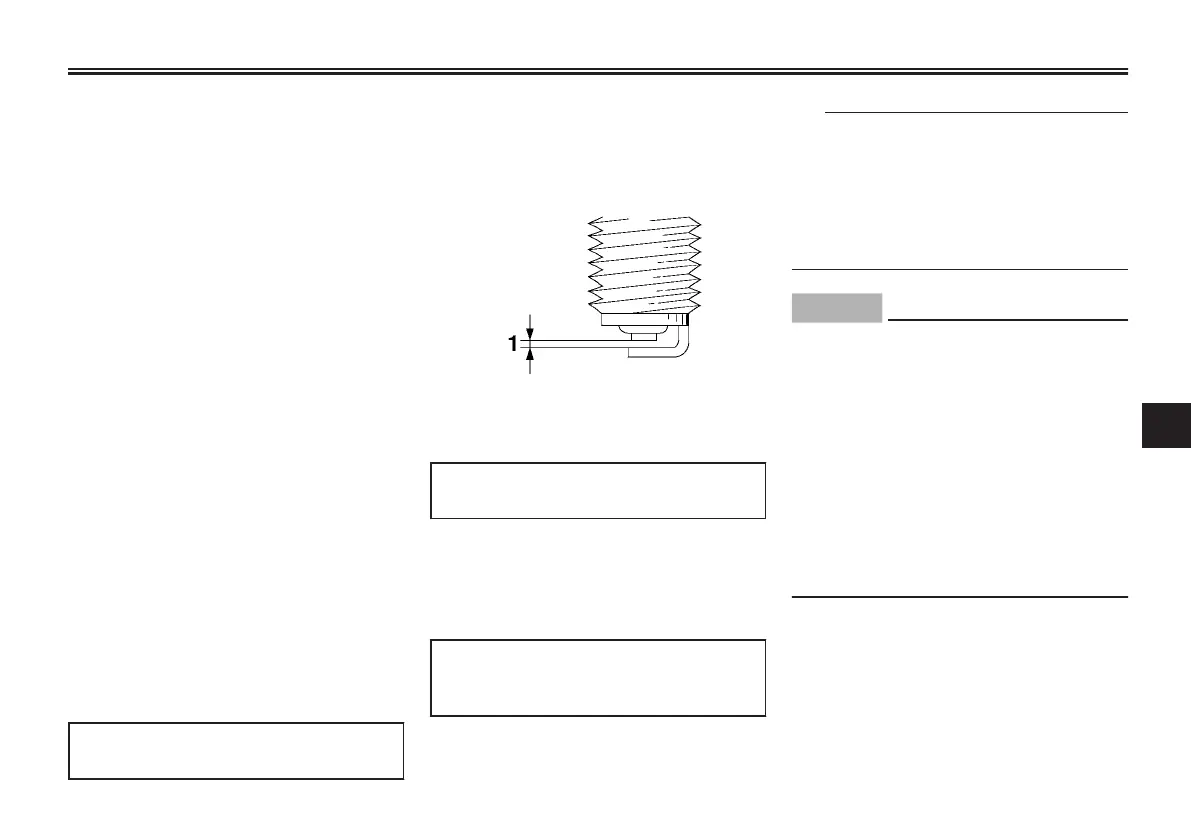
Before installing a spark plug, the spark
pl
ug gap should be measured with a
wire thickness gauge and, if necessary,
adjusted to specification.
1. Spark plug gap
Spark plug gap:
0.
8–0.9 mm (0.031–0.035 in)
Clean the s
urface of the spark plug
gasket and its mating surface, and then
wipe off any grime from the spark plug
threads.
Tightening torque:
Spark plug:
13 N·m (1.3 kgf·m, 9.6 lb·ft)
If a torque wrench is not available when
in
stalling a spark plug, a good estimate
of the correct torque is 1/4–1/2 turn
past finger tight. However, the spark
plug should be tightened to the speci-
fied torque as soon as possible.
ECA10841
Do not use any tools to remove
or
install the spark plug cap, other-
wise the ignition coil coupler may
get damaged. The spark plug cap
may be difficult to remove because
the rubber seal on the end of the
cap fits tightly. To remove the
spark plug cap, simply twist it back
and forth while pulling it out; to in-
stall it, twist it back and forth while
pushing it in.
Periodic maintenance and adjustment
7-8
7



 To Next Page