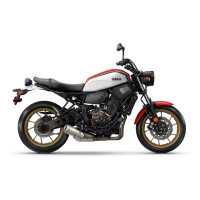
This document is an owner's manual for the Yamaha XSR700M / XSR700MC motorcycle, providing comprehensive information on its operation, maintenance, and safety.
Function Description:
The Yamaha XSR700M / XSR700MC is a 4-stroke, liquid-cooled, DOHC, 2-cylinder inline motorcycle with a 689 cm³ displacement. It features an electric starter and a 6-speed transmission. The motorcycle is designed for on-road use and is equipped with a range of controls and instruments to ensure safe and efficient operation. Key functions include:
- Main Switch/Steering Lock: Controls ignition, lighting, and steering lock.
- Multi-function Meter Unit: Displays speedometer, tachometer, fuel meter, eco indicator, transmission gear, odometer, two tripmeters, fuel reserve tripmeter, instantaneous fuel consumption, average fuel consumption, coolant temperature, air temperature, clock, self-diagnosis mode, and brightness control.
- Indicator Lights and Warning Lights: Includes turn signal, neutral, high beam, oil pressure warning, engine trouble warning, coolant temperature warning, and ABS warning lights.
- Handlebar Switches: Features pass switch, dimmer switch, turn signal switch, horn switch, start/engine stop switch, and hazard switch.
- Clutch Lever: Disengages/engages the clutch for smooth gear changes.
- Shift Pedal: Allows shifting between six gears.
- Brake Lever and Pedal: Activates the hydraulic dual disc front brake and hydraulic single disc rear brake, respectively.
- ABS (Anti-lock Brake System): Enhances braking performance by preventing wheel lock-up.
- Fuel Tank Cap: Secures the fuel tank.
- Fuel Tank Breather Hose and Overflow Hose: Manages fuel vapor and excess fuel.
- Catalytic Converter: Reduces harmful exhaust emissions.
- Seat: Provides seating for the operator and a passenger.
- Shock Absorber Assembly: Features a spring preload adjuster for suspension tuning.
- Auxiliary DC Connector: For installing accessories.
- Sidestand: Supports the motorcycle when parked, integrated with an ignition circuit cut-off system.
- Ignition Circuit Cut-off System: Prevents engine starts with the sidestand down and in gear, and stops the engine if the sidestand is lowered while in gear.
Important Technical Specifications:
- Dimensions:
- Overall length: 2075 mm (81.7 in)
- Overall width: 820 mm (32.3 in)
- Overall height: 1130 mm (44.5 in)
- Seat height: 835 mm (32.9 in)
- Wheelbase: 1405 mm (55.3 in)
- Ground clearance: 140 mm (5.51 in)
- Minimum turning radius: 2.7 m (8.86 ft)
- Weight:
- Curb weight: 186 kg (410 lb)
- Engine:
- Combustion cycle: 4-stroke
- Cooling system: Liquid cooled
- Valve train: DOHC
- Cylinder arrangement: Inline
- Number of cylinders: 2-cylinder
- Displacement: 689 cm³
- Bore × stroke: 80.0 × 68.6 mm (3.15 × 2.70 in)
- Starting system: Electric starter
- Engine Oil:
- Recommended brand: YAMALUBE
- SAE viscosity grades: 10W-40, 10W-50, 15W-40, 20W-40 or 20W-50
- Recommended engine oil grade: API service SG type or higher, JASO standard MA
- Oil quantity: 2.30 L (2.43 US qt, 2.02 Imp.qt) for oil change; 2.60 L (2.75 US qt, 2.29 Imp.qt) with oil filter removal
- Coolant:
- Recommended coolant: YAMALUBE coolant
- Coolant quantity: Reservoir (max level mark): 0.25 L (0.26 US qt, 0.22 Imp.qt); Radiator (including all routes): 1.60 L (1.69 US qt, 1.41 Imp.qt)
- Fuel:
- Recommended fuel: Regular unleaded gasoline (E10 acceptable)
- Octane number (R+M)/2: 86 or higher
- Fuel tank capacity: 14 L (3.7 US gal, 3.1 Imp.gal)
- Fuel reserve amount: 2.7 L (0.71 US gal, 0.59 Imp.gal)
- Spark Plug:
- Specified spark plug: NGK/LMAR8A-9
- Spark plug gap: 0.8–0.9 mm (0.031–0.035 in)
- Tightening torque: 13 N·m (1.3 kgf·m, 9.6 lb·ft)
- Tires:
- Front: 120/70 R 17M/C(58V), PIRELLI/PHANTOM SPORTSCOMP, Tubeless
- Rear: 180/55 R 17M/C(73V), PIRELLI/PHANTOM SPORTSCOMP, Tubeless
- Cold tire air pressure: Front: 225 kPa (2.25 kgf/cm², 33 psi); Rear: 250 kPa (2.50 kgf/cm², 36 psi)
- Minimum tread depth: 1.0 mm (0.04 in) (front and rear)
- Tire air valve: TR412
- Valve core: #9100 (original)
- Maximum Load: 172 kg (379 lb) (total weight of rider, passenger, cargo, and accessories)
- Brakes: Hydraulic dual disc front, hydraulic single disc rear
- Suspension: Telescopic fork front, Swingarm (link suspension) rear
- Electrical System: System voltage: 12 V
- Battery: Model: YTZ10S, Voltage, capacity: 12 V, 8.6 Ah (10 HR)
- Headlight: Bulb type: Halogen bulb, Wattage: H4, 60.0 W/55.0 W
- Brake/Tail Light: LED
- Front Turn Signal/Position Light: 21.0 W/5.0 W
- Rear Turn Signal Light: 21.0 W
- License Plate Light: 5.0 W
- Fuses: Main fuse: 30.0 A, Auxiliary fuse: 2.0 A, Headlight fuse: 15.0 A, Signaling system fuse: 10.0 A, Ignition fuse: 10.0 A, Parking lighting fuse: 10.0 A, Radiator fan motor fuse: 10.0 A, ABS motor fuse: 30.0 A, ABS solenoid fuse: 20.0 A, ABS control unit fuse: 7.5 A, Backup fuse: 7.5 A, Backup fuse 2: 10.0 A
Usage Features:
- Starting the Engine: Requires turning the main switch to "ON," setting the engine stop switch to "RUN," confirming circuit checks (coolant temperature, engine trouble, oil pressure, ABS warning lights), shifting to neutral (or having the sidestand up and clutch lever pulled if in gear), and pushing the start switch.
- Shifting: Control engine power by shifting gears using the shift pedal. Recommended shift points are provided for acceleration and deceleration to optimize performance and fuel efficiency.
- Braking: Use both front and rear brakes smoothly. ABS provides enhanced safety during braking.
- Loading: Adhere to the maximum load limit of 172 kg (379 lb). Distribute weight evenly and keep heavy items low and close to the motorcycle's center. Adjust suspension and tire pressure according to the load. Avoid attaching large or heavy items to the handlebar, front fork, or front fender.
- Accessories: Use genuine Yamaha accessories. Aftermarket products may affect stability, handling, and safety. Ensure accessories do not reduce ground clearance, limit suspension/steering travel, or obscure lights.
- Transporting: Remove loose items, ensure no fuel leaks, shift into gear, and secure the motorcycle with tie-downs to solid parts of the frame or upper front fork triple clamp. Compress suspension slightly to prevent excessive bouncing.
- Engine Break-in: Crucial for engine longevity. Avoid excessive load and high RPMs for the first 1600 km (1000 mi). Change engine oil and oil filter cartridge after 1000 km (600 mi).
- Parking: Park on a level, firm surface away from flammable materials and areas where pedestrians or children might touch hot engine/exhaust parts. Remove the key from the main switch.
Maintenance Features:
- Pre-operation Checks: A list of items to inspect before each ride, including fuel level, engine oil, coolant, brakes, clutch, throttle grip, control cables, drive chain, wheels, tires, pedals, levers, sidestand, chassis fasteners, instruments, lights, signals, and switches.
- Periodic Maintenance Chart: Detailed schedule for emission control system and general maintenance/lubrication, including intervals for:
- Fuel line inspection
- Spark plug inspection and replacement
- Valve clearance adjustment (every 26600 mi / 42000 km)
- Crankcase breather system inspection
- Fuel injection synchronization
- Evaporative emission control system inspection (California only)
- Diagnostic system check
- Air filter element replacement (every 24000 mi / 37000 km)
- Air filter check hose cleaning
- Clutch operation and cable lubrication
- Front and rear brake operation, fluid level, pad wear, and hose inspection
- Brake fluid change (every 2 years)
- Wheel runout and damage inspection
- Tire tread depth, condition, and air pressure check
- Swingarm pivot bearings inspection and repack (every 32000 mi / 50000 km)
- Drive chain slack adjustment, cleaning, and lubrication (every 500 mi / 800 km and after riding in wet conditions)
- Steering bearings inspection and repack (every 12000 mi / 19000 km)
- Chassis fasteners inspection
- Brake/clutch/shift pedal pivot shaft lubrication
- Sidestand pivot lubrication
- Sidestand switch inspection
- Front fork inspection
- Shock absorber assembly inspection
- Rear suspension link pivots lubrication (every 12000 mi / 19000 km)
- Engine oil change
- Engine oil filter cartridge replacement
- Cooling system inspection and coolant change (every 4 years)
- Front and rear brake switches inspection
- Control cables lubrication
- Throttle grip operation and lubrication
- Lights, signals, and switches inspection
- Tool Kit: Located under the seat, contains basic tools for preventive maintenance and minor repairs.
- Engine Oil Check and Change: Regularly check oil level through the crankcase window. Change oil and replace the oil filter cartridge at specified intervals. Use recommended YAMALUBE oil.
- Coolant Check and Change: Regularly check coolant level in the reservoir when the engine is cold. Add recommended YAMALUBE coolant if low. Change coolant at specified intervals.
- Air Filter Element: Disposable oil-coated paper element; replace at specified intervals, more frequently in dusty/wet conditions. Do not clean with compressed air.
- Throttle Grip Free Play: Check and adjust periodically.
- Tire Air Pressure and Inspection: Check cold tire pressure before each ride. Inspect tires for wear, damage, and cracks. Replace worn or damaged tires immediately.
- Cast Wheels: Inspect for cracks, bends, or damage. Have a Yamaha dealer replace damaged wheels. Ensure wheels are balanced.
- Clutch Lever Free Play: Check and adjust periodically.
- Brake Lever Free Play: Ensure no free play. If present, have a Yamaha dealer inspect the brake system.
- Brake Light Switches: Should activate just before braking takes effect. Service by a Yamaha dealer.
- Front and Rear Brake Pads: Check wear indicators. Replace pads as a set if worn.
- Brake Fluid Level: Check before riding. Replenish with DOT 4 fluid if necessary. Have a Yamaha dealer check for leaks if the level drops suddenly. Change brake fluid every 2 years.
- Drive Chain Slack: Check and adjust before each ride. Clean and lubricate thoroughly with O-ring chain lubricant.
- Cables: Check operation and condition. Lubricate cable ends. Replace damaged cables.
- Throttle Grip and Cable: Check operation and lubricate. Ensure rubber cover is securely installed.
- Brake and Shift Pedals: Check operation and lubricate pivot points.
- Brake and Clutch Levers: Check operation and lubricate pivot points.
- Sidestand: Check operation and lubricate pivot and metal-to-metal contact surfaces.
- Rear Suspension: Lubricate pivoting points at specified intervals.
- Front Fork: Check inner tubes for scratches/damage/oil leakage. Check operation by compressing and rebounding.
- Steering: Check for worn or loose bearings. Have a Yamaha dealer inspect/repair if free play is detected.
- Wheel Bearings: Check for play or rough turning. Have a Yamaha dealer check.
- Battery: VRLA (Valve Regulated Lead Acid) battery. Check lead connections. Charge with a special constant-voltage charger if discharged. Store in a cool, dry place if not used for extended periods.
- Fuses: Replace blown fuses with specified amperage.
- Headlight Bulb: Replace halogen bulb if burnt out. Avoid touching the glass part.
- Turn Signal Light Bulb: Replace if burnt out.
- License Plate Light: Have a Yamaha dealer check/replace if not working.
- Troubleshooting Chart: Provides quick checks for fuel, battery, ignition, and compression issues.
- Engine Overheating: Instructions for cooling down the engine and checking coolant level/cooling system.
- Motorcycle Care and Storage:
- Cleaning: Frequent, thorough cleaning is recommended. Avoid high-pressure washers, steam-jet cleaners, harsh chemicals, abrasive compounds, and wax on matte-finished parts. Use cold water for salt exposure.
- Matte Color Caution: Use specific products for matte finishes; avoid brushes, harsh chemicals, and wax.
- Storage: Store in a cool, dry, well-ventilated place. For long-term storage (60 days or more), perform specific steps: repairs, cleaning, fuel tank fill with stabilizer, engine fogging oil, lubrication of cables/pivots/levers/pedals, tire pressure check, lifting wheels off ground, covering muffler outlet, and battery removal/charging.

 Need help?
 General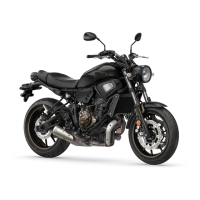



 To Next Page