ELECTRICAL SYSTEM
187
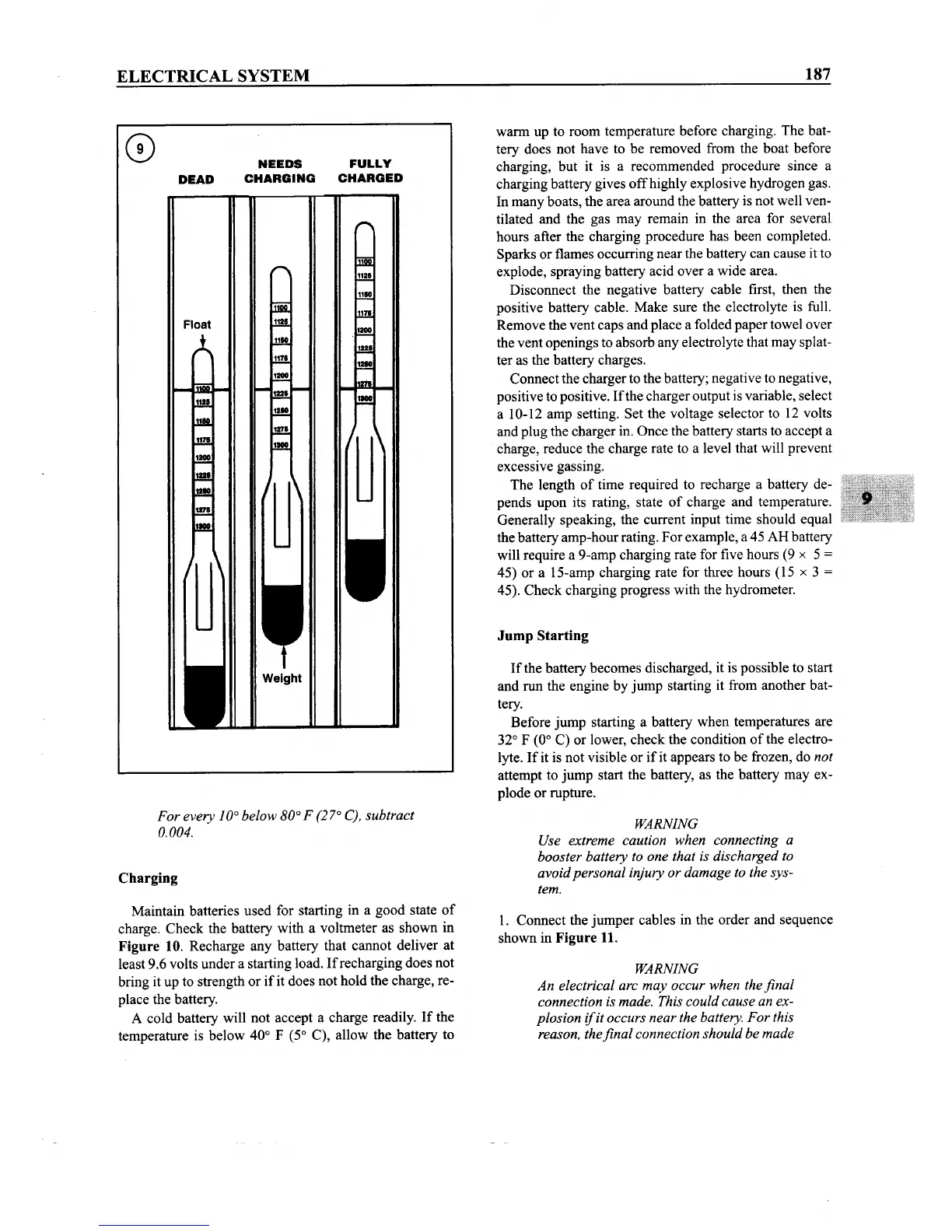
DEAD
NEEDS
FULLY
CHARGING CHARGED
,lOG
112.
1210
Weight
warm up to room temperature before charging. The bat-
tery does not have to be removed from the boat before
charging, but it is a recommended procedure since a
charging battery gives
off
highly explosive hydrogen gas.
In many boats, the area around the battery is not well ven-
tilated and the gas may remain in the area for several
hours after the charging procedure has been completed.
Sparks or flames occurring near the battery can cause it to
explode, spraying battery acid over a wide area.
Disconnect the negative battery cable first, then the
positive battery cable. Make sure the electrolyte is full.
Remove the vent caps and place a folded paper towel over
the vent openings to absorb any electrolyte that may splat-
ter as the battery charges.
Connect the charger to the battery; negative to negative,
positive to positive.
If
the chargeroutput is variable, select
a 10-12 amp setting. Set the voltage selector to 12 volts
and plug the charger in. Once the battery starts to accept a
charge, reduce the charge rate to a level that will prevent
excessive gassing.
The length
of
time required to recharge a battery de-
pends upon its rating, state
of
charge and temperature.
Generally speaking, the current input time should equal
the batteryamp-hour rating. For example, a 45 AH battery
will require a 9-amp charging rate for five hours (9 x 5 =
45) or a 15-amp charging rate for three hours (15 x 3 =
45). Check charging progress with the hydrometer.
Jump Starting
If
the battery becomes discharged, it is possible to start
and run the engine by jump starting it from another bat-
tery.
Before jump starting a battery when temperatures are
32° F (0° C) or lower, check the condition
of
the electro-
lyte.
If
it is not visible or
if
it appears to be frozen, do not
attempt to jump start the battery, as the battery may ex-
plode or rupture.
For every 10° below 80° F (27° C), subtract
0.004.
Charging
Maintain batteries used for starting in a good state
of
charge. Check the battery with a voltmeter as shown in
Figure 10. Recharge any battery that cannot deliver at
least 9.6 volts under a starting load. Ifrecharging does not
bring it up to strength or
if
it does not hold the charge, re-
place the battery.
A cold battery will not accept a charge readily.
If
the
temperature is below 40° F (5° C), allow the battery to
WARNING
Use extreme caution when connecting a
booster battery to one that is discharged to
avoidpersonal injury or damage to the sys-
tem.
1. Connect the jumper cables in the order and sequence
shown in Figure 11.
WARNING
An electrical arc may occur when the
final
connection is made. This couldcause an ex-
plosion
if
it occurs near the battery. For this
reason,
thefinal
connection should be made



 To Next Page