ELECTRICAL SYSTEM
Battery post cleaning tool
185
making or breaking any connection. Poor connections are
a common cause
of
electrical arcs that cause explosions.
Care and Inspection
The following battery maintenance information applies
to unsealed, wet-cell batteries. Although some
ofthe
pro-
cedures also apply to other types
of
batteries, consult the
battery manufacturer for specific recommendations.
I. Disconnect both battery cables (negative first, then
positive) and remove the battery hold-down or retainer
clamp. See
Figure 1 for a typical open installation and
Figure 2 for a typical enclosed installation.
NOTE
Some batteries have a carry strap built in
for
use in Step 2. See Figure 3.
2. Attach a battery carrier or carrier strap to the terminal
posts and
lift the battery from the battery tray.Remove the
battery from the engine compartment.
3. Check the entire battery case for cracks or other dam-
age.
4.
If
the battery has removable vent caps, cover the vent
holes in each cap with small pieces
of
masking tape.
NOTE
Keep cleaning solution out
of
the battery
cells in Step 5, or the electrolyte will be seri-
ously weakened.
5. Scrub the top
of
the battery with a stiffbristle brush,
using a baking soda and water solution (Figure 4). Rinse
the battery case with clear water and wipe it dry with a
clean cloth or paper towels. Remove the masking tape
from the filler cap vent holes,
if
so equipped.
6. Inspect the battery tray or container in the engine com-
partment for corrosion. Remove and clean it,
if
necessary,
with the baking soda and water solution. Rinse it with
clear water and wipe it dry, then reinstall.
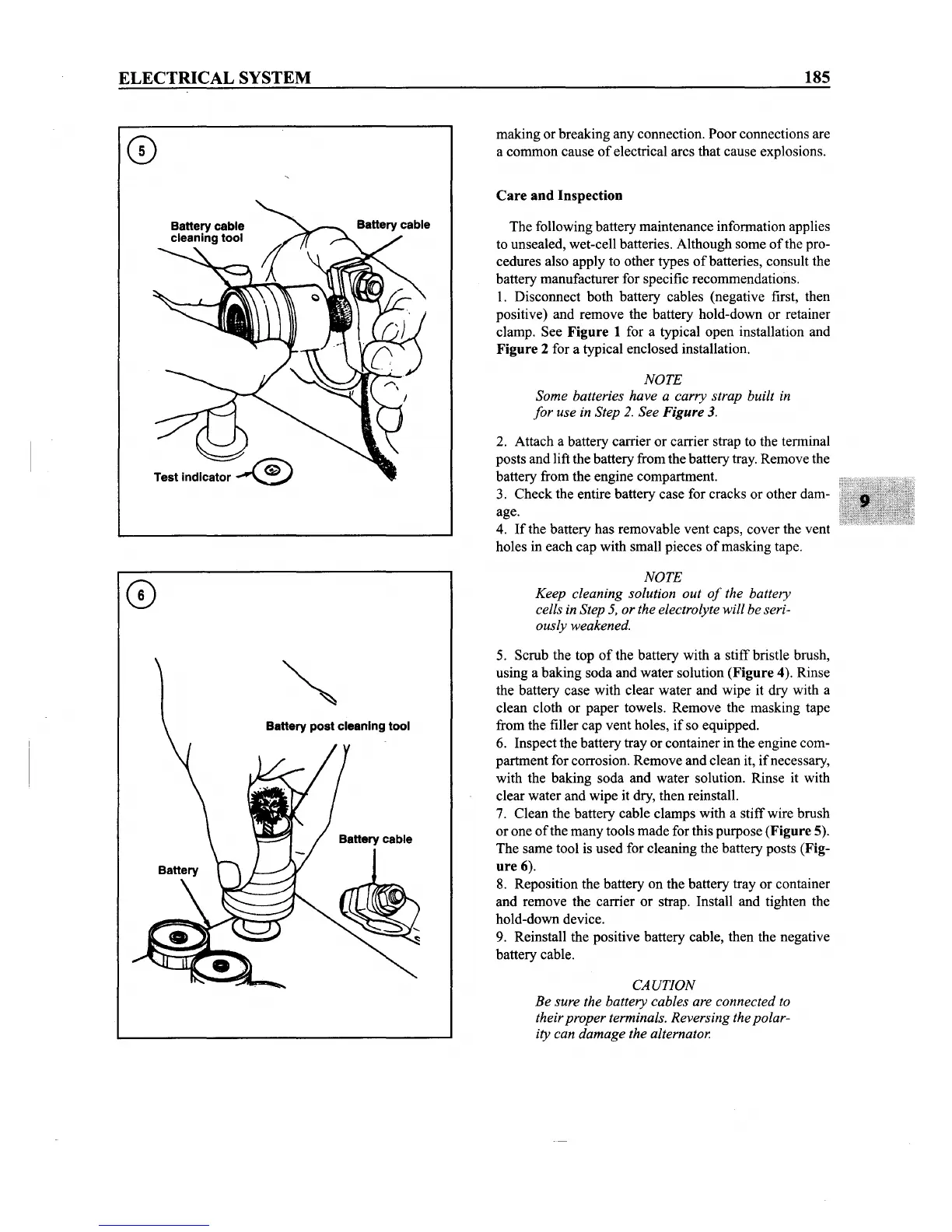
7. Clean the battery cable clamps with a stiffwire brush
or one
ofthe
many tools made for this purpose (Figure 5).
The same tool is used for cleaning the battery posts
(Fig-
ure 6).
8. Reposition the battery on the battery tray or container
and remove the carrier or strap. Install and tighten the
hold-down device.
9. Reinstall the positive battery cable, then the negative
battery cable.
CAUTION
Be sure the battery cables are connected to
their properterminals. Reversing the polar-
ity can damage the alternator.



 To Next Page