Need help?
Do you have a question about the York F4FP024H06T3X and is the answer not in the manual?
Explains safety symbols (DANGER, WARNING, CAUTION) and their meanings for injury prevention.
Covers electrical hazards, installation, ductwork, unit operation, and safety codes.
Details pre-installation checks, operational limits, required clearances, and site selection criteria.
Step-by-step guide for repositioning the drain pan for horizontal installation.
Instructions for ductwork, air filters, and using suspension kits for mounting.
Information on factory-installed TXV metering devices and flex-coil options.
Covers refrigerant line connections, TXV bulb placement, and electric heater/control wiring.
Details low voltage controls, line power connections, and blower speed adjustments.
Provides wiring diagrams for cooling-only and heat pump applications.
Covers drain line requirements, coil cleaning, and blower motor lubrication.
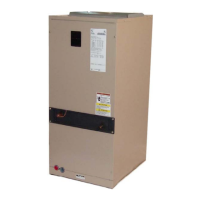
This document describes the installation, operation, and maintenance of Single Piece Air Handlers, specifically models F*FP. These units are designed for versatility, allowing installation in various configurations such as upflow or horizontal applications, and can be used for cooling or heat pump operation, with or without electric heat.
The Single Piece Air Handler serves as a crucial component in heating, ventilation, and air conditioning (HVAC) systems. Its primary function is to circulate conditioned air throughout a building, working in conjunction with an outdoor unit (for cooling or heat pump operation) and, optionally, an electric heater kit for supplemental heat. The unit is designed to handle both supply and return air, ensuring that air is properly filtered and conditioned before being distributed.
The air handler incorporates a blower motor that circulates air, and a coil assembly that facilitates heat exchange. For cooling, the coil removes heat and humidity from the air. In heat pump operation, the coil can either remove heat (for cooling) or add heat (for heating) to the air, depending on the system's mode. When electric heat is installed, heating elements provide additional warmth, especially in colder climates or during defrost cycles of a heat pump.
The unit includes a control board that manages the operation of the blower motor, electric heaters, and communicates with the thermostat and outdoor unit. This control system allows for various operational modes, including cooling only, heat pump with electric heat, and different fan speeds to optimize airflow and comfort. The low voltage transformer provides the necessary power for the control circuitry.
The air handler is designed for flexible installation. It can be positioned for bottom return air in an upflow configuration, or for right or left return in horizontal configurations. This adaptability simplifies installation in diverse architectural settings. The unit features top and side power wiring and control wiring, along with accessible screw terminals for control wiring, making electrical connections straightforward. Easy-to-install drain connections and the option for electric heaters further contribute to ease of installation and reduced costs.
For optimal performance, the air handler must be installed within its intended maximum outlet air temperature and connected to a duct system with an external static pressure within the allowable range specified on the rating plate. When supply ducts carry air outside the space containing the air handler, return air must also be handled by sealed ducts terminating outside that space. The unit is not intended for temporary heating of buildings under construction or for non-ducted (freeblow) applications.
The document emphasizes the importance of proper duct system design and installation to minimize problems with heating and cooling systems. Flexible duct collars are recommended to reduce vibration and noise transmission. If electric heat is used, non-flammable material must be used for duct collars. Sound-absorbing glass fiber insulation is suggested for short return air ducts or where sound may be an issue. Duct insulation is crucial in unheated or uncooled spaces, with a vapor barrier recommended to prevent moisture absorption.
The unit comes with a factory-installed TXV (Thermostatic Expansion Valve) metering device, which can be converted for R-410A refrigerant by changing a bolt-on TXV. "Flex-coils" are also available without a factory-installed metering device, allowing for field installation of an orifice, R-22 TXV, or R-410A TXV to match specific refrigerant choices.
For electric heat applications, an electric heater kit (2HK) must be field-installed. The control board includes a jumper plug for cooling-only applications; this plug must be removed when electric heaters are installed to prevent continuous blower operation. For right-hand airflow installations with circuit breakers, the breakers may need to be rotated 180 degrees to ensure the OFF position is down, as per NEC requirements.
Blower motor speed adjustments are made at the motor terminal block to provide airflow within the minimum and maximum limits approved for the evaporator coil, electric heat, and outdoor unit. Higher efficiencies can be achieved by maximizing indoor air volume, provided CFM limitations are not exceeded and sound levels remain acceptable.
Regular maintenance is essential for the efficient and safe operation of the air handler. Filters must be cleaned or replaced monthly, or more frequently depending on usage and atmospheric conditions. Clean filters are critical for maintaining high unit efficiency.
The coil should be inspected periodically. If cleaning is necessary, it can be washed with a non-acidic cleaner like Calgon CalClean (mixed with water). The solution should remain on the coil for 30 minutes before rinsing with clean water, taking care to avoid contact with painted surfaces.
The blower motor bearings are permanently lubricated, eliminating the need for periodic lubrication.
Condensate drains require regular checks, especially during the cooling season, to ensure that condensate is flowing from the primary drain and not from the secondary drain. If water is observed flowing from the secondary drain, the unit should be promptly shut off, and the condensate pan and drains cleaned to restore free flow in the primary drain. Drain lines should be trapped with a minimum three-inch trap, pitched away from the unit drain pan, and sealed with teflon tape or equivalent.
The manual also provides a troubleshooting guide to assist with common issues such as the blower running continuously, blown fuses, no 24V power, no second-stage heat, or limited heating. This guide helps identify possible causes and directs users to appropriate corrective actions, ensuring the unit operates safely and effectively.
 General
| Brand | York |
|---|---|
| Model | F4FP024H06T3X |
| Category | Air Handlers |
| Voltage | 208/230V |
| Phase | 1 |
| Air Flow | 800 CFM |
| Cabinet | Galvanized Steel |
| Insulation | Foil Faced |
| Blower Motor Type | PSC |
| Drain Pan | Plastic |
| Depth | 21 inches |
| Cooling Capacity | 24000 BTU/h |
| Blower Motor HP | 1/3 HP |

 To Next Page