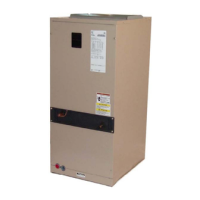
This document is an installation manual for single-piece air handlers, covering both heat pump models (F2RP/F2FP018 through 060 and F3RP/F3FP018 through 060) and cooling models (F2RC/F2FC 024 through 036). It provides comprehensive instructions for installation, operation, and maintenance.
Function Description
The air handler is a versatile unit designed for use in either upflow or horizontal applications, offering flexibility in installation. It can be configured for cooling-only operation or integrated into a heat pump system, with or without supplemental electric heat. The unit features direct-drive, three-speed blower motors, allowing for selection of appropriate air volume to match various application requirements.
For cooling-only applications, the air handler is shipped prewired, and a 6-pin jumper plug (found in the unit's installation envelope or secured near the transformer on the heater duct cover flange) must be installed on the control board to bypass the heater limit controls. Failure to install this plug will result in continuous blower operation. The unit's nameplate should be marked with the appropriate heater selection or "NONE" for cooling-only.
When electric heat is desired, an electric heater kit (2HK) must be field-installed. This involves removing the 4-pin power plug from the control board and the duct cover. The manual provides specific instructions for installing the electric heater accessory before attaching the supply air duct.
The unit's design incorporates accessible top and side power wiring and control wiring, screw terminals for control wiring, and easy-to-install drain connections, all contributing to simplified installation and reduced costs.
Usage Features
The air handler can be positioned for bottom return air in upflow configurations or right/left return air in horizontal configurations. For horizontal installations, the unit may require field installation or conversion of the horizontal drain pan to the correct position (either "A" or "B"). This conversion process involves removing access panels, repositioning the drain pan, and ensuring proper sealing of unused drain plugs. For specific models (F(2,3)FP045, 048, 060), a coil baffle and support bracket may need to be moved for left-hand horizontal applications to prevent water blow-off.
Ductwork connections are critical for optimal performance. The manual advises using 1/2" screws for connecting ductwork to the bottom of the unit, cautioning against longer screws that could pierce the drain pan. Flexible duct collars are recommended to minimize vibration and noise transmission. If electric heat is used, non-flammable duct material is required. For short return air ducts or where sound is a concern, sound-absorbing glass fiber should be used. Insulation with a vapor barrier is essential for ductwork running through unheated or uncooled spaces. The unit is not designed for non-ducted (freeblow) applications, and the supply air duct should be properly sized with a transition to match the unit opening.
The coil in the air handler comes with a factory-installed metering device, either a Thermal Expansion Valve (TXV) for F3RPxxxH06T/F3FPxxxH06T models or an orifice for F2RP/F2FP/F2RC/F2FC models. For TXV-equipped units, the temperature sensing bulb needs to be attached to the coil suction header line after brazing the line set, ensuring it is outside the cabinet and in direct contact with the suction line. For orifice-equipped units, the manual details how to verify and, if necessary, change the pre-installed orifice, emphasizing the importance of relieving inert gas pressure before removal and proper reinstallation to prevent air and contaminants from entering the coil. Refrigerant lines should be routed to avoid obstructing service access to the coil, air handling system, or filter.
Low voltage control wiring can exit the unit from the top right-hand corner or the right-hand side panel. The 24-volt power supply is provided by an internally wired transformer, which may need to be rewired for 208-volt power supplies. Field wiring connects to screw terminals on the control board. Line power connections can be made through the supply air end (top for vertical units) or the left side panel, using the appropriate hole for conduit from the disconnect.
Blower motor speed adjustments are made at the motor terminal block to provide airflow within the minimum and maximum limits for the evaporator coil, electric heat, and outdoor unit. The unit control is also designed to accommodate a two-speed fan kit.
Maintenance Features
Regular maintenance is crucial for the air handler's efficiency and longevity. Air filters, which are field-supplied, must be inspected and cleaned or replaced at least once a month, with frequency depending on operating hours and atmospheric conditions. The unit includes a 1" filter access rack for easy filter removal and installation.
Coil cleaning is recommended if the coil becomes dirty or needs replacement. A solution of Calgon coilclean (one part Coilclean to seven parts water) should be applied and allowed to remain for 30 minutes before rinsing with clean water. Care should be taken to prevent the solution from contacting painted surfaces.
The blower motor bearings are permanently lubricated, eliminating the need for periodic lubrication.
Condensate drains should be checked during the cooling season to ensure proper flow from the primary drain. If condensate is observed flowing from the secondary drain, the unit should be promptly shut off, and both the condensate pan and drains should be cleaned to restore free flow from the primary drain. All drain lines should be trapped a minimum of three inches, pitched away from the unit drain pan, and no smaller than the coil drain connection. Threaded drain connections should be hand-tightened, plus no more than 1/16 turn, and sealed with Teflon tape or equivalent. The drain lines should be routed to avoid freezing temperatures and interference with service access. If the coil is installed in an attic or above a finished ceiling, an auxiliary drain pan is required by most local building codes. The secondary drain is designed to provide a visual warning of a clogged primary drain and must be trapped and piped to a visible location or capped if not used.


 To Next Page
 General