7
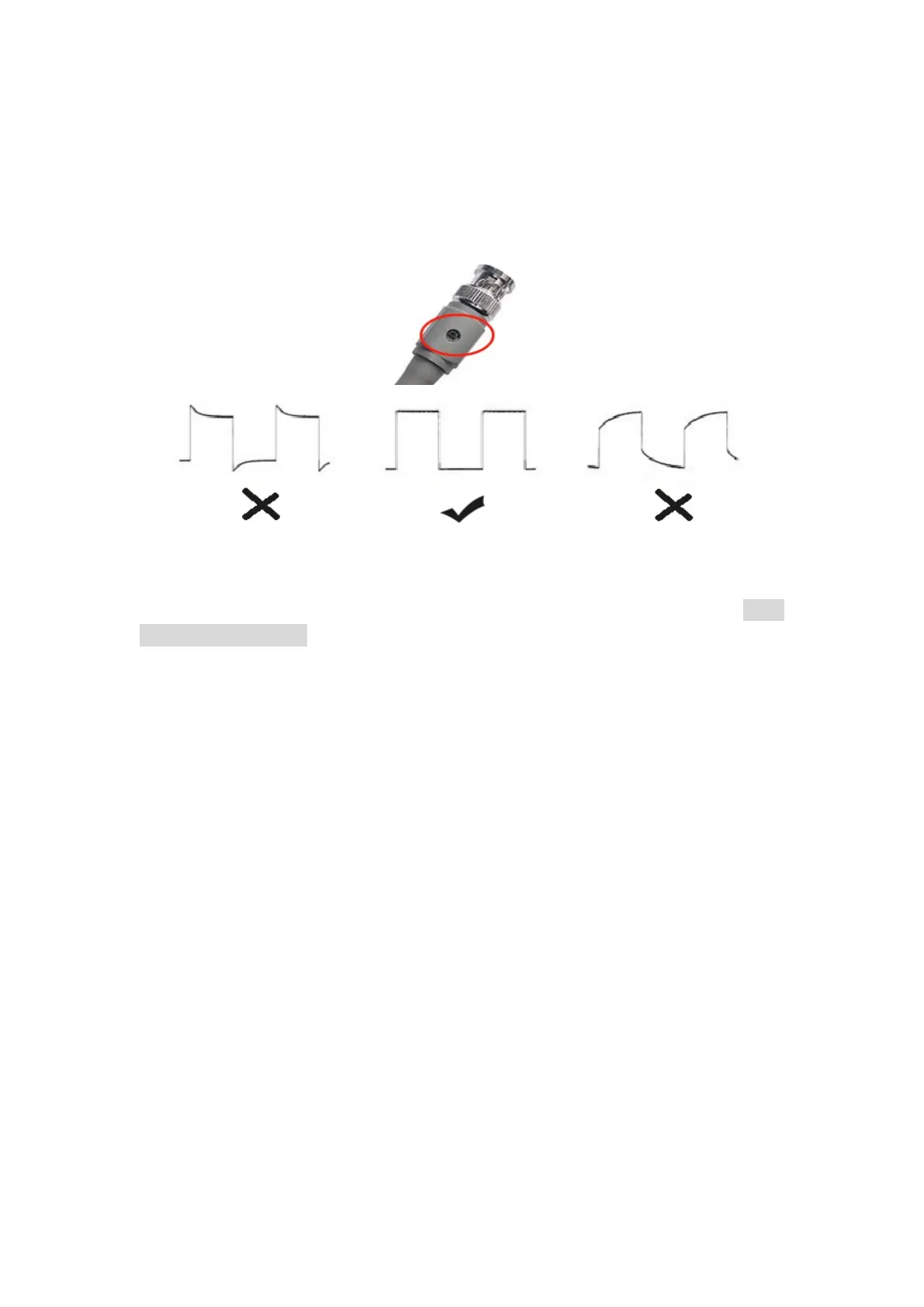
is displayed stably at a suitable position on the screen.
4. Use a screwdriver to rotate the adjustable capacitor on the probe until you get the
waveform in the middle of the figure below. The left and right waveforms below
are references for incorrect calibration.
3.2 Probe bandwidth
Because the 1X probe has a large input capacitance, the bandwidth of the 1X is
usually within 5MHz; while the bandwidth of the 10X is the standard bandwidth of
the probe.
3.3 Probe withstand voltage
The maximum withstand voltage of the probe is generally marked on the probe,
which is usually 600Vpk-pk.
3.4 Use tips
3.4.1 Large input capacitance
Because the probe 1X has a large input capacitance (usually more than 100 pf), it
is not suitable for measuring some capacitively sensitive circuits. For example, when
measuring a passive crystal of MCU, the large capacitor may cause the crystal to fail
to vibrate. As for the output of a high-speed op amp, a capacitive load may cause the
op amp to overshoot or oscillate. For circuits with large capacitances that are not
suitable for measurement, please use 10X. The input capacitance of the 10X is usually
several pf.
3.4.2 Measuring high voltage
The oscilloscope's measurement voltage range is -40V ~ + 40V (80Vpp). Please
use the 10X probe to attenuate the signal by 10 times beyond this range. The
measurable voltage range of 10X range is 600V(DC+AC). Please note that you must


 To Next Page