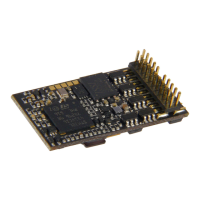
Page 24 MS - SOUND decoders MS440 to MS990 and MN - NON-SOUND decoders MN170 to MN340
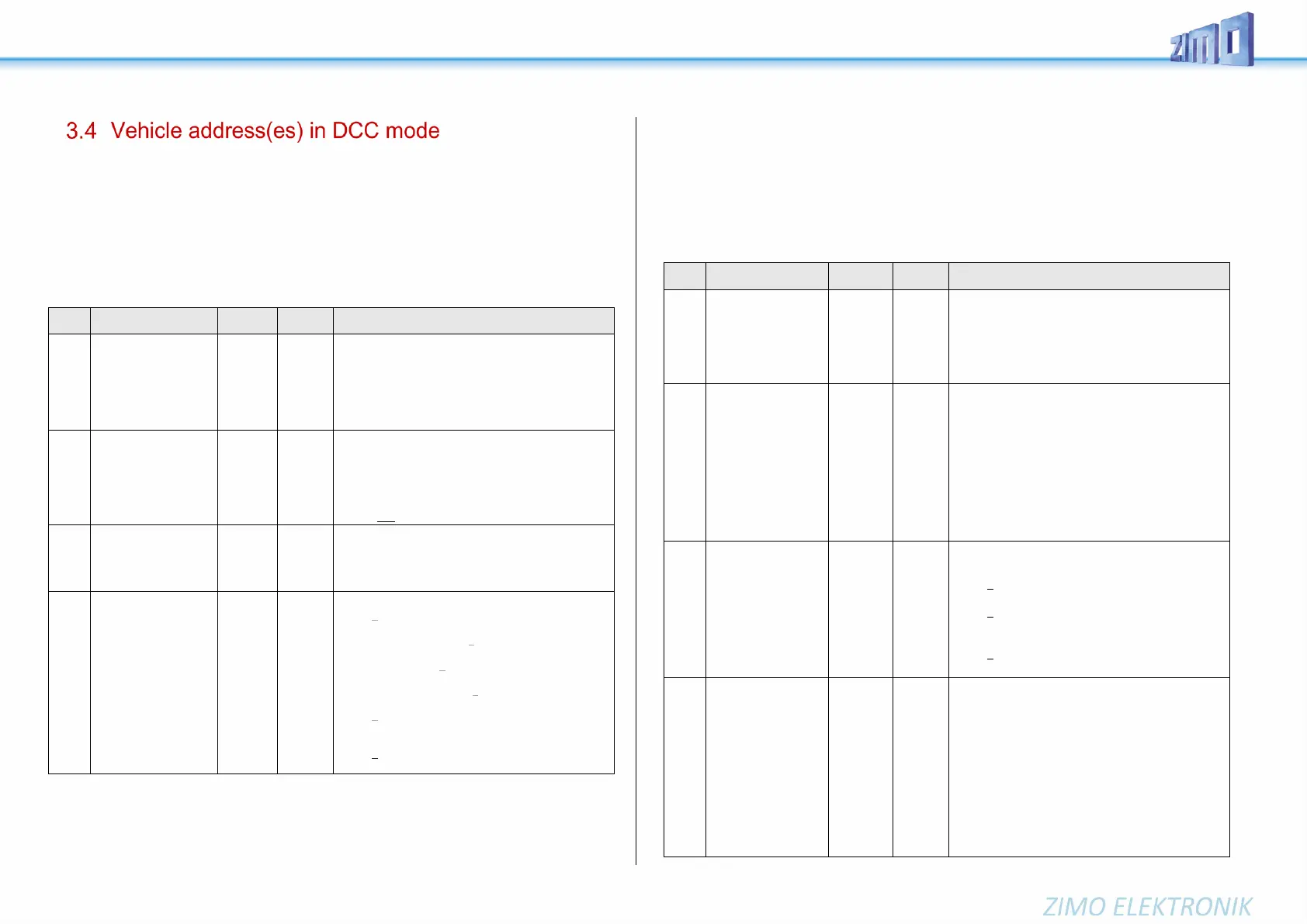
Decoders are usually delivered with default address 3 (CV #1 = 3), for DCC as well as the MM (Märklin
Motorola) format. With this address the decoder is fully functional but it is recommended to change to
a different address as soon as possible.
The address space required for DCC exceeds the range of a single CV, up to 10239 in fact. Addresses
higher than 127 are stored in CV #17 and #18. CV #29, Bit 5 is used to select between the short address
in CV #1 and the long address in CVs #17/#18.
Most digital systems (except for very old or simple products) automatically calculate the value for the
CVs involved and also configure CV #29 Bit 5 to the proper value when writing the address, so that the
user does not have to deal with the necessary coding.
The “short” vehicle address (DCC, MM)
In case of DCC operation:
Primary address as per CV #1 is only valid, if
CV #29 (basic configuration), Bit 5 = 0.
Otherwise, the address per CVs #17 & #18 is valid,
i.e. if CV #29, Bit 5 = 1.
The decoder lock is used to access the CVs of several
decoder with identical address separately.
The CVs #16 of each decoder are programmed to differ-
ent values before installation. If necessary, the CV #15
of this decoder is reprogrammed to the value of "its" CV
#16 > all CVs addressable.
CV #15 and #16 = 0: Decoder is not locked.
The long (“extended”) DCC address
applies to addresses >127.
The loco address per CVs #17 & #18 is valid, if
CV #29 (basic configuration), bit 5 = 1.
14 =
0000 1110
Bit 5 = 0
(“short”
Address)
Bit 0 - Train direction:
0 = normal, 1 = reversed
Bit 1 - Number of speed steps:
0 = 14, 1 = 28/128 speed steps
Bit 2 - automatic change to analog operation
0 = disabled 1 = enabled
Bit 3 - RailCom („bidirectional communication“)
0 = deactivated 1 = activated
Bit 4 - Individual speed table:
0 = off, CVs #2, #5 and #6 are active.
1 = on, according to CVs #67 – #94
Bit 5 - Decoder address selection:
0 = primary “short” address as per CV #1
1 = “extended” address per CVs #17 & #18
Decoder-controlled consisting (a.k.a. “Advanced consisting” according to NMRA)
The combined operation (“consist”) of two or more locomotives (mostly coupled mechanically) with the
same speed can be managed by
- the digital system (common practice with ZIMO systems, without changing any CVs of the decoder) or
- by programming the following decoder CVs individually, or
the CVs are programmed automatically by the digital system (usually with American systems).
This chapter only covers the decoder-controlled consisting!
0, 1 – 127
129 - 255
( = 1 - 127 with
inverted direc-
tion)
Alternate loco address for consist function:
If CV #19 > 0: Speed and direction is governed by this
consist address (not the individual address in CV #1 or
#17&18); functions are controlled by either the consist
address or individual address, see CVs #21 & #22.
Bit 7 = 1: Driving direction reversed
Bits 0 – 6: Extended
consist address
AND (independent of
whether extended con-
sist address is used)
Bit 7: Switching on
RailCom response for
consist address
0 – 102,
128 – 130
Bit 7 SW
version
4.225 and
higher
“Extended” consist address: the value defined in CV #20
is multiplied by 100 and added to the value in CV #19,
which then results in the address in consist operation.
E.g. CV #20 = 12, CV #19 = 34 equals addr. 1234;
CV #20 = 100, CV #19 = 00 equals addr. 10000.
Bit 7 = 1: on RailCom address the Channel-2 messages
(speed, direction information, etc.) are sent out, and in
Channel-1 (on all addresses except own Consist) Con-
sist address is reported.
The consist address is CV #19 (if CV #20 =0); or CV
#19 and #20 (see above, if CV #20 is not 0).
Functions
F1 - F8
in consist operation
Functions so defined here will be controlled by the con-
sist address.
Bit 0 = 0: F1 controlled by individual address
= 1: …. by consist address
Bit 1 = 0: F2 controlled by individual address
= 1: …. by consist address
………. F3, F4, F5, F6, F7
Bit 7 = 0: F8 controlled by individual address
= 1: …. by consist address
Functions
F0 forw. rev.
in consist function
and
Activating
Auto-Consist
Select whether the headlights are controlled by the con-
sist address or individual address.
Bit 0 = 0: F0 (forw.) controlled by individual address
= 1: …. by consist address
Bit 1 = 0: F0 (rev.) controlled by individual address
= 1: …. by consist address
Bit 2 = 0: F9 (forw.) controlled by individual address
= 1: …. by consist address
Bit 3 = 0: F10 (forw.) controlled by individual address
= 1: …. by consist address
Bit 4 = 0: F11 (forw.) controlled by individual address
= 1: …. by consist address


 To Next Page
 Loading...