MS - SOUND decoders MS440 to MS990 and MN - NON-SOUND decoders MN170 to MN340 Page 73
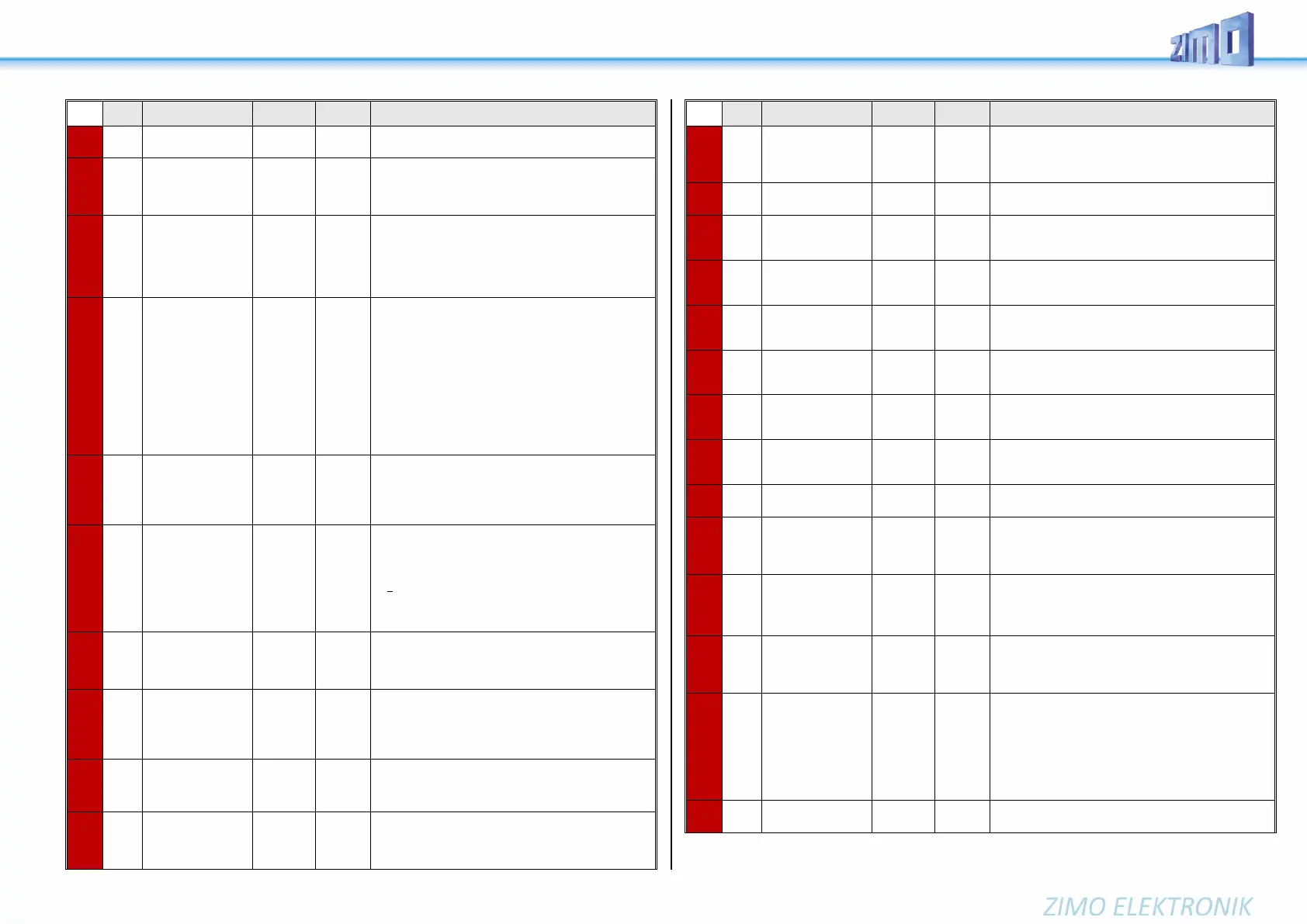
CV #277 defines the degree of dependency; the proper
value has to be set by trial.
With this CV, a change in volume in reaction to small load
changes can be suppressed (i.e. in curves) in order to pre-
vent chaotic sound impressions.
Suitable settings can only be determined by trial.
This CV determines how quick the sound reacts to load
changes, whereas the factor is not just time but rather
“load-change dependent time” (= the bigger the change
the faster the effect). This CV is also used to suppress
chaotic sound changes.
Suitable settings can only be determined by trial.
Diesel engine
-
Load dependency
With this setting, the diesel motor’s reaction to the load
(defined by PWM and speed step). NOTE: the sound of
the diesel motor practically always depends on accelera-
tion and speed.
Diesel-hydraulic loco - higher and
lower PWM and performance steps,
Diesel-electric loco - driving/idle
Loco with switchgear - steps.
= 0: no influence motor PWM according to speed
= 1 to 255: increasing to maximum influence
NOTE: It is recommended, first to perform the auto-
mated test run with CV #302 = 75 first (see chapter 5.3).
Driving noise-
(Steam chuffs)
Volume -
for full acceleration
sound
The volume of steam chuffs at maximum acceleration is
set with CV #283 (default: 255 = full volume).
If CV #281 = 1 (acceleration threshold set to 1 speed step),
the volume defined here is applied with each speed in-
crease, even if it is just 1 step.
Deceleration
threshold
for
reduced volume dur-
ing deceleration
0 -255
(Internal
Speed steps)
Steam chuffs should be played back at less volume (or
muted) signifying the reduced power requirement during
deceleration. The sound reduction logic is analog to a re-
versed acceleration (per CV #281 to #283).
= 1: Reduces sound to a minimum (as per CV #286)
when speed is reduced by just 1 step.
= 2, 3 ... sound reduced to minimum after
lowering speed by this number of steps.
Time needed for the
volume reduction
at deceleration
After the speed has been reduced, the sound should re-
main quieter for a specific time (analog to the acceleration
case).
Value in CV #285 = time in tenth of a second!
Volume -
of reduced
driving noise-
at deceleration
CV #286 is used to define the chuff volume during decel-
eration (default: 20 = pretty quiet but not muted).
If CV #284 = 1 (deceleration threshold set to 1 speed step),
the volume defined here is applied with every reduction in
speed (even if decreased by just 1 step).
Threshold
for
brake squeal
The brake squeal should start when the speed drops be-
low a specific speed step. It will be automatically stopped
at speed 0 (based on back-EMF results).
Brake squeal
minimum drive time
The braking squeal is to be suppressed when an engine is
driven for a short time only, which is usually a shunting run
and often without any cars (it is mostly the cars that are
squealing not the loco itself!).
NOTE: Brake squeal sounds can also be assigned to a
function key (see allocation procedure CV #300 = …), with
which the brake squeal can be started or stopped manu-
ally!
= 1 - 255: Effect of pitch
Thyristor sound
pitch:
“slow” pitch increase
Sound pitch for speed defined in CV #292.
Thyristor sound
pitch:
Maximum pitch
Sound pitch at top speed.
Thyristor sound
pitch:
slow speed
Speed for sound pitch per CV #290.
Thyristor sound
pitch:
Steady volume
Thyristor sound volume at steady speed (no acceleration
or deceleration in progress).
Thyristor sound
pitch:
Vol. at acceleration
Volume during acceleration
Thyristor sound
pitch:
Vol. at deceleration
Volume during heavier decelerations (braking)
Electric motor
Minimum load
Internal speed step at which the motor sound becomes au-
dible; at this speed step is starts at a low volume and
reaches maximum volume as per CV #296 at the speed
step define in CV #298.
Electric motor
Volume -
Speed dependency
Internal speed step at which the motor sound reaches the
maximum volume defined in CV #296.
See ZSP manual!
Electric motor
Pitch (frequency)
Speed dependency
The motor sound will be played back faster, correspond-
ing to this CV with rising speed.
= 0: Pitch (speed of play back) will not rise
= 100: Doubling the pitch
Cornering squeals-
order
Reed configuration
Bit0 - switching input 1 activates cornering squeal
Bit1 - switching input 2 activates braking squeal
Bit2 - switching input 3 activates braking squeal
Bit3 - switching input 4 activates braking squeal
Bit 7 - 0 = key defined in CV #308 suppresses cornering
squeal of reed inputs if this key is ON
1 = key defined in CV #308 activates cornering
squeal independent of Reed inputs
0: No key defined. Reed inputs always active.
1-28 = key F1 to F28.


 To Next Page
 Loading...