MS - SOUND decoders MS440 to MS990 and MN - NON-SOUND decoders MN170 to MN340 Page 75
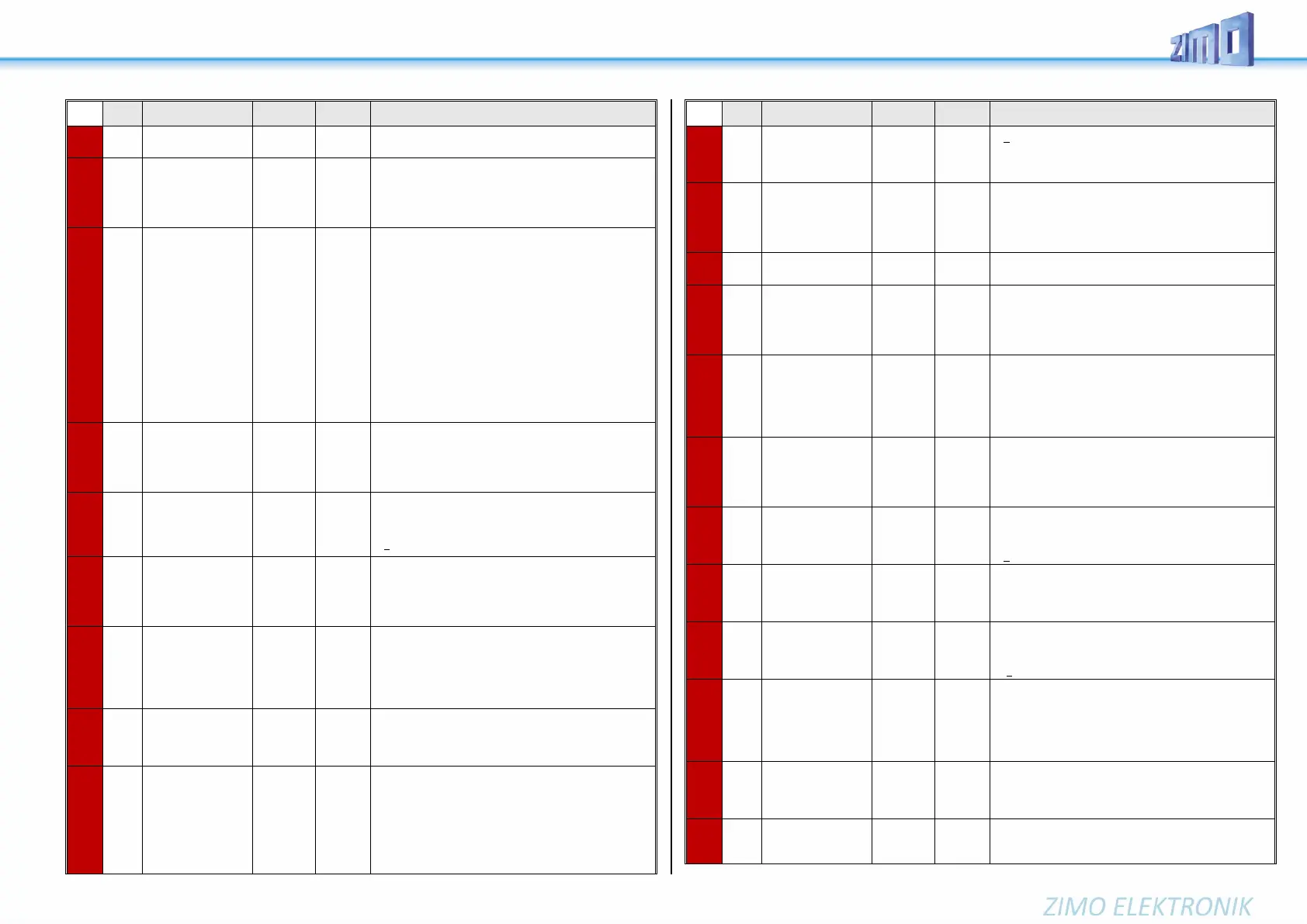
Bit 6 = 1: Transition sets in diesel projects, which are
played back when switching from one set to another.
Key
to switch key for
driving and sound
performance when
driving solo
0=: no key, no solo drive
= 1 - 28: One function key (F1 – F28) acts as the switch-
over key for driving a heavy train or a single locomotive.
If the
key for solo drive
(CV #347, see
above) is activated,
the measures de-
fined here have to
be met.
Bit 2 already in version
4.10
Bits 0, 3, 4 (only Diesel):
When driving solo (function key as per CV #347 is ON):
Bit 0 = 1: ... Diesel sound (sound steps) should
rev up unlimited to maximum rpm (or limited in rela-
tion to speed step as per CV #389).
Bit 1 = 1: acceleration and deceleration times should be
reduced according to CV #3 / #4, but consider
the reduction according to CV #390.
Bit 2 = 1: motor’s idle sound should be played back when
driving at low speeds, whereas the highest speed
step shall still be playing the idle sound set in
CV #391.
Bit 3 = 1: deactivate 2nd smoke fan and heating element
with this key (diesel loco with two engines only
drives with one).
Bit 4 = 1: Suppress brake squeal
Braking time for
brake key
To achieve the desired effect, the deceleration time in CV
#4 must be set to a very high value (@ 50 - 250) but the
brake time in CV #349 rather low (5 - 20). This simulates
a coasting effect with the “regulator at 0”, while the brake
key results in a short stopping distance.
Electric switch gear
sound,
locked after
starting
Time in tenth of seconds (0-25 sec), the switchgear sound
shall not be played back after starting; this is useful if the
first switching step is already in the sample “Stand -> F1”.
= 0: Switchgear is played back immediately after starting.
Speed of the
smoke fan at
constant speed
for DIESEL
locomotives
The speed of the fan is set by PWM; the value of CV #351
defines the behaviour during normal driving.
= 128: Half voltage (PWM) when driving.
Speed of the
smoke fan during
acceleration and
engine starting
for DIESEL
locomotives
To create a cloud of smoke when starting the machines,
the fan is set to higher (usually maximum) speed, as well
as in case of strong acceleration during operation.
= 255: Maximum voltage at start-up
Automatic
turn-off of the
smoke generator
For effects “010010xx” or “010100xx” (smoke generator):
overheating protection: Turn-off half a minute to 2 hours.
= 0: no automated shut-down
= 1 to 255: automatic turn-off after 25sec/unit
Chuff beat
frequency
at
speed step 1
also see
CV #267
in this table
CV #354 works only if used together with CV #267!
CV #354 compensates for the non-linear speed measure-
ments of the “virtual cam sensor”:
While the adjustment of CV #267 is done in the vicinity of
speed step 10 (slow but not very slow), a correction for
speed step 1 can be performed with CV #354 (extremely
slow).
= 0: no effect
= 1 - 127: Steam chuffs at speed step = 1 (and
extremely slow speed) more common than CV #267
= 255 - 128: less chuff beats.
Speed of the smoke
fan at standstill for
STEAM locomotives,
and
DIESEL locomotives
With CV #355 the speed of the fan at standstill - if sound
is switched on - is set. This has the effect of emitting
smoke (a small amount, but visible) even when stopped.
If this key is activated, the speed controller changes the
driving sound, not the speed
Thyristor sound
pitch:
Lowering
volume at
higher speed
Internal speed step at which the thyristor sound volume
should be reduced. The volume stays at this reduced level
while braking.
By changing CV #158 Bit 6 = 1, the volume will be raised
while braking, nonetheless.
Thyristor sound
pitch:
Course of
Lowering
volume at
higher speed
Defines a curve as to how the thyristor sound should be
lowered at the speed step defined in CV #357.
= 0: no reduction.
= 10: reduced by about 3 % per speed step.
= 255: aborts the sound when the speed step defined in
CV #357 is reached.
Electric switch gear
sound,
Switch gear play-
back duration during
speed changes
Time in tenth of a second the switch gear should be heard
during speed changes (adjustable from 0 – 25 sec.).
Effective only if switch gear sound is part of the sound pro-
ject.
Electric switch gear
sound,
Duration of playback
after stopping
Time in tenth of a second the switch gear should be heard
after the engine comes to a full stop (adjustable from 0 –
25 sec.).
= 0: no sound after stop.
Electric switchgear
Time until the next
playback
During rapid successions in speed changes the switch
gear sound would be played back too often.
CV #361: Time in tenths of a second (0 – 25 sec.) de-
fines minimum delay between multiple playbacks.
Thyristor sound
pitch:
Switching threshold
to second sound:
Defines a speed step at which a second thyristor sound for
higher speeds is played back; this was introduced for the
sound project “ICN” (Roco OEM sound)
= 0: no second thyristor sound.
Electric switch gear
sound,
Distribution of speed
steps on switching
steps
Number of shift steps to cover the whole speed range; i.e.
if 10 shift steps are programmed, the switch gear sound is
played back at internal speed step 25, 50, 75… (a total of
10 times)
= 0: synonymous with 5; i.e. 5 switch steps over
the whole speed range.
Diesel engine with
Switchgear
Speed drop during
upshifts
This special CV applies only to diesel-mechanical engines
and defines the typical drop in speed when shifting up. See
sound projects (i.e. VT 61)
Diesel engine with
Switchgear
Upshift rpm
This special CV applies only to diesel-mechanical engines
and defines the highest rpm before shifting up.
See sound projects (i.e. VT 61)


 To Next Page
 Loading...