Large-scale Decoder & Sound Decoder MX695, MX696, MX697, MX699 Page 45
ZIMO cab key arrangement:
((((( 1 F0 ((((( 2 F1 ((((( 3 F2
((((( 4 F3 ((((( 5 F4 ((((( 6 F5
((((( 7 F6 ((((( 8 F7 ((((( 9 F8
ZIMO MX31/MX32 key arrangement:
((((( 1 F0 ((((( 2 F1 ((((( 3 F2
((((( 4 F3 ((((( 5 F4 ((((( 6 F5
((((( 7 F6 ((((( 8 F7 ((((( 9 F8
shortened and played back only as long as the function key is pressed, by
omitting the center portion.
Note: F6 and F7 are only effective provided the loop markers are included in the sample; basic
settings are also saved; changes take effect only if F6/F7 is actuated.
Note: If F6 and F7 are not actuated, the sound sample will always be played back in the same
length it was saved, regardless how long the function key is pressed.
F3 = CLEAR + end : The allocation procedure is stopped and the current sound removed.
There will be no sound allocated to this function key.
F8 = STORE + end : The allocation procedure is stopped and the last selected function
sound is stored and ready for playback when this function key is pressed.
The allocation procedure can also be ended by any other programming procedure (e.g. CV
#300 = 0 or any other value or CV) or by removing power from the decoder. The “old” alloca-
tions remain active in such cases; such “forced endings” are also useful when the “old” sound
should remain as the current sound without first having to locate it again.
The selection procedure is supported with sound signals:
The “cuckoo jingle” sounds when:
the last stored sound sample of that group is reached; use the key to scroll in the
opposite direction (F1, F2) to listen to the other stored sounds,
the last stored sound group is reached (with F4 or F5); use the other key (F4 or
F5) to scroll in the opposite direction.
play-back is attempted (with F0) but no sound sample is available,
a wrong key is pressed.
The “confirmations jingle” is played after ending the allocation procedure with F3 or F8.
Allocation of sound samples to the random generators Z1…Z8:
The MX690 decoders provide 8 simultaneously playing random generators who’s timing is de-
termined by CV’s; see “CV table” from CV #315.
A sound sample can be added to each random generator from the pool of samples in the de-
coder.
The allocation procedure for random sound is initiated with a “Pseudo-Programming” in op-
erations mode (on-the-main):
CV # 300 = 101 for random generator Z1
(Z1 has special logic incorporated for the compressor
and should therefore always be used for that)
CV # 300 = 102 for random generator Z2
CV # 300 = 103 for random generator Z3
etc.
.
Depends on entry: Z1 . . . Z8
The function keys have the following special meaning
during the selection
procedure!
The meaning and action of the function keys is the same as for function sounds (see above):
F0 = play: playback
F1, F2 = prev, next: playback of previous or next sound sample
etc.
but
F6 = still: If F6 is active when ending the allocation procedure, the sound sample is
played as random sound at standstill only (default).
F7 = cruise: If F7 is active when ending the allocation procedure, the sound sample is
played as random sound when the locomotive is moving.
The allocation procedure for random sound is the same as for function sound!
Allocation sound samples to switch inputs S1, S2, S3:
The MX690 has 3 switch inputs available, of which two (“1” & “2”) are freely available to the
user while one (“3”) is usually reserved for a cam sensor input; which can also be used for oth-
er inputs if not used for a cam sensor (i.e. the virtual cam sensor is used instead). These in-
puts can accept reed switches, optical or hall-effect sensors and similar; see chapter 8: “Con-
necting speaker, cam sensor”.
A sound sample can be allocated to each switch input, from the pool of stored samples in the
decoder; playback times can be set with the help of CV’s #341, 342 and 343, see CV table.
The switch input allocation procedure is initiated with the operations mode Pseudo-
Programming
CV #300 = 111 for switch input S1
CV #300 = 112 for switch input S2
CV #300 = 113 for switch input S3
and so on… .
Depends on entry: Z1 . . . Z8
The function keys have the following special meaning
during the selection
procedure!
The meaning and action of the function keys is the same as for function sounds (see above):
F0 = play : play back
F1, F2 = prev, next : play back of previous or next sound sample
and so on.
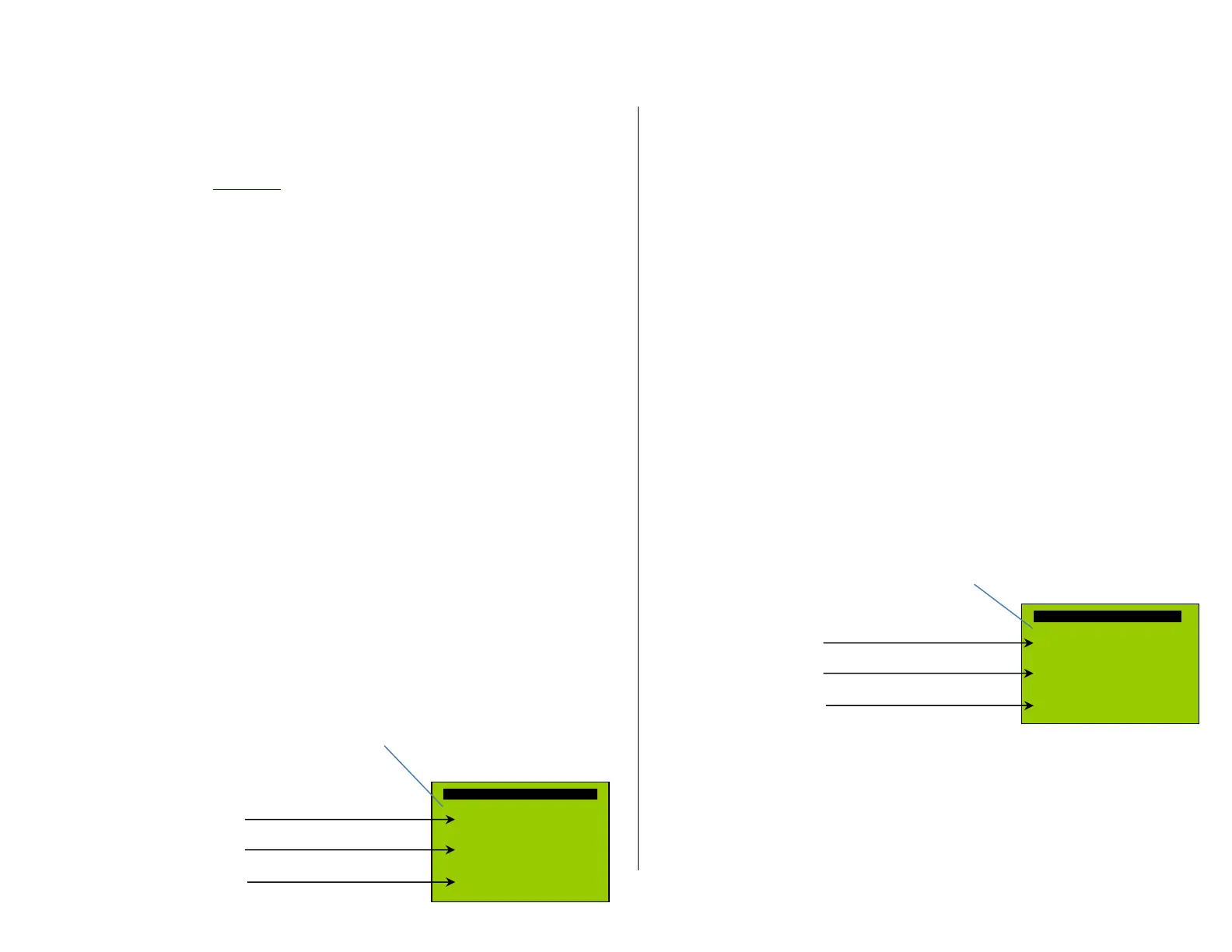
RANDOM SOUND SELECTION .
Z2 --- SAMPLE ---
((((( play ((((( prev ((((( next
CLEAR --- GROUP ----
((((( + end ((((( prev ((((( next
----- LOOP ----- STORE
((((( still ((((( cruise (((( + end
SWITCH INPUT SELECTION .
S1 --- SAMPLE ---
((((( play ((((( prev ((((( next
CLEAR --- GROUP ----
((((( + end ((((( prev ((((( next
----- LOOP ----- STORE
((((( ((((( (((( + end


 To Next Page