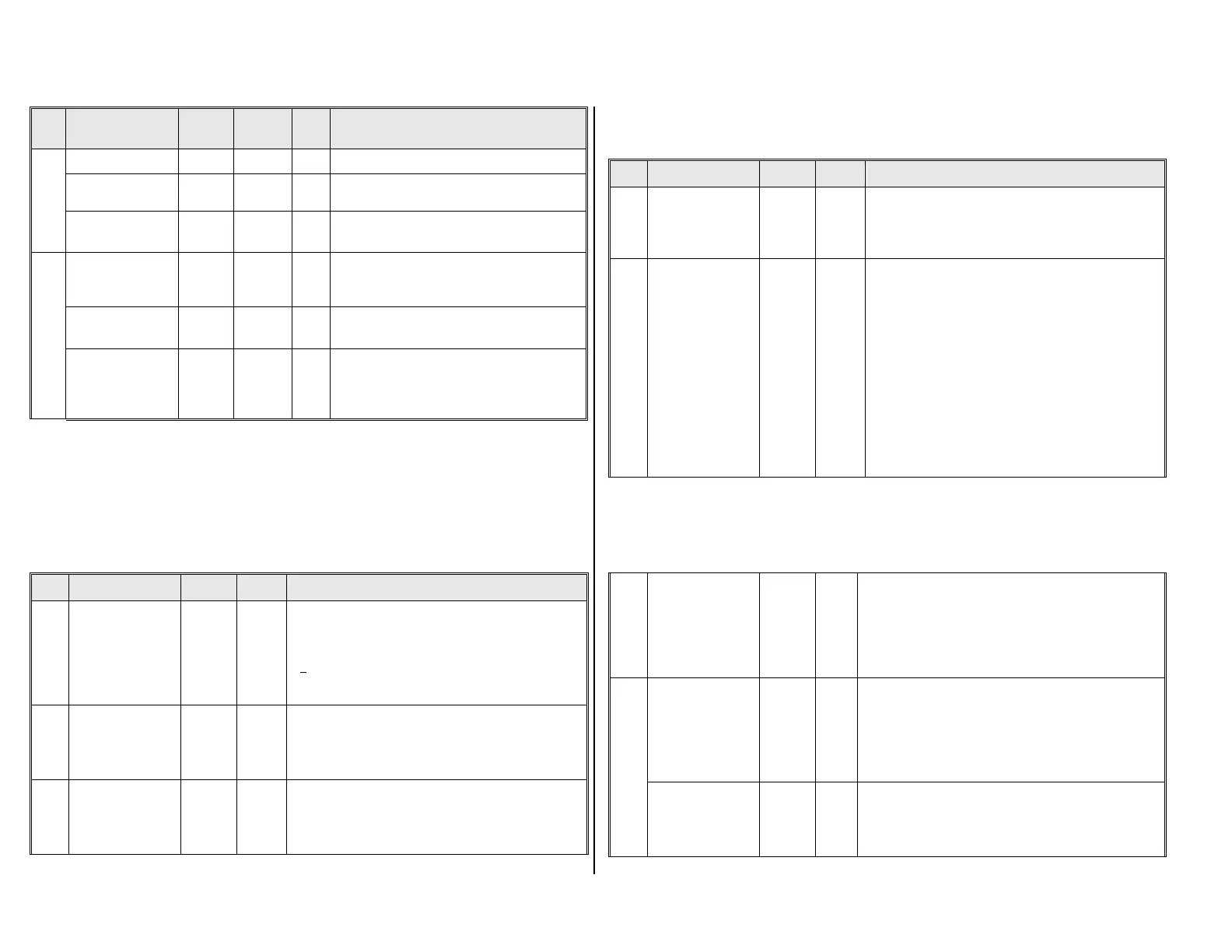
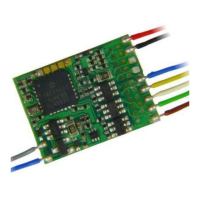
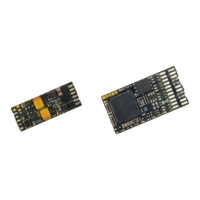
Page 56 Large-scale Decoder & Sound Decoder MX695/6/7/9
Electric brake -
maximum speed
…and the value in CV #382
= 0: Pitch independent of speed
= 1…255: …depends increasingly on speed.
Electric brake –
Deceleration
threshold
The number of speed steps lowered during decel-
eration before the electric brake sound is played
back.
Electric brake –
Downhill
= 0: no effect at “negative” load
= 1 – 255: Sound triggered at “negative” load.
Bit 3 = 0: Sound fades out at sample end
= 1: Sound ends at with sample end
Bit 2…0: Increases minimum playback time by 0 …
7 seconds, to prevent an interruption in break
sound between speed steps.
Coasting and Notching functions are required for driving situtations where the engine sound
cannot be derived from speed, acceleration and load only.
Primarily in diesel locomotives (but not necessarily limited to diesels), the motor’s idle sound or a
certain specified speed step sound is enforced by keystroke.
This method can be used for “downshifting” (often to neutral) as well as “upshifting” (i.e. elevated
idle for heating). Future software versions will expand this function to a fully independent sound
effect.
Coasting-Key
(or Notching)
Function key that activates “Coasting“, which forces the mo-
tor sound to a specified speed independent of the driving
situation. Define the (sound) speed in CV #375 (often used
for idle sound while coasting).
= 0: does NOT mean F0, but rather that NO key is assigned
for coasting.
= 1 ... 28: One of the function keys F1 … F28 for “Coasting“
Coasting-Step
(or Notching)
Motor speed (sound) to be activated with coasting key (as
per CV #374), independent of driving situation.
= 0: Idle sound (typical coasting situations)
= 1 … 10: Sound speed (Diesel engines typically have 5 to
10 notches, which can be activated with the coasting key.
The number of speed steps the train’s speed has to be re-
duced within 0.5 seconds in order for the automatic coasting
effect to set the motor sound to idle (without assigning a
coasting key above). The motor sound will not return to idle
if the speed is reduced at a slower rate.
It is especially convenient if the sound step can be raised manually with a function key when
operating diesel engines.
Key assignment for
raising diesel step
Define a function key that raises the diesel motor to the min-
imum step defined in CV #340.
See below if more function keys are needed to raise the
sound further.
Define diesel step
and possibly more
key assignments
Minimum step the sound of the diesel motor should increase
to with the key defined in CV #339. These steps are not mo-
tor speed steps but rather sound steps. A sound library can
have 1 to 10 speed (sound) steps (i.e. “1” forces the sound
to sound step 1, “2” to sound step 2 etc.). The sound can
only be increased with these keys. For sound decrease, use
the coasting functions in the table above.
To add more function keys for more speed increases use
this calculation:
Lowest speed (sound) step for the first key defined in CV
#339 + (16 * (number of keys – 1)).
Example: F4 is defined as the first key in CV #339, which is
supposed to raise the speed from idle to the first cruise step.
To add 3 more keys (F5 to 2
nd
cruise step, F6 to 3
rd
, F7 to
4
th
): 1 (first cruise step above idle) + 63 (4 * 16 – 1) = 64.
7.8 Random and Switch input sounds
Minimum interval for
random generator Z1
The random generator generates internal pulses in irregular
intervals that are used to playback a sound file assigned to
the random generator. CV #315 defines the shortest possible
interval between two consecutive pulses.
Sound samples are assigned to the random generator Z1 with
the help of the procedure CV #300 = 101, see above! By de-
fault, the compressor is assigned to Z1.
Special note to random generator Z1:
The random generator Z1 is optimized for the compressor
(which should be played back shortly after the train has
stopped); therefore the default assignment should be retained
or at the most be used for a different compressor. CV #315
also determines the proper time the compressor is started af-
ter coming to a stop!
Maximum interval
for random generator
Z1
CV #316 defines the maximum time interval between two
consecutive pulses of the random generator Z1 (that is most
often the start of the compressor after coming to a stop); the
actually occurring pulses between the values in CV #315 and
#316 are equally distributed.


 To Next Page