24
EVAP. CONDENSER SECTION - cont.
Mechanical Cleaning:
Do not attempt to mechanically clean the copper tubing
in the evaporative condenser. Do not use wire brushes or
any other mechanical device on the copper tubing. Se-
vere damage may result. Contact your water treatment
expert for recommendations on chemical cleaning proce-
dures.
PARTS
Contact your local AAON Representative for factory
authorized parts. Be sure to include the Serial Number
from the product nameplate when ordering or request-
ing quotations.
The air cooled condenser section rejects heat by passing
outdoor air over the fin tube coils for cooling of the hot
refrigerant gas from the compressors. The heated air will
discharge from the top of the section through the propel-
ler fans.
The condenser coils should be inspected yearly to ensure
unrestricted airflow. If the installation has a large
amount of airborne dust or other material, the condenser
coils should be cleaned with a water spray in a direction
opposite to that of the airflow. Care should be taken to
prevent bending of the aluminum fins on the copper
tubes.
AIR COOLED CONDENSER SECTION
One method of calculating evaporation and bleed in
gallons per minute (gpm) is shown below:
Evaporation Rate =
Total Heat of Rejection Via Evaporation/(1050 *500)
Bleed Rate =
Evaporation Rate/(Cycles of Concentration-1)
Example:
A unit has 100 ton cooling capacity with a compressor
EER = 15.
Total Heat of Rejection
= Tons x 12000 x (1+ 3.413/EER) Btu/hr
= 100 x 12000 x (1+3.413/15) = 1,473,040 Btu/hr
Total Heat of Rejection Via Evaporation
= Total Heat of Rejection x ( 1-.22)
= 1,473,040 x (1-.22) = 1,148,971 Btu/hr
Evaporation Rate =
1,148,971 (Btu/hr) / 525,000 (Btu/hr/gpm) = 2.19 gpm
Assuming 4 cycles of concentration:
Bleed Rate = 2.19/(4-1) = .73 gpm
The above water bleed system is a good means of control
for many forms of scale build up or corrosion. Some
system conditions, however, may be much more severe
requiring more extensive forms of water treatment. It is
important that operating and maintenance personnel be
aware of this problem and knows when to recommend
water treatment.
Following are important signs to look for when inspecting
a given unit:
1. Scale formation on the heat exchanger surfaces with
resulting decreased operating efficiency of
equipment.
2. Accelerated corrosion or rusting of the metal
surfaces, resulting in coil or casing failure.
3. Slime and algae formation on the metal surfaces,
tending to block circulation piping and the water
distribution system.
Following are guidelines to be used in water treatment:
1. Any water treatment must be compatible with
stainless steel and copper.
2. The water pH should be maintained between 6.5 and
9.0 at all times.
3. Batch feed process should never be used.
4. Acid treatment not recommended due to corrosive
effect on materials.
5. Do not use hydrochloric acid (HCl- muratic acid)
6. Avoid any introduction of chlorides into the
condenser.
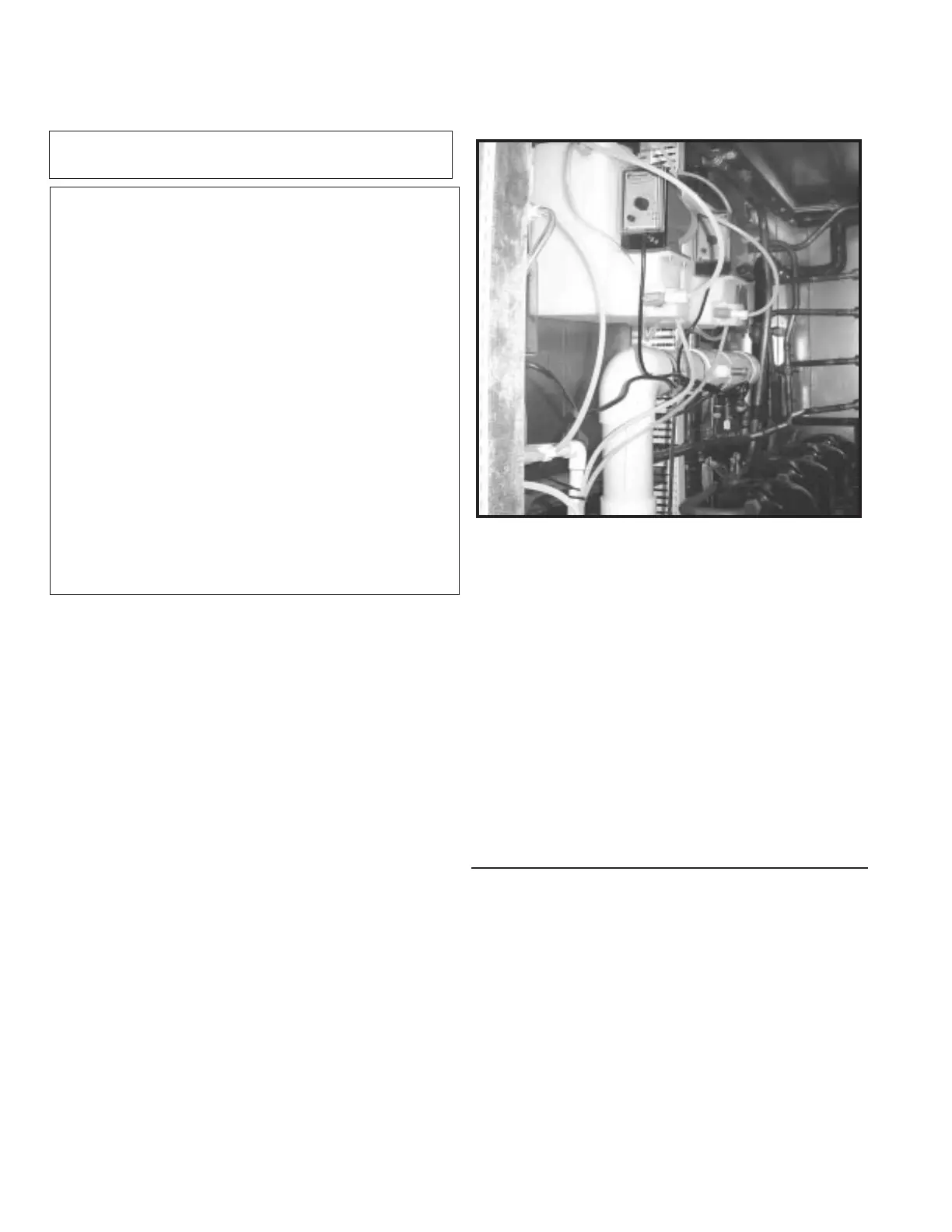
EVAPORATIVE CONDENSING
CHEMICAL DISPENSING SYSTEM


 To Next Page