Need help?
Do you have a question about the ABB AMXE250 and is the answer not in the manual?
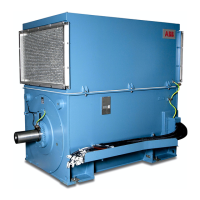
Provides general guidelines for installation, maintenance, and disposal of the AMXE250 motor.
Details the primary uses of the motor as a traction, generator, or auxiliary unit in vehicles and marine applications.
Specifies the warranty period for the motor.
Outlines precautions for installation and operation to maintain electromagnetic compatibility.
Defines the necessary qualifications and training for personnel involved in motor handling.
Lists the manual and other related technical documents for the motor.
Highlights safety precautions, hazards of rotating parts, hot surfaces, and modifications.
Specifies uses outside the motor's design or limitations and the condition for technical modifications.
Presents detailed technical specifications and identification data from the motor's rating plate.
Discusses factors affecting motor lifetime, particularly winding and bearing temperatures, and recommended limits.
Covers procedures for delivering the motor, inspecting delivery, and safe lifting.
Provides recommendations for storing the motor indoors, dry, dust-free, and vibration-free.
Explains how to remove anti-corrosion coatings from mating surfaces before installation.
Outlines the procedure and importance of checking insulation resistance before commissioning.
Steps for preparing the motor for installation, including removing locking devices and checking lifting points.
Guidance on aligning the motor shaft with the mating coupling for low noise and vibration.
Details flange mounting, side mount interfaces, and bottom mounting procedures.
Instructions for connecting the liquid cooling system, including coolant type and pressure limits.
Details how to safely connect the motor to the power supply and inverter.
Explains the importance and procedure for ensuring proper grounding of the motor.
Covers the connection of auxiliary M12 connectors and protection caps.
Discusses operating the motor in failure mode, potential damage, and precautions.
Provides a schedule for routine visual and detailed inspections and maintenance actions.
Details the specific actions for visual inspections, bearings, seals, cleaning, and painting.
Specifies requirements for spare parts and how to obtain information on price and delivery.
Lists foreseen consumables required for maintenance and their ABB part numbers.
A checklist to verify that all installation steps and requirements have been met.


 To Next Page
 General