
 Need help?
Do you have a question about the ABB Emax2 and is the answer not in the manual?
Information and contact details for technical assistance and support.
List of abbreviations and their meanings used in the manual.
This document outlines the lifting instructions for Emax2 Retrofill Circuit Breakers ranging from 600A to 5000A, specifically designed for use in AKD5, AKD6, AKD8, and AKD10 switchgear. The manual emphasizes safety precautions and provides detailed guidance on the proper use of lifting devices for these breakers.
The primary function of these lifting devices is to safely and efficiently install or remove Emax2 Retrofill Circuit Breakers into or from various AKD series switchgear. These breakers are essential components in electrical distribution systems, providing protection against overcurrents and short circuits. The retrofill design allows for the upgrade of older AK series switchgear with modern Emax2 technology, enhancing performance and reliability without requiring a complete switchgear replacement. The lifting devices are crucial for handling these heavy and sensitive electrical components, ensuring both personnel safety and the integrity of the equipment during installation and maintenance.
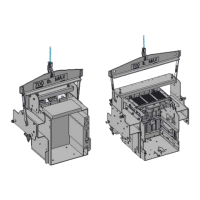
Key usage features of the lifting devices are highlighted through a series of illustrations and step-by-step instructions. The lifting devices consist of a spreader bar, lifting hooks, steel plain washers, steel drive rivets, and a hoist label indicating a maximum weight capacity of 700 lb. The manual specifies three types of lifting devices (Type A, B, and C) tailored to different breaker capacities and switchgear configurations. For instance, Type A is used for AKD5-10/OEM RF kits up to 2000A (AK50), Type B for AKD5/8/10 OEM 3000A-4000A (AK50, AK100), and Type C for AKD5/8/10 AK100, AKR-125, WP 5000A. This categorization ensures that the correct lifting apparatus is selected for the specific breaker being handled, optimizing safety and operational efficiency.
The instructions emphasize several critical steps for safe operation. Before lifting, it is imperative to ensure that the lifting device is securely attached and locked with a suitable hoist. The lifting hooks, which are designed to open and close within a ±7° angle in the vertical plane, must be properly engaged with the spreader bar. The spreader bar itself has multiple slots, allowing for flexibility in positioning the hooks to match the hooking points on the retrofill breaker. This adaptability is vital given the varying designs and sizes of the breakers. The manual provides clear visual aids, such as figures 1C, 2C, 3C, 4C, 5C, 6C, and 7C, to demonstrate the correct engagement of the hooks in the slots.
During the lifting process, operators are instructed to maintain a steady hold on the retrofill breaker and guide it carefully. This guidance is essential to ensure that both sets of pins on the breaker align easily with the rail slots of the AKD switchgear. The process requires attention to detail, checking both sides and underneath the breaker to prevent misalignment or damage. Once the retrofill breaker is properly seated in the rail slots, the lifting hooks can be unhooked, and the hoisting apparatus moved out of the way. The manual strictly warns against placing hands or fingers on the lifting hooks or bars once the kit is lifted, or manipulating the kit by holding anywhere other than the provided handle or grips. This reinforces the importance of using the designated handles for guidance to avoid pinch points and other hazards.
Maintenance features, while not explicitly detailed for the lifting devices themselves, are implicitly addressed through the emphasis on proper usage and safety. The robust construction of the lifting devices, comprising steel components like spreader bars, hooks, washers, and rivets, suggests durability under the specified load limits. Regular inspection of these components for wear, damage, or deformation would be a crucial maintenance practice to ensure their continued safe operation. Any signs of damage would necessitate replacement of the affected parts or the entire lifting device to prevent accidents. The hoist label, clearly indicating the maximum load, serves as a constant reminder for operators to adhere to weight limits, thereby preventing overloading and potential structural failure of the lifting device.
The manual also includes general precautions that are fundamental to any lifting operation involving heavy electrical equipment. These include warnings about pinch points and the strict use of provided handles for guidance. Such precautions are not only for the safety of the personnel but also for the longevity and proper functioning of the equipment being handled. By following these guidelines, the risk of damage to the retrofill breakers, which are complex and costly components, is significantly reduced.
In summary, the lifting devices for Emax2 Retrofill Circuit Breakers are specialized tools designed to facilitate the safe and precise installation and removal of these breakers in AKD switchgear. Their function is to provide a secure and stable means of handling heavy electrical components. Usage features include specific instructions for engaging hooks, guiding the breaker into position, and adhering to weight limits. While explicit maintenance instructions for the lifting devices are not provided, the emphasis on safe operation and the robust design imply that regular inspections and adherence to load capacities are critical for their ongoing reliability and safety. The document serves as a vital guide for technicians and engineers involved in the installation and maintenance of modernizing electrical infrastructure with Emax2 retrofill solutions.
 General
| Type | Air Circuit Breaker |
|---|---|
| Breaking Capacity | Up to 150 kA |
| Number of Poles | 3 or 4 |
| Installation | Fixed or Withdrawable |
| Communication | Modbus, Profibus, Ethernet |
| Operating Temperature | -25°C to +70°C |
| Rated Current | 800A - 6300A |
| Protection | Short circuit |
| Standards | IEC 60947-2 |


 To Next Page