6. Surge arrester monitoring theory
The total leakage current is measured by means of the zero-flux
current transformer, and the electric field generated by the system
voltage is measured in terms of the current induced in the field probe,
both shown in figure 6.3.4. The field probe current, see figure 6.3.5, is
used to compensate for the harmonic content in the system voltage.
Every 10 seconds, the data communication system of the EXCOUNT-II
sensor is activated to establish contact with an EXCOUNT-II transceiver
in the vicinity. If successful, the sensor makes the total leakage current
and field probe current measurements described above and transmits
the measured data to the transceiver. In addition, the sensor also trans-
mits surge counting data along with data on ambient temperature and
sensor identity, etc. For details on the sensor/transceiver data commu-
nication system, see technical data in section 11 on page 42.
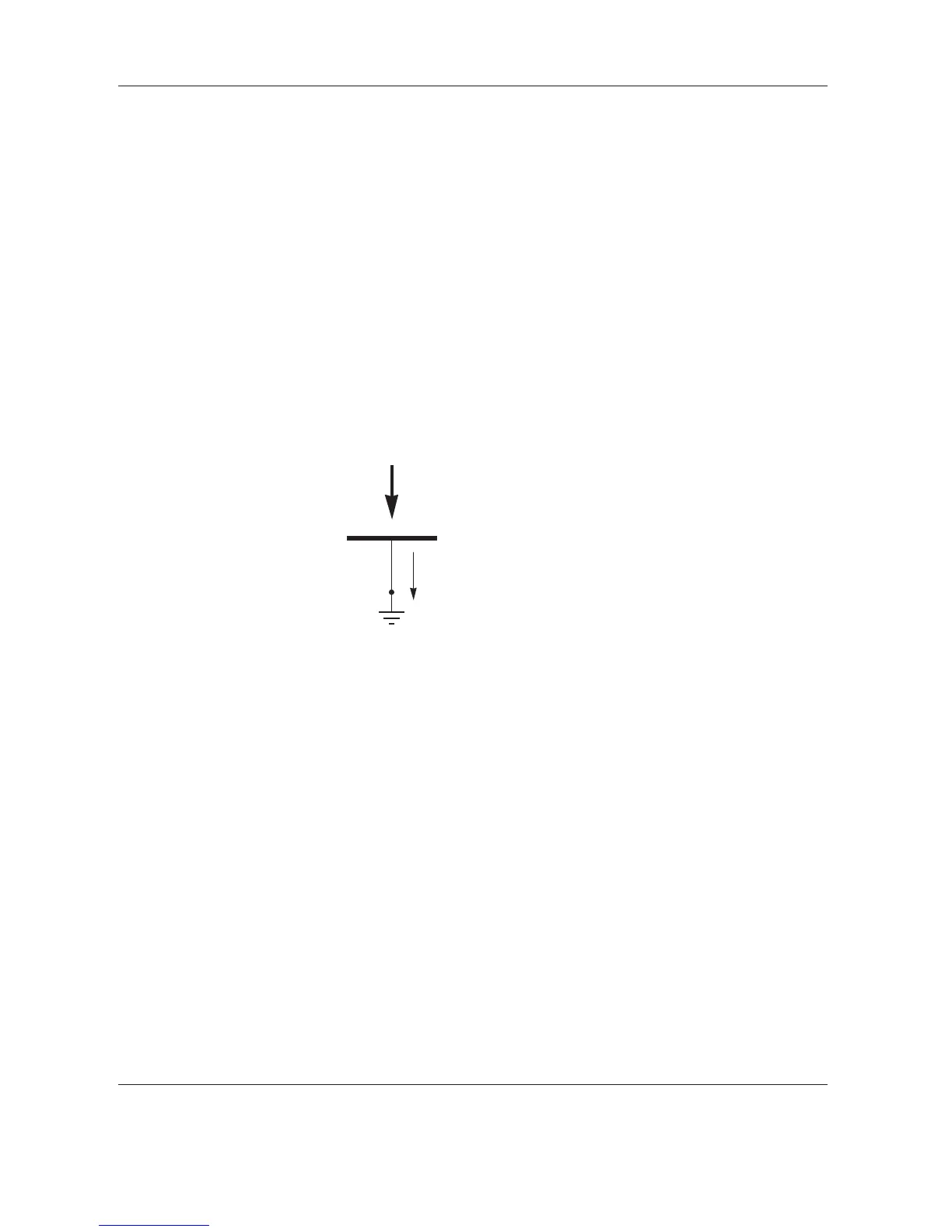
Figure 6.3.5
Principle of field probe for determination
of system voltage harmonics
In the transceiver, the magnitudes of the total leakage currents are
checked with regard to the measurement ranges (see Table 1). Extre-
mely low current levels, caused by the arrester being out of opera-
tion etc., are also identified. Accepted measurements are analysed
by means of Discrete Fourier Transformation (DFT) to determine the
magnitude and phase angle of the first and third order harmonic
components of the total leakage and field probe currents (for resistive
leakage current option). Several measurements are analysed to verify
the stability of the current levels. The total leakage current and field
probe current data (as well as the surge counting data) are temporarily
stored in the transceiver for later downloading to a personal computer.
Field
probe
Electric field
surrounding the
arrester
I
p


 To Next Page