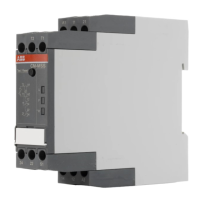
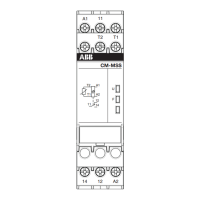
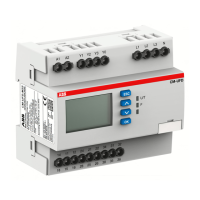
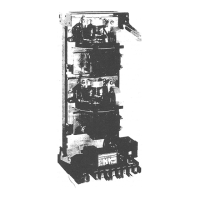
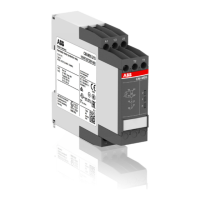
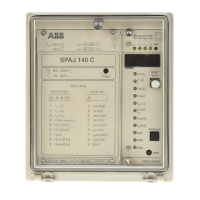
The MMCO is a microprocessor-based multi-phase (2 or 3 phase) and ground, time and instantaneous AC overcurrent relay. It is designed to sense current levels exceeding a predefined setting and initiate a trip command to a circuit breaker to clear faults. The relay offers a wide array of time-current characteristics, making it suitable for diverse applications such as coordination with fuses and reclosers, cold-load pickup, motor starting, and fixed-time applications.
Function Description:
The MMCO relay continuously executes its protective functions when DC power is applied. It provides seven families of CO curves for the USA version (MMCO-2, MMCO-5, MMCO-6, MMCO-7, MMCO-8, MMCO-9, MMCO-11) and three families for the IEC version (IEC-A, IEC-B, IEC-C), each with 63 selectable curves determined by the time dial setting.
The relay's operation is based on ABB proprietary software, which is resident in memory components. The purchase of the MMCO includes a restrictive license for the use of this software solely for protective functions. ABB reserves the right to request the return of memory components if the relay is no longer used as a protective device. The programs cannot be copied, transferred, or applied to other devices.
Important Technical Specifications:
- Temperature Range: -20 to +55 deg. C (operating), -40 to +70 deg. C (storage).
- Frequency: 50 Hz or 60 Hz (selectable).
- Time Delay Pickup Settings: 0.5 Amps to 12 Amps in 1 Amp steps (5 Amp CT), 0.01 Amps to 2.4 Amps in 0.01 Amp steps (1 Amp CT).
- Pickup Accuracy: 5% for Time Delay setting, 5% for Instantaneous Trip setting.
- Timing Accuracy: At 5 times pickup, 10% or 3 cycles (whichever is greater); at 20 times pickup, 10% or 3 cycles (whichever is greater). A 10 ms pickup time must be added to curves for TDTRIP output relay.
- Dropout Ratio (Time Delay & Inst. contacts): 98% Min.
- TRIP Reset Time: 2.5 cycles typical, 3.5 cycles max.
- TRIP Seal-In Current: 0.5A DC current minimum required through TRIP contact circuits to Seal-in TRIP contacts and TRIP LED.
- Instantaneous Unit Pickup: 1 Amp to 127 Amps in 1 Amp steps (5 Amp CT), 0.2 Amps to 25.5 Amps in 0.1 Amp steps (1 Amp CT).
- Maximum Pickup Time: 1.5 cycles @ current = 3 x pickup, 2 cycles @ current = 2 x instantaneous setting, 4 cycles @ current = 1.2 x instantaneous setting.
- Contact Ratings: Make: 30 Amp at 250 Vdc for 1 sec (one shot); Break: 50 W Resistive up to 250 Vdc.
- DC Power Supply: Nominal Voltage 48/125 Vdc (Operating Voltage 38-140 Vdc) with 8 Watts max. drain; 250 Vdc (Operating Voltage 200-280 Vdc) with 10 Watts max. drain.
- AC Ratings (CT Type): 5A CT (Continuous Rating 16 Amps, 1 Second Rating 200 Amps, Ohmic Burden 0.005 Ω); 1A CT (Continuous Rating 5 Amps, 1 Second Rating 100 Amps, Ohmic Burden 0.025 Ω).
Usage Features:
The MMCO is housed in a standard FT-22 flexitest case and consists of five printed circuit modules: Power Supply, Current Transformer (CT), Microprocessor, Display, and Input/Output (I/O).
The Display module features a 16x2 character alphanumeric LCD for displaying the last four trip targets, settings, metering, relay catalog number, software versions, and optional time and date. It also includes a red "TRIP" LED (blinks for time-delay pickup, steady for trip, seals-in on breaker trip current) and an amber "MONITOR" LED (ON for normal operation, OFF for hardware failure or alarm).
Five keypad push-buttons (SELECT, SCROLL, RAISE, LOWER, ENTER) allow users to navigate modes (settings, targets, time setting, metering) and adjust parameters. Three external buttons (EXTERNAL SCROLL, TARGET RESET, TRIP TEST) provide additional functionality without opening the relay case.
- Metering Mode: Displays current (IA, IB, IC, I0), status ("S"), and optional day, date, and time. Status codes indicate internal hardware or software failures.
- Settings Mode: Allows selection of phase and ground pickup, instantaneous settings, time dial, curve type, frequency, and directional control options. Settings are changed using RAISE/LOWER buttons and confirmed with ENTER.
- Targets Mode: Displays trip data for the previous four faults (T1-T4), including type of trip, current at trip time, and optional day, date, and time. Data for 16 faults can be read remotely via communications.
- Set Time Mode (Optional): Allows adjustment of day, month, year, hour, minute, and second for relays with the real-time clock option.
- Directional Control Option: Requires external battery positive voltage applied to specific terminals to enable phase and ground time delay or instantaneous tripping.
- Remote Reset Option: Allows remote resetting of the sealed-in TRIP LED by applying battery positive voltage to specific terminals.
- INCOM Communications: An optional INCOM device allows remote access to display information, read fault cases, and make settings using a password.
Maintenance Features:
- Acceptance Test: A performance check is recommended upon receipt to verify proper circuit functioning, including minimum trip, time curve accuracy, and instantaneous trip.
- Calibration: The relay is factory-calibrated. Customer adjustments are generally not required unless the relay is found to be out of calibration during the acceptance test. Calibration involves adjusting potentiometers on the Microprocessor and Power Supply boards to ensure correct voltage references and current readings.
- Display Adjustment: The LCD display contrast can be optimized for specific lighting and viewing angles using a potentiometer on the front panel.
- Real-Time Clock Adjustment (Optional): Factory-adjusted; customer adjustment is not recommended as it requires removing the Microprocessor module. If necessary, it involves adjusting a trimmer capacitor to achieve a frequency of 1.000000 Hertz.
- Battery Replacement: For relays with the real-time clock option, the lithium battery (BT1) should be replaced with ABB Style 9648a03h01 only to avoid the risk of fire or explosion.
- Periodic Inspection: All relays should be inspected periodically (at least once a year) to ensure proper operation and settings suitability.
- Electrostatic Discharge (ESD) Precautions: When handling the relay out of its case, ESD procedures must be followed to prevent damage to static-sensitive components.
- Renewal Parts: Interchangeable parts can be furnished for customers equipped to perform repair work. When ordering, complete nameplate data should be provided.
- Installation: The relay should be mounted vertically on a switchboard panel in a location free from dirt, moisture, excessive vibration, corrosive fumes, and heat, with an ambient temperature between -20 to +55 degrees C. Grounding can be achieved via mounting studs or screws.

 Need help?

 To Next Page
 General