
 Need help?
Do you have a question about the ABB Terra AC Series and is the answer not in the manual?
Outlines the purpose and scope of the installation manual.
Identifies the intended audience for the installation manual.
Lists past versions, dates, and descriptions of changes.
Specifies the original language and translation policy.
Explains the role and typical nature of illustrations used.
Details the measurement units used throughout the document.
Explains formatting and conventions used for readability.
Provides guidance on how to effectively navigate and use the manual.
Explains common symbols and signal words for warnings and information.
Details specific symbols used for identifying risks and dangers.
Lists other essential documents relevant to the EVSE.
Provides manufacturer details and contact information for support.
Defines common abbreviations used in the manual.
Defines key terms and concepts used within the document.
Clarifies directional references and coordinate systems used.
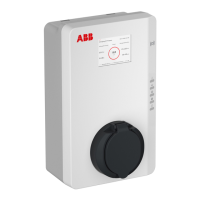
Provides a brief overview of the EVSE and its capabilities.
Specifies the proper and intended applications for the EVSE.
Explains the information found on the EVSE's identification plate.
Details how the EVSE functions and operates.
Presents a general system overview and component layout.
Describes various available features and configurations for the EVSE.
Identifies and explains the device's control indicators and buttons.
Details the functionality and layout of the companion mobile application.
States manufacturer responsibility and limitations.
Specifies the necessary expertise for safe installation.
Lists essential personal protective equipment (PPE) for handling.
Provides overarching safety guidelines for working with the EVSE.
Outlines critical safety precautions to follow during installation.
Details proper procedures for electrical earthing and grounding.
Explains the meaning of various safety and warning signs on the unit.
Provides guidance on the proper disposal of components and the unit.
Outlines the overall steps for installing the EVSE.
Details the process of safely unpacking the EVSE and its components.
Provides criteria for choosing a suitable installation location.
Lists requirements and actions needed to prepare the installation site.
Describes the overall process for physically mounting the EVSE.
Details the steps for installing the necessary mounting hardware.
Explains how to securely attach the EVSE to the wall.
Provides an overview of the electrical connection steps.
Guides on how to properly insert the AC input cable.
Details the process of connecting the AC input power cable.
Explains how to establish network and communication links.
Provides instructions for replacing the EV charge cable.
Outlines the overall steps for commissioning the EVSE.
Details the procedure for powering up the EVSE.
Guides on initial configuration and setup of the EVSE.
Explains how to link the EVSE to its mobile application.
Describes the process of adding RFID cards for authorization.
Instructions for safely removing the main cabinet cover.
Instructions for securely reattaching the main cabinet cover.
Details how to remove the cover for maintenance access.
Details how to reattach the cover after maintenance.
Provides a systematic approach to diagnosing issues.
Offers a reference table of common problems and solutions.
Explains the procedure for safely powering down the EVSE.
Explains the coding system for identifying EVSE models and features.
Lists the weights of different EVSE models.
Details required protective devices and compliance standards.
Lists all components supplied with the EVSE.
Covers general compliance, safety, certification, and IP rating.
Lists the tools necessary for installing the EVSE.
Specifies the environmental conditions for operation and storage.
Details the specifications for the wall mounting surface.
Provides information on the maximum noise emission.
Presents the physical dimensions of the EVSE.
Details the electrical input parameters for various configurations.
Describes specifications for connectivity and interface logic.
Provides detailed specifications for various required cables.
Details the electrical output parameters for different regions.
Lists power consumption during different charging modes.
Specifies torque values for various terminal blocks and screws.
 General
| Output Power | up to 22 kW |
|---|---|
| Max Output Current | 32 A |
| Cooling Method | Natural convection |
| Connector Types | Type 2 |
| Communication Protocols | OCPP 1.6 |
| Installation | Wall or pole mounting |
| Communication Interface | Ethernet, Wi-Fi |
| Enclosure Rating | IP54 |
| Operating Temperature | -30°C to +50°C |
| Efficiency | 98% |




 To Next Page