Need help?
Do you have a question about the ABB TPS52-F31 and is the answer not in the manual?
States the objective and scope of the operation manual for the turbocharger.
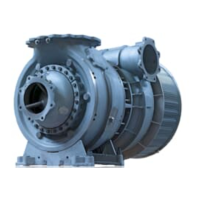
Describes the physical arrangement and operational principles of the turbocharger's components.
Defines the proper application and limitations for the turbocharger's intended operation.
Provides critical general data, safety rules, and organizational measures for turbocharger use.
Explains how to interpret the technical specifications and identification details on the rating plate.
Outlines residual risks and responsibilities during turbocharger operation and maintenance.
Defines the meaning and required adherence to mandatory safety signs.
Provides essential guidelines for safe operational practices and routine maintenance.
Details potential hazards from mechanical, noise, chemical, and thermal sources during operation.
Specifies safety precautions and procedures for lifting and handling turbocharger components.
Details on lubrication, filtration, viscosity, and pressure essential for turbocharger start-up.
Steps for performing necessary visual checks and tests before initial operation.
Procedure for safely restarting the turbocharger after periods of inactivity.
Guidance on routine visual checks, monitoring, and functional tests during operation.
Provides recommended intervals for replacing key turbocharger components based on usage.
Explains the turbocharger speed monitoring system and its operational aspects.
Procedure for cleaning the compressor stage while the turbocharger is running.
Method for cleaning the turbine section using wet cleaning processes during operation.
Instructions for cleaning individual turbocharger parts using mechanical methods.
Identifies common issues encountered during engine start-up and provides troubleshooting steps.
Addresses operational issues like low oil pressure, speed variations, and temperature anomalies.
Troubleshooting guide for problems related to the turbocharger speed sensor and its signals.
Step-by-step instructions for safely disconnecting and removing the turbocharger from the engine.
Detailed procedure for mounting, connecting, and securing the turbocharger during installation.
Procedure for dismantling and reassembling the turbocharger and its main components.
Measurement of axial (A) and radial (B) clearances for assessing component fit and wear.
Measurement of radial clearances (N, R) between rotating and stationary parts using feeler gauges.
Specifies correct torque values for various screw connections during assembly and disassembly.
Procedure for safely shutting down the turbocharger, including fitting protective cover plates.
Measures for preserving the turbocharger when the engine is idle for up to one year.
Procedures for long-term storage and preservation of the turbocharger components.
Information required for ordering replacement parts, including serial number and part description.
Diagrams and lists showing part numbers for major turbocharger components.
Visual guide to part numbers for components within the turbocharger cartridge group.
 General
| Output Voltage | 24 VDC |
|---|---|
| Protection Class | IP20 |
| Cooling Method | Convection |
| Mounting | DIN rail |
| Operating Temperature | +70°C |


 To Next Page