EasyManua.ls Logo

Acer ED272 - User Manual

Acer ED272
29 pages
Print Icon
To Next Page IconTo Next Page
Loading...
Acer LCD Monitor
User’s Guide

Questions and Answers

Summary

Special notes on LCD monitors

Information for your safety and comfort

Safety instructions

Read safety instructions carefully for future reference and follow product warnings.

Cleaning your monitor

Guidelines for safely cleaning the monitor screen and cabinet using a soft cloth.

Connecting;disconnecting the device

Observe guidelines for connecting and disconnecting power to the LCD monitor safely.

Warnings

Accessibility

Ensure power outlet is accessible and close to the operator for easy disconnection.

Safe listening

Instructions to protect hearing, including gradual volume increase and avoiding noise.

Using electrical power

Guidelines for safe operation using electrical power, including proper grounding and cord usage.

Product servicing

Instructions to refer servicing to qualified personnel and not attempt self-repair.

Potentially explosive environments

Safety precautions for operating the device in potentially explosive atmospheres.

Additional safety information

Safety notice regarding small parts and keeping them away from children.

IT Equipment Recycling Information

Information on Acer's commitment to environmental protection and product recycling.

Tips and information for comfortable use

Disposal instructions

Instructions for environmentally responsible disposal and recycling of electronic devices.

LCD pixel statement

Explanation of LCD pixel behavior and what constitutes a malfunction.

Taking care of your vision

Finding your comfort zone

Tips for adjusting monitor position and posture for maximum comfort during use.

Eyes

Recommendations for resting and blinking eyes to reduce eyestrain during prolonged use.

Display

Tips for display setup, including cleaning, positioning, and brightness/contrast adjustments.

Developing good work habits

Advice on developing relaxing and productive work habits, including breaks and exercise.

Declaration of Conformity

Federal Communications Commission Declaration of Conformity

Unpacking

Attaching; Removing the base

Screen position adjustment

Connecting the Power cord

Power saving

Explanation of the monitor's power saving mode and its indicator LED.

Display Data Channel (DDC)

Information on DDC protocol for plug-and-play installation and monitor capability reporting.

Connector pin assignment

Standard timing table

Installation

Users controls

Adjusting the OSD settings

Adjusting the Volume

Instructions for adjusting the monitor's volume level using the on-screen display.

Selecting the Input

Guide to selecting the video input source, such as VGA or HDMI, via the OSD.

The Function page

Adjusting the Picture

How to adjust picture settings like brightness, contrast, and color through the OSD menu.

Adjusting the Color

Guide to adjusting color temperature, hue, and saturation using the OSD settings.

Adjusting the Audio

Instructions for adjusting audio settings, primarily volume, via the OSD.

Adjusting the OSD

How to adjust OSD settings like language, timeout, and transparency.

Adjusting the System

Settings for input, auto source, wide mode, DDC/CI, and HDMI black level adjustment.

Product information

Viewing basic monitor information such as resolution, frequency, and serial number.

TROUBLE SHOOTING

Summary

Special notes on LCD monitors

Information for your safety and comfort

Safety instructions

Read safety instructions carefully for future reference and follow product warnings.

Cleaning your monitor

Guidelines for safely cleaning the monitor screen and cabinet using a soft cloth.

Connecting;disconnecting the device

Observe guidelines for connecting and disconnecting power to the LCD monitor safely.

Warnings

Accessibility

Ensure power outlet is accessible and close to the operator for easy disconnection.

Safe listening

Instructions to protect hearing, including gradual volume increase and avoiding noise.

Using electrical power

Guidelines for safe operation using electrical power, including proper grounding and cord usage.

Product servicing

Instructions to refer servicing to qualified personnel and not attempt self-repair.

Potentially explosive environments

Safety precautions for operating the device in potentially explosive atmospheres.

Additional safety information

Safety notice regarding small parts and keeping them away from children.

IT Equipment Recycling Information

Information on Acer's commitment to environmental protection and product recycling.

Tips and information for comfortable use

Disposal instructions

Instructions for environmentally responsible disposal and recycling of electronic devices.

LCD pixel statement

Explanation of LCD pixel behavior and what constitutes a malfunction.

Taking care of your vision

Finding your comfort zone

Tips for adjusting monitor position and posture for maximum comfort during use.

Eyes

Recommendations for resting and blinking eyes to reduce eyestrain during prolonged use.

Display

Tips for display setup, including cleaning, positioning, and brightness/contrast adjustments.

Developing good work habits

Advice on developing relaxing and productive work habits, including breaks and exercise.

Declaration of Conformity

Federal Communications Commission Declaration of Conformity

Unpacking

Attaching; Removing the base

Screen position adjustment

Connecting the Power cord

Power saving

Explanation of the monitor's power saving mode and its indicator LED.

Display Data Channel (DDC)

Information on DDC protocol for plug-and-play installation and monitor capability reporting.

Connector pin assignment

Standard timing table

Installation

Users controls

Adjusting the OSD settings

Adjusting the Volume

Instructions for adjusting the monitor's volume level using the on-screen display.

Selecting the Input

Guide to selecting the video input source, such as VGA or HDMI, via the OSD.

The Function page

Adjusting the Picture

How to adjust picture settings like brightness, contrast, and color through the OSD menu.

Adjusting the Color

Guide to adjusting color temperature, hue, and saturation using the OSD settings.

Adjusting the Audio

Instructions for adjusting audio settings, primarily volume, via the OSD.

Adjusting the OSD

How to adjust OSD settings like language, timeout, and transparency.

Adjusting the System

Settings for input, auto source, wide mode, DDC/CI, and HDMI black level adjustment.

Product information

Viewing basic monitor information such as resolution, frequency, and serial number.

TROUBLE SHOOTING

Overview

This document serves as a user's guide for an Acer LCD Monitor, providing essential information for its safe and comfortable use, installation, operation, and troubleshooting.

Function Description

The Acer LCD Monitor is designed for video and visual display of information obtained from electronic devices. It functions as a primary display unit for computers, allowing users to view graphical interfaces, documents, and multimedia content. The monitor supports various display modes and resolutions, ensuring compatibility with a wide range of systems. It is equipped with power-saving features to reduce energy consumption when not in active use. The monitor also incorporates Display Data Channel (DDC) protocol, enabling plug-and-play functionality by automatically communicating its capabilities to the host system.

Usage Features

The monitor offers several features to enhance user experience and comfort:

  • Screen Position Adjustment: Users can adjust the monitor's tilt to optimize their viewing position. The monitor can be tilted up to 20 degrees upwards and 5 degrees downwards, allowing for personalized ergonomic setup.
  • Connectivity: The monitor provides multiple input options, including VGA and HDMI, to connect to various host systems. This versatility ensures compatibility with both older and newer computer systems.
  • On-Screen Display (OSD) Settings: The OSD menu allows users to customize various display parameters.
    • Main Menu: Provides quick access to essential settings such as Main menu, Input Switch, Volume, and Mode.
    • Mode Control: Users can turn display modes on or off and select from predefined profiles like sRGB, Reading, DarkRoom, User, Standard, ECO, Graphics, and Movie, optimizing the display for different content types.
    • Volume Adjustment: For models with audio input, the volume can be adjusted directly through the OSD.
    • Input Selection: Users can manually switch between VGA and HDMI inputs.
    • Picture Settings: This section allows fine-tuning of image quality parameters such as Brightness, Contrast, Black Boost, Blue Light, ACM (Adaptive Contrast Management), H.Position (Horizontal Position), V.Position (Vertical Position), Focus, and Clock.
      • Brightness: Adjusts the overall luminance of the display.
      • Contrast: Controls the degree of difference between light and dark areas.
      • Black Boost: Enhances the amplitude of dark color levels, making blacks appear less black.
      • Blue Light: Filters out blue light by adjusting the showing ratio (80%, 70%, 60%, 50%) to reduce eye strain. Lower values provide better protection.
      • ACM: Toggles Adaptive Contrast Management on or off.
    • Color Settings: This menu provides options for color calibration.
      • Gamma: Adjusts the luminance tone, with a default value of 2.2 (standard for Windows).
      • Color Temperature: Allows selection of color presets like Cool, Warm, Bluelight, or User-defined.
      • 6-axis Hue: Enables adjustment of the hue for red, green, blue, yellow, magenta, and cyan.
      • 6-axis Saturate: Allows adjustment of the saturation for red, green, blue, yellow, magenta, and cyan.
    • Audio Settings: (For models with audio input) Allows adjustment of the monitor's volume.
    • OSD Settings: Configures the OSD itself, including Language, OSD Timeout (delay before the OSD menu turns off), and Transparency (for gaming mode, with options from 0% to 80%).
    • System Settings: Manages general monitor functions.
      • Input: Selects the video source (VGA or HDMI).
      • Auto Source: Automatically searches for available input sources.
      • Wide Mode: Allows selection of screen aspect ratio (Full, Aspect, or 1:1).
      • Hot Key Assignment: Assigns functions to hot keys.
      • DDC/CI: Enables monitor settings to be controlled via software on the PC.
      • HDMI Black Level: Adjusts the blackness level under HDMI source (Normal or Low).
      • Quick Start Mode: Enables the monitor to start rapidly.
  • Power Saving: The monitor automatically enters a "power saving" mode, indicated by an amber power LED, when it receives a control signal from the display controller or after a period of user inactivity (default 5 minutes). It recovers quickly (around 3 seconds) upon detecting a control signal or user input (mouse movement, keyboard press).
  • Ergonomic Tips: The guide provides comprehensive advice for comfortable computer use, including finding a comfortable viewing angle, avoiding fixed postures, taking regular breaks, and performing stretching exercises. It also offers suggestions for vision care, such as frequent eye rests, focusing on distant points, blinking regularly, keeping the display clean, positioning the head correctly, adjusting brightness/contrast, and eliminating glare.

Maintenance Features

Maintaining the Acer LCD Monitor involves simple yet important steps to ensure its longevity and optimal performance:

  • Cleaning: The monitor should always be unplugged before cleaning. A soft cloth should be used to wipe the screen and the front and sides of the cabinet.
  • Electrical Safety:
    • Ensure the power outlet is easily accessible and close to the equipment operator.
    • Unplug the power cord from the electrical outlet to disconnect power.
    • Do not allow anything to rest on the power cord or place the product where people will walk on the cord.
    • Avoid overloading power outlets or strips.
    • Use the supplied power supply cord set or a suitable replacement that meets specified requirements (detachable type, UL listed/CSA certified, type SPT-2, rated 7 A 125 V minimum, VDE approved or equivalent, 4.5 meters maximum length).
    • The product's power cord is equipped with a three-wire grounded plug; ensure the power outlet is properly grounded.
  • Product Servicing: Users are advised not to attempt to service the product themselves due to the risk of dangerous voltage points. All servicing should be referred to qualified service personnel, especially if the power cord is damaged, liquid has been spilled, the product has been exposed to water or rain, it has been dropped, the case is damaged, or if it exhibits a distinct change in performance or abnormal operation.
  • Environmental Protection: Acer is committed to environmental protection and encourages recycling of used equipment. Users are instructed not to dispose of the electronic device in regular trash but to recycle it according to Waste from Electrical and Electronics Equipment (WEEE) regulations.
  • Pixel Statement: The guide clarifies that the presence of a small percentage (0.01% or less) of missing or constantly lit pixels is normal for LCD screens and does not constitute a malfunction.
  • Storage and Placement:
    • Do not use the product near water or place it on unstable surfaces.
    • Ensure proper ventilation by not blocking or covering the product's slots and openings. Avoid placing it on soft surfaces like beds or rugs, or near heat sources like radiators, or in built-in installations without adequate ventilation.
    • Never insert objects into cabinet slots or spill liquid onto the product.
    • Avoid placing the product on vibrating surfaces to prevent damage to internal components.
    • Do not use the device in sporting, exercising, or vibrating environments to prevent unexpected short circuits or damage.

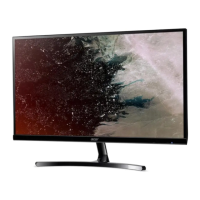
Acer ED272 Specifications

General IconGeneral
Screen shapeFlat
Backlight typeLED
Display diagonal27 \
Display technologyLCD
Native aspect ratio16:9
Maximum refresh rate75 Hz
Contrast ratio (typical)1000:1
Display number of colors16.7 million colors
Display brightness (typical)250 cd/m²
NVIDIA G-SYNC-
Product colorBlack
HDMIYes
Tilt angle range-5 - 20 °
Energy efficiency scaleA to G
Power consumption (standby)- W
Power consumption (typical)35 W
Cables includedAC, VGA
Weight and Dimensions IconWeight and Dimensions
Depth (with stand)193.04 mm
Width (with stand)612.14 mm
Height (with stand)462.28 mm
Weight (with stand)3946.25 g
Depth (without stand)49.276 mm
Width (without stand)611.886 mm
Height (without stand)452.12 mm
Weight (without stand)3719.46 g

Related product manuals