Active DST Module - DST-2-C
Page 5© 2016 Active Research Limited
Full information on the complete Actisense product range
can be found on the Actisense website.
General features
Depth transducer interface
Connects to a standard piezoelectric depth transducer
crystal element using a three-wire interface. Generates
the high transmit voltages, and receives the weak echo
returns from the sea-bed. Using an advanced sea-bed
tracking algorithm, the depth value is determined and
output as NMEA 0183 depth sentences DBT and DPT.
Speed transducer interface
Connects to a standard ‘paddle-wheel’ hall-effect speed
transducer using a three-wire interface. Generates the
required power supply, and receives the pulse signal from
the paddle-wheel. Once a speed transducer has been
detected (after sensing a minimum of three log pulses),
statistical analysis is used to determine both speed and
distance values, and output them as NMEA 0183 speed
sentence VHW and distance travelled sentence VLW.
Data output will then continue, regardless of the transducer
output until a power reset occurs.
Temperature transducer interface
Connects to a standard thermistor transducer using a two-
wire interface. Once a temperature transducer has been
detected (after sensing a resistance at power-up), a very
high resolution algorithm is used to determine the
temperature value and output it as NMEA 0183 temperature
sentence MTW.
Technical features
High-speed microcontroller capable of 10 million
instructions per second. More than enough power to perform
all the processing required to produce the accurate and
very fast tracking depth output of the system, in addition to
the speed, distance and temperature calculations.
Flash ROM technology that supports automatic
programming for quick and easy updates, 10,000+ erase
cycles and a 10-year Data Retention provides carefree
user conguration.
Sounding transducer circuitry capable of interfacing to
a wide selection of transducers, including Airmar (www.
airmar.com). Refer to the Compatible transducer list
section for further details.
NMEA 0183 full-differential output driver. This can
drive up to 4 fully compliant NMEA 0183 device loads, with
a 10mA (maximum) drive capability. The full-differential
output ensures better quality communications and lower
noise emissions on unshielded twisted pair cabling.
This connection also allows the unit to be updated via the
free ash upgrade software available on the Actisense
website if the DST-2 software requires an update.
Wide battery input voltage range to offer maximum
compatibility, the NMEA 0183 DST-2 can operate from a
battery supply anywhere between 10 and 28 volts.
Low Power Consumption - typically 65mA at 12 volts.
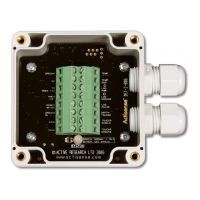
Very tough Polycarbonate case is certied to IP66
(classied as “totally protected against dust and protection
against low pressure jets of water from all directions”).
Being Polycarbonate, it is also incredibly strong, offering
a wide temperature range and superior protection to the
electronics inside. The IP66 rating of the case is only
limited by the sealing gasket strip, which can be enhanced
by applying a suitable non-acid based marine sealant to
the gasket after wiring and testing. This will allow use of
the unit in areas where salt spray could enter, accidental
immersion may occur, or in environments where maximum
long-term reliability is paramount.
Robust Nylon grommets are certied to IP68 (classied
as immersible for long periods without water ingress). Note
that to achieve this level of water integrity all grommets
must be occupied by round-section cables.
Large range of possible cable diameters of between
4.5mm and 10mm, single or multi-pair wire types can be
easily accepted.
Software updates
The DST-2’s built-in rmware is held in “ash” memory,
allowing quick and easy upgrades using a simple Microsoft
Windows (95/98/ME/NT/2000/XP) user interface program
(ActiPatch) running on a connected PC.
It is our policy to provide these updates free on our website,
www.actisense.com, so that your DST module can
become more sophisticated with time, and should there be
any bugs reported in the software, they can be promptly
xed without the unit coming out of commission.
This upgrade can be performed with the unit completely
in-situ, via a PC connected to the NMEA 0183 port with the
Actisense RS485-to-RS232 converter cable.


 To Next Page