Active DST Module - DST-2-C
Page 7© 2016 Active Research Limited
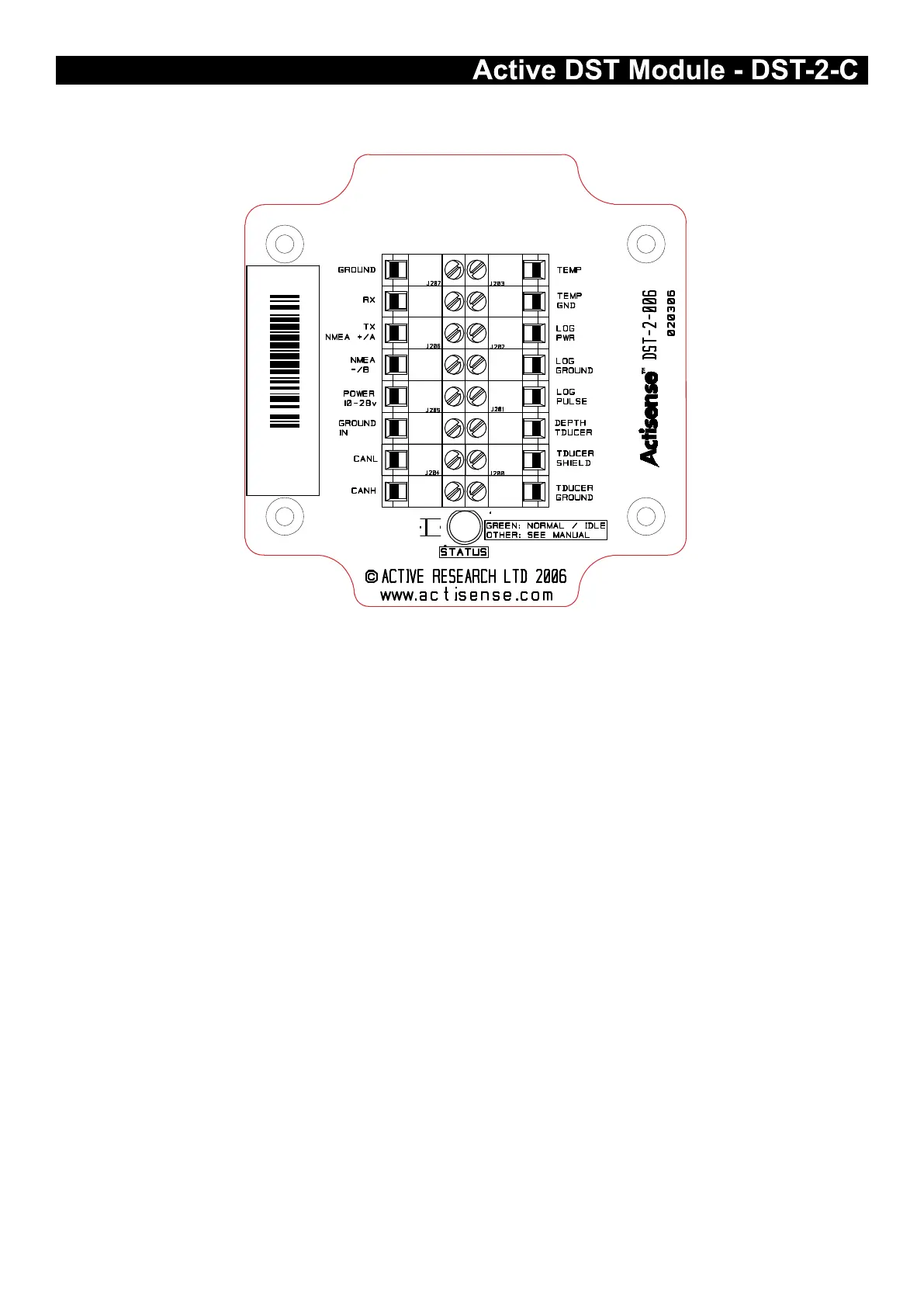
1. Depth transducer input/outputs.
The three-wire connection type is exible enough to
interface to most standard piezoelectric crystal depth
transducers.
2. Speed transducer input/output.
The standard three-wire connection type should
easily interface to most standard hall-effect paddle-
wheel speed transducers.
3. Temperature transducer inputs.
The standard two-wire connection type should
easily interface to most standard thermistor type
temperature transducers.
4. An NMEA 0183 data output.
The NMEA 0183 output comprises of two connections:
‘+/A’, ‘-/B‘ and conforms in full to the NMEA 0183
standard for differential communications.
5. Battery supply input.
Note:
1. To complete the NMEA 0183 standard all device
interconnection NMEA cables used should meet the
two-conductor, shielded, twisted pair conguration
specication. The shield connection of these wires
should be connected at the instrument end only to
prevent ground loops.
2. Refer to the Specications section for the full details
on input/output specications.
3. If a laptop / PC that is to be used with the DST-2
module does not have an RS-232 serial port available,
the Actisense USB to RS-232 adapter cable
has been tried and tested to provide a compatible
communications port, when used in conjunction with
the Actisense NMEA Opto-isolator adapter cable.
Please visit the Actisense website for full details on
these, and other Actisense products.
The DST module (DST-2) has screw-terminal “Phoenix” type external connections for: -
Connections
Figure 1 – All external connections
NMEA DST MODULE
99999
DST-2-C-200


 To Next Page