Page 8© 2016 Active Research Limited
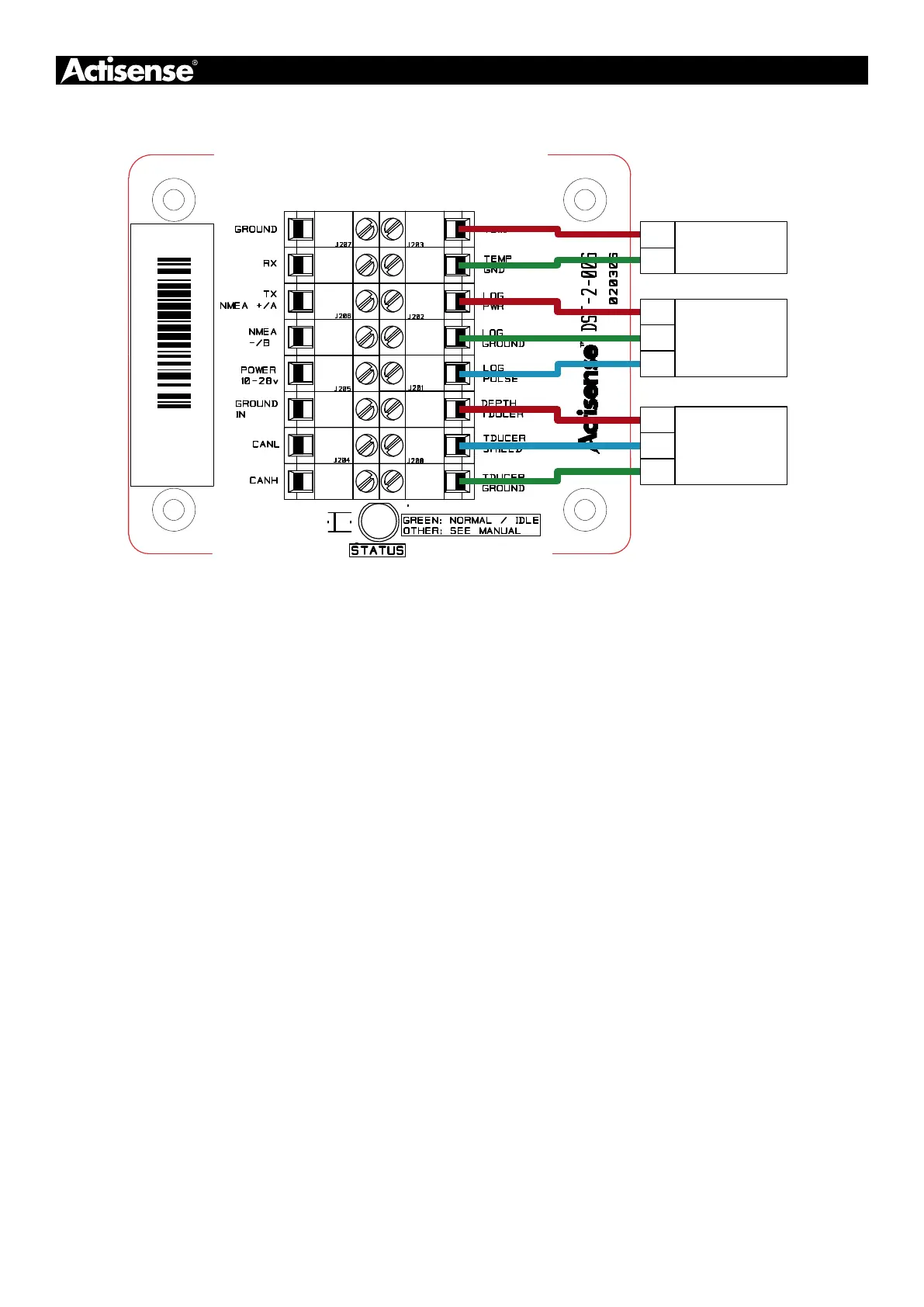
Depth transducer input/outputs
Depth transducers have two or three connections:
A ‘Live’ connection marked ‘DEPTH TDUCER’ on
the PCB, usually a coloured wire on twisted pair cable
(Airmar), or the centre conductor on a coaxial cable.
A ‘Ground’ connection marked ‘DEPTH GROUND’,
often the black core of a twisted pair cable (Airmar).
Coaxial cables have a common shield/ground.
A ‘Shield’ connection which is the shield of a two-wire
cable, or the outer sheath on a coaxial cable.
Two-connection transducers only provide the ‘Live’ and
ground connections. Whilst the DST-2 will work with these
types of depth transducers, the performance obtained may
not be as good as that from a transducer with separate
shield and ground connections (due to a poorer SNR).
Speed/Log transducer input/outputs
Log transducers generally have three connections:
A pulse connection marked ‘LOG PULSE’ on the DST
PCB, supplies the speed pulses relative to speed.
A ground connection marked ‘LOG GROUND’, used
as a return for the pulse signal and power supply.
A power supply connection marked ‘LOG PWR’,
supplies the speed transducer with its power. The
installer must ensure that this power supply is only
connected to the log transducer. Damage may occur
if this supply output is incorrectly connected, as it is
connected to the sensitive internal DST circuitry.
Temperature transducer inputs
Thermistor type transducers have two connections:
A resistance input connection, marked ‘TEMP’ on
the DST-2 PCB.
A second resistance connection, marked ‘TEMP
GND’, is connected to the other side of the thermistor
transducer. The polarity of these two signals is not
important.
Airmar “Triducer” type sensors share a common ground
connection for the speed/log and temperature sensors.
If the required transducer does not have a separate
ground for log and temperature, simply connect the
single ground to the temperature ground marked
“TEMP GND” on the DST-2 PCB.
Temperature transducers suitable for connection to the
DST-2 are of the “thermistor” sensor type with a 10kΩ
impedance at 25º Centigrade, as used in all Airmar
technology transducers.
Note:
1. Wire colours are for guidance only.
2. These connections should be carefully connected to
each transducer according to the instructions of the
transducer manufacturer(s).
Connecting to NMEA devices
Figure 2 – Transducer connections
NMEA DST MODULE
99999
DST-2-C-200
Depth
transducer
+
-
Sh
Temperature
transducer
+
G
Speed
transducer
G
+
Ps


 To Next Page