3
GENERAL DESCRIPTION
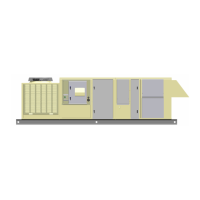
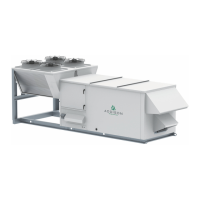
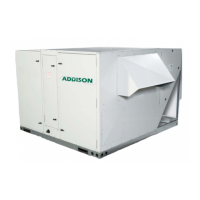
The model TRS Series A packaged cooling and heating unit is designed to cool a conditioned space with mechanical
refrigeration, chilled water, energy conservation wheel or a combination of these systems. During the heating mode
supply air may be heated by indirect fired gas, electric strip, steam or hot water. The cabinet design provides space for a
number of options, including 100% outside air applications and the use of desiccant wheels. Most of these options will be
covered in this manual; for those of a more custom nature, consult the ADDISON Application Engineering Department.
Model TRS units are designed for rooftop curb, slab mounted or installed on post and rail applications. Horizontal supply
with 100% outside air does not require a curb and may be slab mounted. Horizontal or vertical supply with vertical return
is available with a 14” high solid bottom roof curb (sold separately as an option). Horizontal supply and return air duct
connections are made with the use of a 24” high solid bottom roof curb (sold separately as an option).
Unpacking, Inspection
When received, the unit should be checked for damage that might have occurred in transit. If damage is found, it should
be noted on the carrier’s Freight Bill. Request for inspection by carrier’s agent should be made in writing at once.
Design Certification
All units are certified by Electrical Testing Laboratories (E.T.L.) under ANSI/UL 1995. The gas furnace designs are
certified by E.T.L. under the appropriate ANSI standards for use with natural or propane (L.P.) gas as specified when
ordering unit.
Codes and Ordinances
These units must be installed in accordance with the standard of the National Fire Protection Association or the National
Fuel Gas Code. The National Fuel Gas Code is available from the American Gas Association, 1515 Wilson Boulevard,
Arlington, VA 22209. NFPA Publications are available from the National Fire Protection Association, Batterymarch Park,
Quincy, MA 02269. Local authorities having jurisdiction should be consulted before installations are made to verify local
codes and installation procedures.
All field wiring to the unit must be done in accordance with these instructions, the National Electric Code (ANSI/NFPA 70-
1981) in the United States and all local codes and ordinances.
Clearances from the heater and vent to construction or material in storage must conform with the National Fuel Gas
Code, pertaining to gas-burning devices, and such material must not attain a temperature over 160°F by continued
operation of the heater.
Installation should be done by a qualified agency in accordance with the instructions in this manual and in compliance
with all codes clearances and requirements of authorities having jurisdiction.
INSTALLATION
Unit Location, Clearances
A 36" clearance must be allowed for access to the compressor and electrical panel. A 24" clearance must be maintained
for the air inlet to the condenser coil(s). Do not locate the unit under an overhang that will short circuit hot air to the coil
intakes.
When installed at ground level, the unit should be mounted on a level concrete slab which should extend at least 2"
beyond the unit on all sides. The top of the slab should be 2" above the ground level. The depth of the slab below the
ground level and its structural design is governed by the type of soil and climatic conditions. The slab must not be in
contact with any part of the building wall or foundation. The space between the slab and building wall prevents the
possibility of transmitting vibration to the building. The dimensions of the slab or roof mount should be checked and
verified before the equipment arrives. Unit supports, roof opening, roof curb flashing, drain requirements, and electric
locations are important to a good installation.
When installing the equipment on top of a building, the following should be considered. Structural members supporting
the unit must be sufficiently strong for the weight of the unit and mounting rails. Transmission of sound into the building is
sometimes a problem when the structure is not strong enough.
Locate the unit as near as possible to the center of the area to be environmentally controlled. Sufficient clearance must be
available for service, edge of roof, other units, or hazards. The condenser air inlet and discharge air must be
unobstructed by overhang, walls, or other equipment. Avoid locations next to exhaust fans or flues.
Select a location where external water drainage cannot collect around the unit. Locate the unit so roof runoff water does
not pour directly on the unit. Provide gutter or other shielding at roof level.
Where snowfall is anticipated, mount the unit above the maximum snow depth for the area.


 To Next Page