7
INSTALLATION (CONT’D)
Clearances
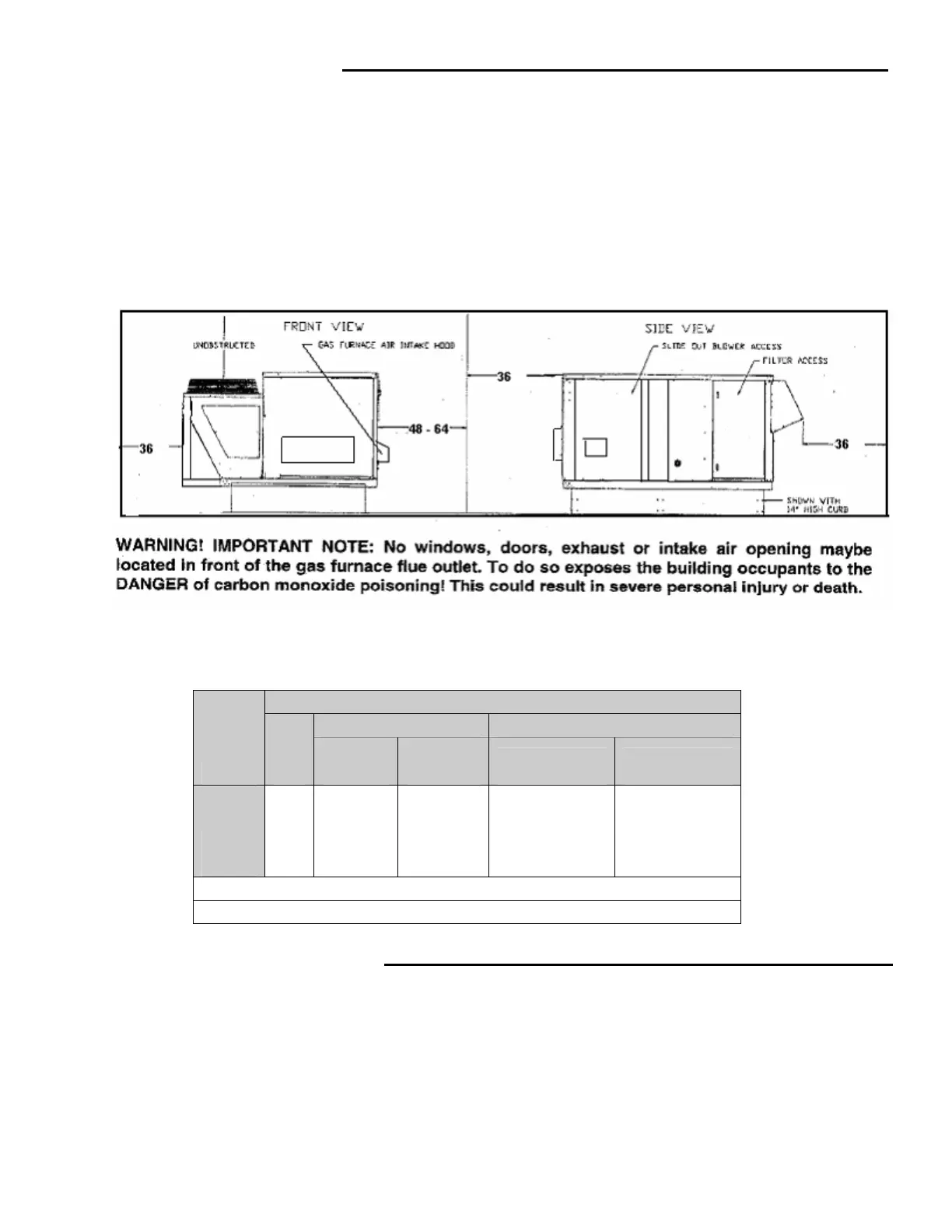
Adequate clearance around the unit must be kept for safety, accessibility, service, and maintenance. 48 inches clearance
is required on the side (furnace and electrical) end of the unit. This clearance must be maintained for compressor removal
and up to 64 inches in the case of a furnace or ECW wheel unit.
All combustible materials must be kept out of the area. A 48 inch clearance is also required on the front (outside air) end
of the unit for blower removal and for adequate outside air accessibility. The clearance of 64 inches on the filter access
side of the unit is required for ECW wheel removal if installed. A clearance of 36 inches is required on the condenser side
for an adequate supply of condenser air.
Accessibility, Service and Maintenance Clearances
Combustion Air Clearances
REQUIRED CLEARANCES
Sides* Bottom
Model Top Control Opposite
To
Combustibles
To Non-
Combustibles
TRS
Series
36"
Width
Of
Furnace
Plus 6" 0" 24" 0"
*Provide clearance as shown for safety, for combustion, and for service.
COOLING SYSTEM OPTIONS
Hot Gas Bypass
Hot gas bypass is a means of capacity control during lower ambient temperature conditions. The Hot Gas Bypass valve
is an adjustable valve and should be set to open when the refrigerant suction pressure drops to 107-112 psig. It varies
unit capacity by introducing discharge refrigerant into the evaporator circuit where it creates a false evaporator load. The
hot gas is cooled prior to its return to the compressor as it passes through the evaporator.
The Hot Gas Bypass Solenoid Valve is energized through the thermostat and routs discharge gas to the hot gas bypass
valve. It is de-energized during the pump down cycle.


 To Next Page