ADOBE FRAMEMAKER 10
MIF Reference
206
<FWeight `Medium'>
<FEncoding `JISX0208.ShiftJIS'>
<FLanguage Japanese>
<FLocked No>
> # end of Font
<String ` '>
> # end of ParaLine
> # end of Para
Kumihan Tables
Kumihan tables specify line composition rules for Japanese documents. FrameMaker uses standard JIS 4051
Kumihan rules by default. In most cases, the JIS standard is fine, but there are cases where corporate standards might
differ from the JIS rules.
Kumihan tables are associated with a document. To customize the Kumihan tables for a document, you specify the
tables in MIF. Then you can import the MIF into an existing document, or into a template you will use to create new
documents.
Understanding Kumihan tables
Kumihan tables specify line composition rules by assigning characters to various classes, and then specifying four
tables of rules that apply to the characters of each class.
The
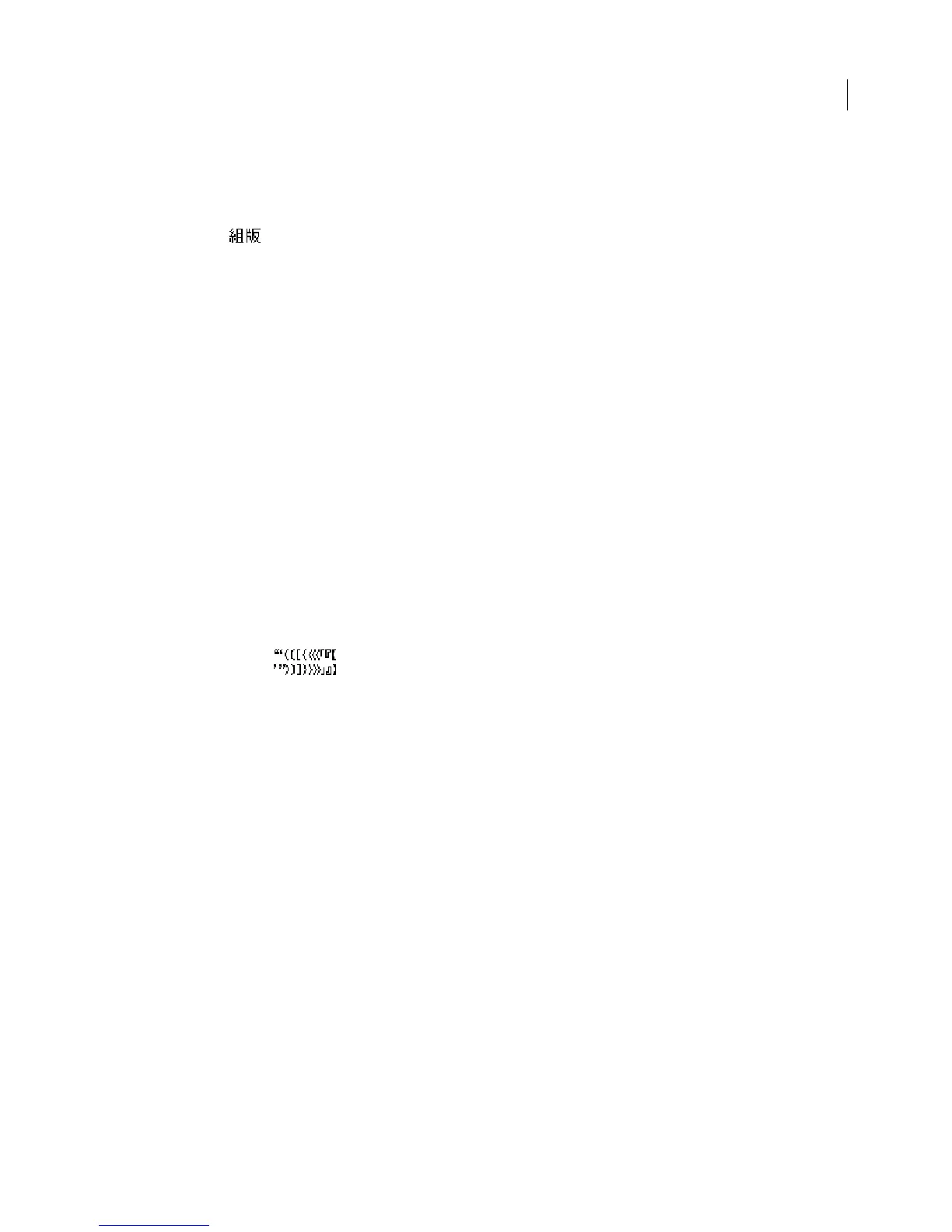
CharClass statement assigns each character to one of 25 classes. For example, the BegParentheses class
and the
EndParentheses class are defined by the following MIF statements, and they contain the characters shown
in the statement.
<BegParentheses ` '>
<EndParentheses ` '>
For more information on the CharClass statement, see “CharClass statement” on page 208.
The four statements that define the tables of rules that apply to the characters of each class are
SqueezeTable,
SpreadTable, LineBreakTable, and ExtraSpaceTable. Each of these statements specify the actions FrameMaker
takes for the characters in each of the 25 classes.
For example, the
LineBreakTable statement specifies whether a line break can occur between a character of one
class and a character of another class. Here is an example of a
LineBreakTable statement that specifies when a line
break can occur between a character in the
BegParentheses class and a character in each of the 25 classes:
<BegParentheses 1 1 1 1 1 1 1 1 1 1 1 1 1 1 1 1 1 1 1 3 1 1 1 1 1>



 To Next Page