
 Need help?
Do you have a question about the AEG PROTECT C. 10000 and is the answer not in the manual?
Explains the manual's purpose and important operational information for safe use.
Covers compliance with current specs, limitations of liability, and warranty conditions.
Details handling recommendations, contact hotline, and copyright notice.
Describes the core technological components and features of the UPS.
Explains the system architecture and how the UPS interacts with mains and loads.
Lists detailed technical data for the UPS models, including input, output, and battery specs.
Provides essential safety rules, accident prevention, and explains warning symbols.
Defines the necessary qualifications and authorizations for personnel handling the UPS.
Lists critical safety warnings and precautions specific to the PROTECT C. unit.
Details product conformity with relevant CE directives and standards.
Guides users on how to unpack the UPS and check for transport damage.
Provides instructions for safely moving and positioning the UPS at the installation location.
Outlines criteria for selecting an appropriate and safe installation environment for the UPS.
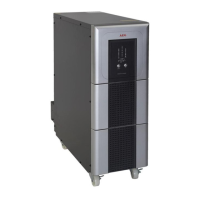
Illustrates the front, display, and rear views of the UPS, identifying key elements and connections.
Details safety measures and initial checks before connecting the UPS and loads.
Covers general mains connection, connector checklists, cable sizing, and one-phase wiring.
Explains preparation and steps for connecting loads to the UPS output.
Information on connecting compatible external battery packs for extended runtime.
Instructions for physically securing the UPS and battery units after connection.
Step-by-step guide for connecting the UPS to mains and initiating its start-up sequence.
Explains normal, battery, bypass, and manual bypass operating states.
Provides guidance on managing and responding to UPS overload situations.
Details the RS232 port for system management and software connectivity.
Describes the communication slot for installing optional expansion cards.
Introduces the "CompuWatch" software for monitoring and controlling the UPS.
Explains the meaning of LEDs and buttons on the UPS for status indication.
Provides a comprehensive table mapping LED displays and alarm signals to operation states.
Offers guidance on identifying and resolving common UPS problems and error messages.
Explains the n+x technology for configuring multiple UPS units in parallel.
Details the procedures for connecting multiple UPS units in a parallel configuration.
Covers steps for activating parallel operation and modifying the configuration.
Information on battery charging times and recommended maintenance tasks.
Guides users on performing visual checks, battery checks, and fan inspections.
Provides recommendations for storing the UPS and its batteries to maintain performance.
Instructions for safely dismantling and disposing of the UPS system.
Provides definitions for technical terms used throughout the operating manual.
 General
| Real Power | 9000 W |
|---|---|
| Output Frequency | 50/60 Hz |
| Output Voltage THD | < 3% |
| Transfer Time | 0 ms |
| Emergency Power Off (EPO) | Yes |
| Form Factor | Tower |
| Operating Temperature | 0-40 °C |
| Humidity | 0-95% non-condensing |
| Power Rating | 10000 VA |
| Output Voltage | 230 V |
| Input Voltage | 230 V |
| Efficiency in ECO Mode | >98% |
| Battery Type | Sealed Lead-Acid (SLA) |
| Waveform Type | Sinewave |
| Communication | USB, RS-232, SNMP |
| Noise Level | < 55 dB |
| Protection Features | Overload, short circuit, over temperature |



 To Next Page