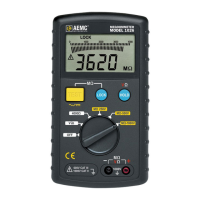
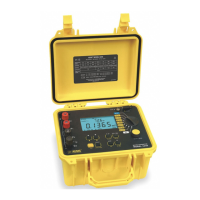
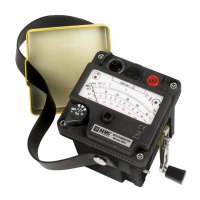
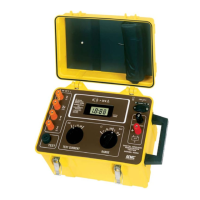
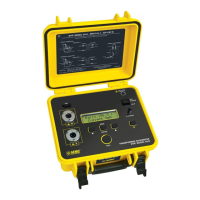
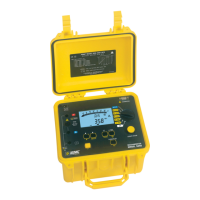
Megohmmeter Model 1000N/1100N
- 25 -
7KH(IIHFWVRI7HPSHUDWXUH
Insulation resistance measurements are changed by variations in
temperature of the insulation material. Typically, when the temperature
goes up, the insulation resistance will go down. Inversely, when the
temperature drops the insulation resistance will increase in value.
The best way to obtain consistent measurement results is to test the
insulation at a standard temperature, typically 68°F (20°C). If the
temperature of the material you are testing is either higher or lower than
68°F (20°C), refer to the temperature correction chart (see table). As a
general rule the insulation resistance value may be corrected by:
•
Halving the resistance measurement value for every 10°C above the
base temperature of 68°F (20°C), or
•
Doubling the resistance value for every 10°C below 68°F (20°C)
°C °F
Multiplication
Factor
0320.25
5410.36
10 50 0.50
15 59 0.75
20 68 1.00
25 77 1.40
30 86 1.98
35 95 2.80
40 104 3.95
45 113 5.60
50 122 7.85
55 131 11.20
60 140 15.85
65 149 22.40
70 158 31.75
75 167 44.70
80 176 63.50



 To Next Page