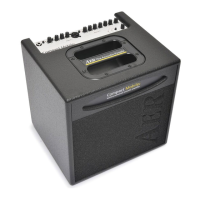
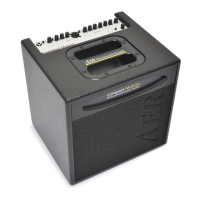
28
6. Donnée techniques
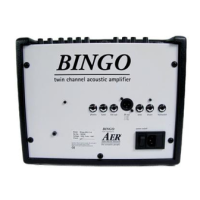
Footswitch connector
footswitch Connector for a dual footwitch
(dual, latching, toggle on-o switch)
Stereo jack socket: ¼” (6.35 mm)
Tip = internal eect on/o
Ring = external eect on/o
Sleeve = common (ground)
Function: Switch ON = eect OFF
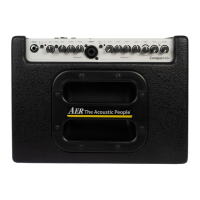
Tone controls
channel 1 colour at 700 Hz –3 dB
at 8 kHz +10 dB
bass at 100 Hz (shelf type) ± 8 dB
middle at 800 Hz ±6 dB
treble at 10 kHz (shelf type) ±8 dB
channel 2 bass at 100 Hz (shelf type) ±8 dB
treble at 10 kHz (shelf type) ±11 dB
Eects
Internal eect Digital eect processor
1 Reverb
2 Reverb with longer predelay
3 Delay (320 ms, repetitive)
4 Chorus
External eect Parallel eect loop, see send and return
eects pan Blends the eects (internal and external) bet-
ween channels 1 and 2, with reverse direction
of rotation for the external eects.
Power amp
Construction Monolithic IC with DMOS output
Rating Output power (THD = 1%) 60 W / 4 Ω
Continuous output power is determined by
the limiter, see limiter threshold.
General
Distortion THD + N (6 W / 4 Ω) < 0.1%
measured at loudspeaker terminals
Noise Residual noise (A-weighted),
referred to rated output power: –94 dB
Acoustical: approx. 17 dB (A) / 1 m
Signal / noise ratio: see input specs
Analog signal processing
Subsonic lter, adaptive peak limiter
Limiter
threshold 50 W / 4 Ω
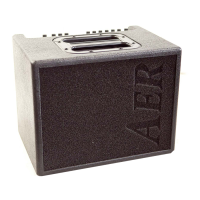
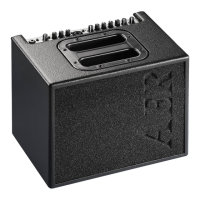
Speaker system 8” (200 mm) dual cone full-range speaker, bass-
reex enclosure
Power supply Mains voltage (depending on model):
100, 120, 220, 230, or 240 V~, 50–60 Hz
Power consumption: max. 120 W
Mains fuse Size 5 x 20 mm
Rating
for 220, 230, 240 V models: T 1A L 250V
for 100, 120 V models: T 2A L 250V
Operating temperature
Permissible ambient temperature 0…35 °C
Cabinet Birch plywood, thickness: 12 mm (0.47“)
Finish Waterbased acrylic, black spatter nish
Dimensions and weight
Dimensions Height 260 mm (10.20“)
Width 325 mm (12.8“)
Depth 240mm (9.45“)
Weight 7.1 kg (15.6 lbs)
NOTES
Options congurable by internal jumpers (refer modication
to qualied personnel):
Low-gain option (more headroom) for mic input
Deactivation of 48 V phantom power for mic input
DEFINITIONS
Rated conditions
• Nominal input voltage at input under test
• master fully clockwise
• high / low and colour o
• bass / middle / treble / pan centered
• eects level fully anticlockwise
• gain of unused inputs fully anticlockwise
• gain of input under test adjusted to nominal output voltage
at line out. (This condition corresponds by design to the rated
output power.)
Nominal input voltage: Standard condition for specications,
if not stated otherwise.
Minimum input voltage: Input voltage required for nominal out-
put with maximum gain and volume settings.
Maximum input voltage: Input voltage that does not cause
distortion more than rated THD+N, suitable control settings
provided.
Nominal output voltage or power refer to rated conditions.
THD + N: Total harmonic distortion + noise, with input voltage
reduced by 10 dB after setting up rated conditions.
Signal / noise ratio: Ratio of output voltage at rated conditions to
output noise voltage with input shorted.
Equivalent input noise voltage: Noise voltage at loudspeaker ter-
minals divided by gain of amplier. Input shorted after setting
up rated conditions.
Residual noise: Output noise with minimal gain and volume
settings.
Adaptive limiter: Adaptive with respect to power supply.
Maintains constant headroom regardless of power supply
uctuations.
General: Signal voltages are RMS values. Test signal sine 1 kHz
sine unless stated otherwise. Noise measured from 20 Hz to 20
kHz. Noise stated for a specic input implies that all other inputs
are not used. Sound pressure level (SPL) based on
loudspeaker specication by manufacturer.
Specications and appearance subject to change without notice.
TD20171212_en (Compact 60
/4)


 To Next Page