8
5.3 Footswitch
A standard double-footswitch (on-/o-switch)
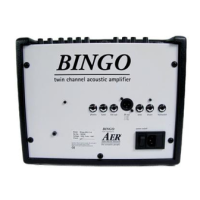
can be plugged into the footswitch-socket on the
rear side of the amplier via stereo cable. By this
footswitch the internal and external eects can be
switched on and o.
5.4 Phantom power
Microphones requiring 48V phantom power can be
connected to the XLR-socket of channel 2 directly.
Factory-provided phantom power is activated but,
if required, may be deactivated by an internal jum-
per.
In contrary 9V phantom power, if required, can ad-
ditionally be activated in channel 1 by an internal
jumper.
Please note: For both alterations the device must
be opened, therefore only qualied service per-
sonnel may carry out the modications concer-
ning the de-/activating of phantom power.
General Note: Use of 48V or 24V phantom power
(Phantom power = remote supply, here: powering
an audio device via the connected audio line)
Turn on the phantom power only if the unit connec-
ted to an XLR socket that is designed to handle it!
In general, suitable units are e.g. condenser micro-
phones, active DI-boxes and other special audio
devices, whose power supply is drawn from the
phantom power. Such devices are also labelled ac-
cordingly; please heed the permissible power con-
sumption (max.10mA).
High-quality dynamic microphones with a balanced
signal need no phantom power, but can handle it
anyway.
Other devices, which have not been designed expli-
citly for phantom power operation, can suer from
considerable malfunctions and damage may result
as well.
Examples of devices that may be damaged by in-
correct application of phantom power include:
Low-cost dynamic microphones with a mono jack-
plug (unbalanced signal) that were tted afterwards
with an XLR connector.
Audio devices with a balanced XLR output (e.g. DI-
boxes, eects devices, instrument preamps with
a DI output etc.) which are not protected against
phantom power applied to their XLR output. (The
DI connectors on AER products are protected
against applied phantom power.)
Other audio devices (such as preamps, eects pe-
dals etc.) whose unbalanced line output was repla-
ced by an XLR socket.
If in doubt please consult the manufacturer of the
device you are using.
5.2 Eects
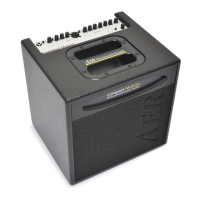
The CompactMobile2 has a built-in (internal) digi-
tal eects processor, with the select-switch you can
choose between 4 dierent eects:
1 = reverb 1 (short)
2 = reverb 2 (long)
3 = delay (320 ms)
4 = chorus
The efx-level-control determines the intensity of
the internal eects (left stop = no eect).
Furthermore an additional eects unit (external ef-
fect) may be connected to the CompactMobile
2.
For this purpose use the send and return sockets
on the rear side of the amplier (send goes to in-
put, return to the output of the external eects
device). The intensity of the eect is adjusted at the
external eects unit.
With the efx-pan control the dierent eects are
blended with the original signal. The efx-pan works
as follows:
left stop: internal eect on channel 1
external eect on channel 2
mid position: internal eects on channel 1 + 2
external eects on channel 1 + 2
right stop: internal eects on channel 2
external eects on channel 1
P.S. For questions or suggestions contact us:
tachauch@aer-amps.com


 To Next Page