24 22.05 4037360_01
— Handle the unit with care and without sudden movements;
— Do not stand under the unit during lifting;
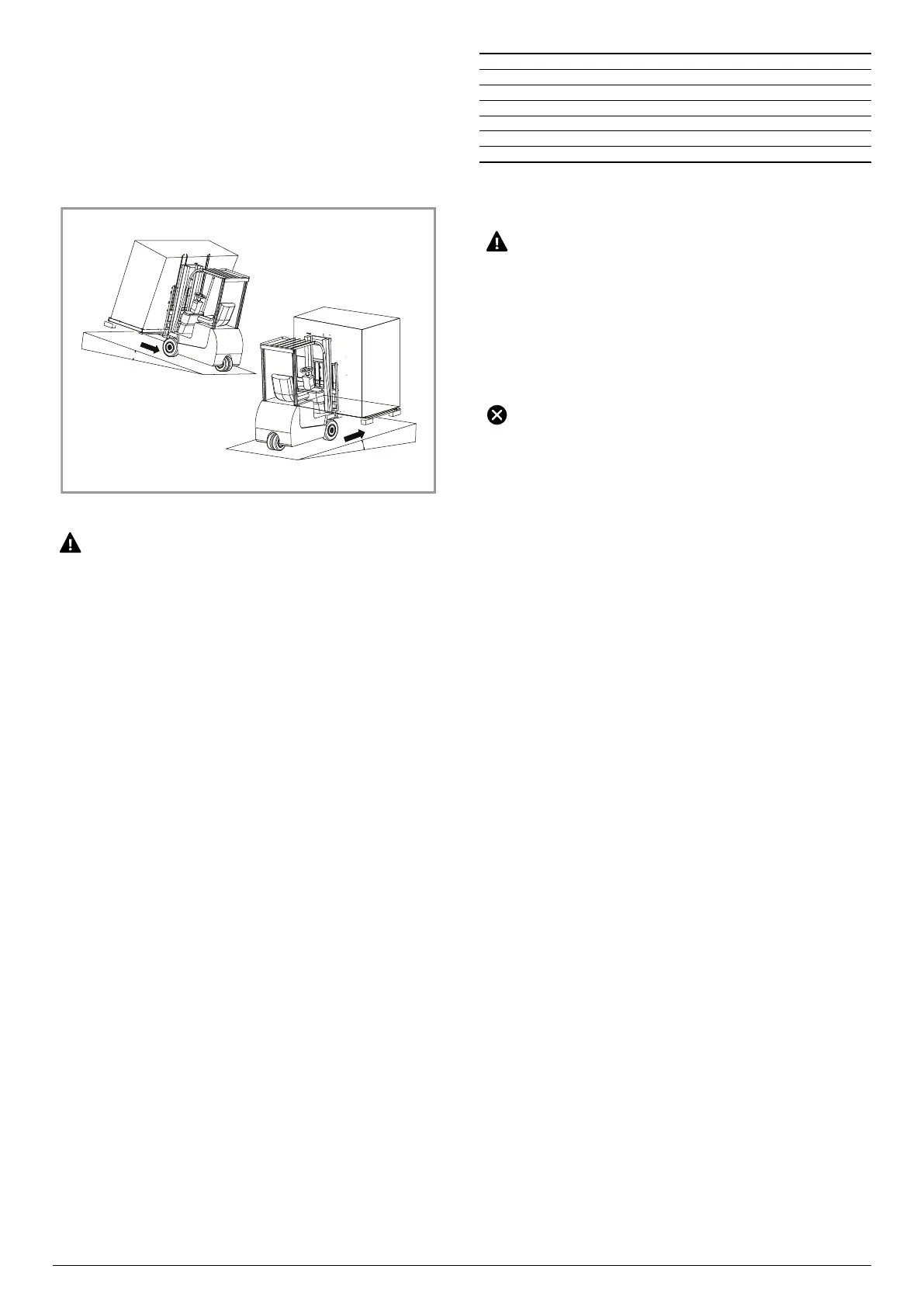
HANDLING WITH A FORKLIFT
The forks of the forklift must pass completely below the load. During descent, the
load must be lowered in reverse, with the pillar inclined to the rear, during ascent
the load must be lifted in forward gear, with the pillar inclined to the rear.
Handling with a forklift for sizes from 0280 to 0675
STORAGE
It is possible that the units may not be immediately installed upon receipt. If they
are stored for a medium-long period of time, the following procedures are recom-
mended:
— The units cannot be stacked;
— Check for any damage
— Make sure there is no water inside the hydraulic systems;
— Do not remove the protections from the heat exchanger;
— Do not remove the plastic protective lms;
— Make sure that the electrical panels are closed;
— Before using the equipment, put all the supplied items in a dry and clean loca-
tion so that they can be used in the future.
The minimum and maximum unit storage temperature depends on the
type of refrigerant used, see the table. Above this limit, there is a risk of
refrigerant leaks through the pressure relief valves.
Maximum storage temperature
Refrigerant Type Class Min temp. (°F) Max. temp. (°F)
R134a HFC A1 -4.0 °F < 122.0 °F
R410A HFC A1 -4.0 °F < 122.0 °F
R513A HFC A1 -4.0 °F < 122.0 °F
R32 HFC A2L -4.0 °F < 122.0 °F
R1234ze HFO A2L -4.0 °F < 122.0 °F
PLACE OF INSTALLATION
All units in this series are designed for indoor installation in machin-
ery rooms only, according to EN378. Attention: the ambient tempera-
ture inside the technical room where the unit is installed must not exceed
113.0 °F, otherwise ventilation systems must be installed.
The location of the unit must be dened by the system designer or a person who is
an expert in the material and must consider both the purely technical requirements
as well as any local laws in force.
For unit installation it is important to perform the following preliminary prepara-
tion tasks:
The following must be avoided
— Locations with aggressive atmospheres;
— Areas in which the unit's noise level could be amplied due to reverberations
or resonance;
POSITIONING
The units must:
— They must be installed in an area that cannot be accessed by the public and/or
be protected against access by unauthorised persons, if necessary also install
fences;
— Be positioned on a levelled surface that is able to support the weight of the
unit with the refrigerant load and complete water, in addition to the occasional
presence of maintenance equipment;
— Creating a support base that is independent from the main building is always
advisable to avoid the transmission of vibrations;
— It is recommended to place a rubber sheet between the oor and the equip-
ment or use suitably sized anti-vibration supports.
— The unit must be xed to the anti-vibration supports and these rmly xed
to the concrete base, see chapter weight distribution and minimum technical
spaces;
— Check that the contact surfaces of the anti-vibration supports are levelled at the
base. If necessary, use spacers or level the base, but in any case make sure that
the anti-vibration supports are placed at on the surfaces of the base;
— The use of anti-vibration supports MUST be done in combination with the in-
stallation of exible couplings in the unit's water pipes. The anti-vibration sup-
ports must be xed to the unit BEFORE being earthed. AERMEC is not responsi-
ble for selecting the capacity of the anti-vibration supports;
— Each side of the unit must have space to allow all routine and extraordinary
maintenance to be performed.
— During installation, check that atmospheric or environmental agents do not af-
fect or corrode the components of the cooling circuit, causing refrigerant leaks
into the environment. Where present, proceed with the appropriate measures
in compliance with the regulations in force.



 To Next Page