Need help?
Do you have a question about the AILE FC-BP131 and is the answer not in the manual?
Thank you for purchasing the blood pressure monitor and its basic function.
Explains the meaning of various warning and information symbols used in the manual.
Crucial safety guidelines and precautions for using the blood pressure monitor.
Defines the device's purpose, indications, contraindications, and target users.
Overview of the blood pressure monitor's body and display components.
Explains the various indicators and symbols shown on the blood pressure monitor's display.
Details about the arm cuff's size and proper usage.
Information about the power source and step-by-step guide for battery installation/removal.
Instructions for changing the measurement unit (kPa/mmHg) and selecting user profiles.
Guidelines for proper posture, cuff placement, and body relaxation during measurement.
Recommendations for the optimal environment for taking accurate blood pressure readings.
Advice on the importance of consistent timing for daily blood pressure measurements.
Initial step to begin a blood pressure measurement, showing display activation.
Describes the measurement process, including pressurization, heartbeat detection, and calculation.
Explains how results are shown after measurement, including irregular heartbeat indication.
How to manually turn off the device or its automatic shutdown feature.
Instructions to access and view the average of the last three measurements.
Steps to retrieve stored measurement readings from memory.
How to clear stored measurement data from the device's memory.
Explains the meaning and detection of the Irregular Heartbeat (IHB) symbol.
Basic explanation of how blood circulation relates to systolic and diastolic blood pressure.
Discusses hypertension, its causes, and the importance of regular monitoring.
Information on classifying blood pressure readings based on WHO guidelines.
Lists common symptoms and causes associated with high blood pressure.
Suggests lifestyle changes and medical consultation for managing high blood pressure.
Instructions on how to clean, disinfect, and maintain the blood pressure monitor.
Warning against self-repair and advice to contact distributors for defects and calibration.
Explains error symbols that may appear on the display and their corrections.
Detailed technical specifications of the blood pressure monitor, including ranges and accuracy.
Explains the device's intended use, applied parts, and compliance with medical standards.
Information regarding electromagnetic compatibility (EMC) standards and classifications.
Instructions for maintaining safety and essential performance concerning electromagnetic disturbances.
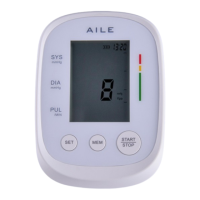
The AILE Upper Arm Electronic Blood Pressure Monitor, Model No.: FC-BP131, is a medical device designed for the non-invasive measurement of systolic and diastolic blood pressure and pulse rate in adult individuals. It utilizes the oscillometric method, detecting the movement of blood through the brachial artery and converting it into a digital reading. This method simplifies use as it does not require a stethoscope.
The device is intended for intermittent measurement of human body blood pressure from the upper arm. It features a large screen display for clear readings and offers both kPa and mmHg display switching and measurement functions.
A key feature is the WHO warning strip "■" symbol display function. As blood pressure values change, the "■" symbol will appear in a higher position on the display, indicating higher blood pressure levels according to WHO definitions.
The monitor includes a double memory lookup function, capable of storing 120 sets of measurement values for each of two users, totaling 240 records. This allows users to track their blood pressure status over time. The device can also calculate and display the average of the last three measurements, which is accessible by pressing the memory key.
For user convenience, the monitor incorporates several automatic functions:
The device also provides heartbeat prompting and measurement completed prompting functions, along with an incorrect prompting function to guide the user. An irregular heartbeat (IHB) symbol will be displayed if an irregular rhythm is detected two or more times during a measurement, defined as a rhythm more than 25% slower or faster than the average rhythm.
The monitor is designed for ease of use. To begin, ensure the air plug is properly inserted into the main unit. For accurate readings, remove all clothing from the upper arm so the cuff fits directly on the skin. Sit in a chair with feet flat on the floor, placing the arm on a table to level the cuff with the heart. The cuff should be wrapped tightly around the upper arm, with the hose running down the inside of the arm, approximately 0.8-1.2 inches (2-3cm) above the elbow. Ensure there is 1-2 fingers' space between the arm and cuff. Relax the arm with the palm upward and fingers naturally curved before starting a measurement.
To take a measurement, simply press the "START/STOP" button. All display symbols will appear, and the cuff will inflate automatically. The heartbeat symbol will flash when a pulse is detected, and the device will calculate the pulse. Once the measurement is complete, blood pressure and pulse rate will be displayed, and the cuff will deflate. The results are automatically stored in memory. The inflation or measurement can be stopped at any time by pressing the "START/STOP" button.
The memory function allows users to review past measurements. When the unit is off, pressing the "MEM" button will display the average of the last three measurements for the current user. Subsequent presses of the "MEM" button will cycle through the latest measurement values. The device supports two users, and the user can be switched by pressing the "SET" button when power off, and then pressing "SET" again. Memory records for a user can be deleted by long-pressing the "MEM" button in memory mode, then confirming with the "START/STOP" button.
The unit can be powered by 4 AAA alkaline batteries (not included) or via a USB Type C (DC5V1A) connection.
To ensure the longevity and accuracy of the blood pressure monitor, proper care and maintenance are essential:
The device is designed to be robust, but users should be aware of potential error indicators displayed on the screen, such as "Err" for inflation errors or a low battery symbol, which prompt corrective actions like re-wrapping the cuff or replacing batteries. Troubleshooting guidance is provided for common issues like no power or incorrect readings.
 General
| Model | FC-BP131 |
|---|---|
| Type | Upper Arm Blood Pressure Monitor |
| Measurement Method | Oscillometric |
| Power Supply | 4 x AA batteries or AC adapter |
| Display | LCD |
| Automatic Shut-off | Yes |
| Memory Capacity | 90 readings |
| Measurement Range (Pulse) | 40-199 beats/min |

 To Next Page