AIMS Power www.aimscorp.net
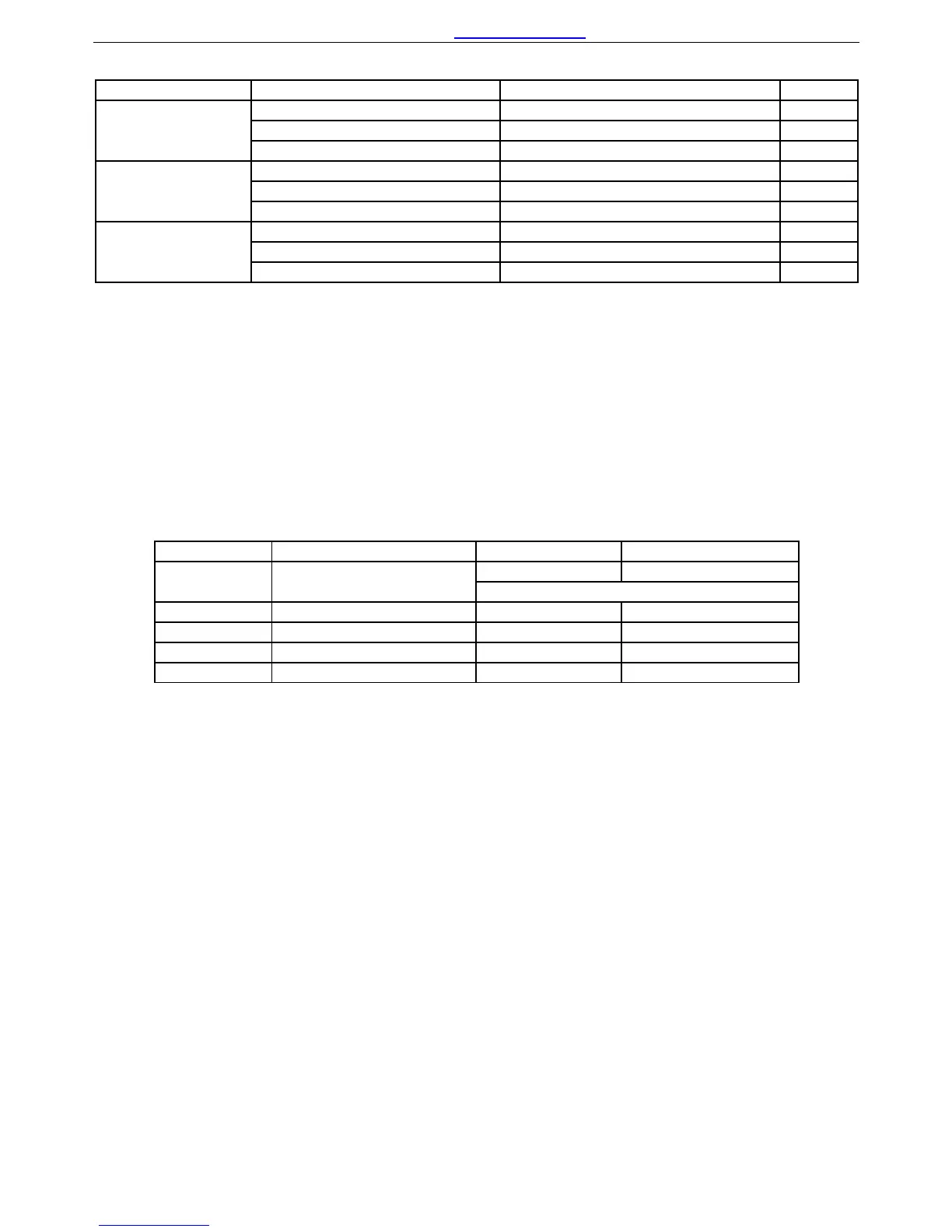
Condition Enter Condition Leave condition Speed
HEAT SINK
TEMPERATURE
T ≤ 60℃(140℉) T > 65℃(149℉) OFF
65℃(149℉)≤ T < 85 ℃(185 )℉ T ≤ 60℃(140℉) or T ≥ 85℃(185 )℉ 50%
T > 85℃(185 )℉ T ≤ 80℃(176 )℉ 100%
CHARGER
CURRENT
I ≤ 15% I ≥ 20% OFF
20%< I ≤ 50%Max I≤ 15% or I > 50%Max 50%
I > 50%Max I ≤ 40%Max 100%
LOAD Percentage
(INV MODE)
Load < 30% Load ≥ 30% OFF
30% ≤ Load < 50% Load ≤ 20% or Load ≥ 50% 50%
Load ≥ 50% Load ≤ 40% 100%
Allow at least 30CM of clearance around the inverter for air flow. Make sure that the air can circulate freely
around the unit.
Fan noise level <60db at a distance of 1m
2.5.11 DIP Switches
On the DC end of inverter, there are 4 DIP switches which enable users to customize the performance of the
device.
Switch NO Switch Function Position: 0 Position: 1
SW1 Low Battery Trip Volt 10.0VDC 10.5VDC
*2 for 24VDC, *4 for 48VDC
SW2(230V) AC Input Range 184-253VAC 154-264VAC(40Hz+)
SW2(120V) AC Input Range 100-135VAC 90-135VAC(40Hz+)
SW3 Load Sensing Cycle 30 seconds 3 seconds
SW4 Battery/AC Priority Utility Priority Battery Priority
Low Battery Trip Volt:
Deep discharge of the lead acid battery leads to high losses in capacity and early aging. In different
applications a different low voltage disconnection level is preferred. For example, for solar applications,
user may intend to have less DOD to prolong the battery life cycle. While for mobile applications users may
intend to have more DOD to reduce battery capacity and on board weight.
For 12VDC models, the Low Battery Trip Volt is set at 10.0VDC by default. It can be customized to
10.5VDC using SW1. This is to prevent batteries from over-discharging while there is only a small load
applied on the inverter.
*2 for 24VDC, *4 for 48VDC
AC Input Range:
There are different acceptable AC input ranges for different kinds of loads.
For some relatively sensitive electronic devices, a narrow input range of 184-253VAC (100-135V for
120VAC model) is required to protect them.
While for some resistive loads which work in a wide voltage range, the input AC range can be customized to
154-264VAC (90-135V for 120VAC model), this helps to power loads with the most AC input power
without frequent switches to the battery bank.
In order to make the inverter accept dirty power from a generator, when the SW2 is switched to position “1”,
the inverter will bypass an AC input with a wider voltage and frequency (40Hz plus for 50Hz/60Hz).
Accordingly, the AC charger will also work in a wider voltage and freq range (43Hz plus for 50Hz/60Hz).
15


 To Next Page