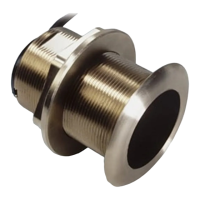
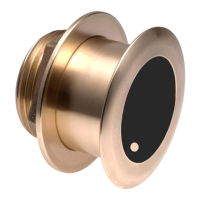
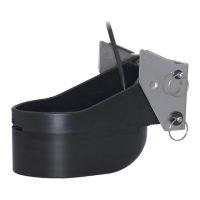
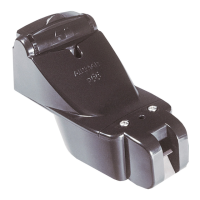
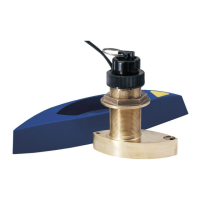
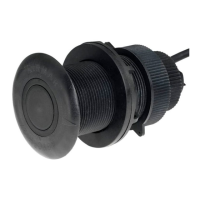
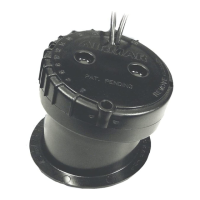
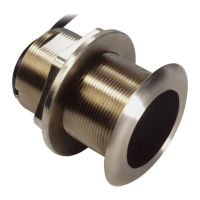
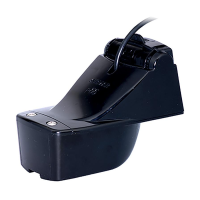
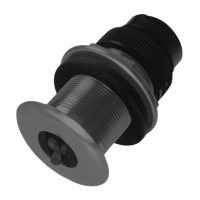
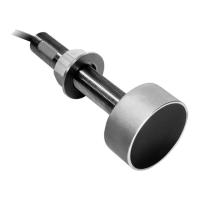
SS60, SS75L/M/H
isolation
bushing
hull
hull nut
washer
marine sealant on flange, side wall of housing,
and isolation bushing where it contacts the hull
housing
SS565
wrench
flat (2)
Stainless steel housing in a metal hull—To prevent electrolytic
corrosion, the stainless steel housing must be isolated from the
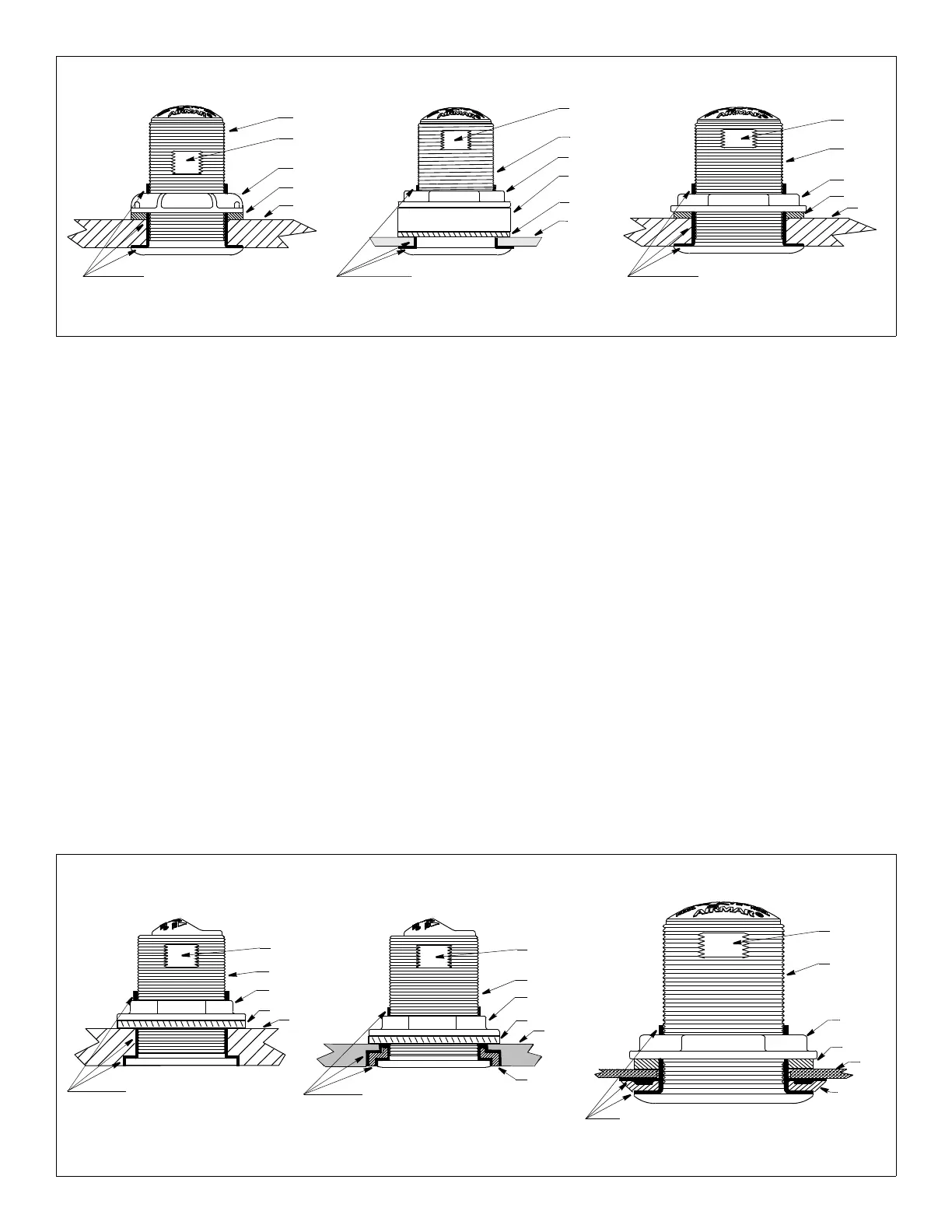
metal hull. Slide the isolation bushing onto the housing (Figure 5).
Apply additional marine sealant to the surfaces of the isolation
bushing that will contact the hull, filling any cavities in and around
the bushing.
Installing
1. From outside the hull, thread the cable through the mounting
hole. Push the housing into the mounting hole using a twisting
motion to squeeze out excess sealant.
12° and 20° models—From inside the hull, point the arrow on the
top of the transducer (and the cable exit) toward the KEEL or
centerline of the boat (Figure 1). This will align the angle of the
element inside the transducer with the deadrise angle of your hull.
2. From inside the hull, slide the washer onto the housing (Figure
4 or 5).
B117, B150M—Also slide the spacer onto the housing and rest
it against the washer. Do not use the spacer if there is insufficient
space to tighten the nut or it is within 11mm (1/2") of the top of
the housing.
Stainless steel housing in a metal hull—Be sure the washer
contacts the hull. Do not tighten the hull nut with the washer
against the isolation bushing, as the housing will not be firmly
installed. If necessary, sand the isolation bushing until the
washer rests against the hull.
3. Screw the hull nut in place.
Plastic housing—Do not clamp tightly on the wrench flats to
avoid possibly fracturing the housing.
Plastic hull nut—Hand-tighten only. Do not over tighten.
Metal hull nut—Tighten with slip-joint pliers.
Metal hull—Use the spacer if there are not enough threads to
tighten the hull nut against the hull.
Cored fiberglass hull—Do not over tighten, crushing the hull.
Wood hull—Allow the wood to swell before tightening the hull nut.
4. Remove any excess marine sealant on the outside of the hull to
ensure smooth water flow under the transducer.
Cable Routing & Connecting
CAUTION: If your transducer came with a connector, do not
remove it to ease cable routing. If the cable must be cut and
spliced, use Airmar’s splash-proof Junction Box No. 33-035 and
follow the instructions provided. Removing the waterproof
connector or cutting the cable, except when using a water-tight
junction box, will void the sensor warranty.
1. Route the cable to the instrument, being careful not to tear the
cable jacket when passing it through the bulkhead(s) and other
parts of the boat. Use grommets to prevent chaffing. To reduce
electrical interference, separate the transducer cable from other
electrical wiring and the engine. Coil any excess cable and
secure it in place using cable ties to prevent damage.
2. Refer to the echosounder owner’s manual to connect the
transducer to the instrument.
Figure 4. Bedding and installing in solid fiberglass or wood hull
washer
hull
P19
housing
hull nut
marine sealant on flange
B60, B75L/M/H/HW, SS60, SS75L/M/H
marine sealant on flange
wrench
3
flat (2)
housing
hull nut
wrench
flat (2)
isolation
Copyright © 2006 - 2022 Airmar Technology Corp.
B117, B150M
housing
hull nut
spacer
washer
hull
marine sealant on flange
and sidewall of housing
and sidewall of housing and sidewall of housing
SS565
solid fiberglass or wood hull
marine sealant on flange
and sidewall of housing
washer
housing
hull nut
wrench
flat (2)
bushing
Figure 5. Bedding and installing a stainless steel housing
Copyright © 2006 - 2017 Airmar Technology Corp.
washer
hull
housing
hull nut
wrench
flat (2)
wrench
flat (2)
metal hull metal hull
hull
hull
washer
marine sealant on flange,
and isolation bushing
sidewall of housing,
where it contacts the hull


 To Next Page
 Loading...