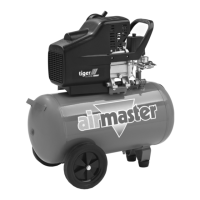
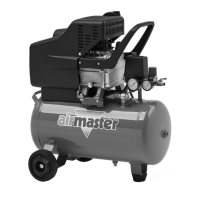
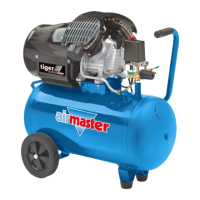
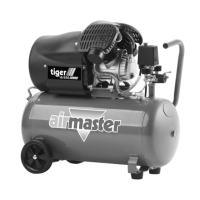
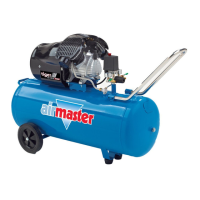
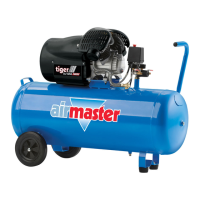
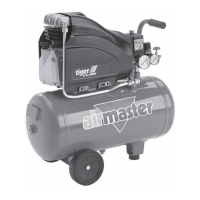
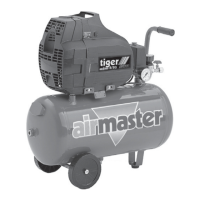
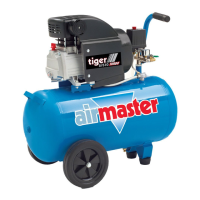
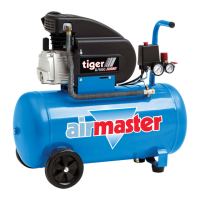
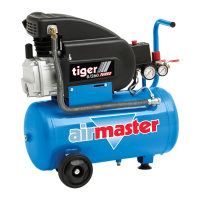
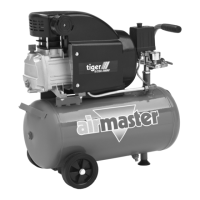
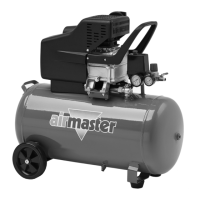
The Airmaster Tiger 11/550 is a 50L air compressor designed for a range of applications, from DIY to professional use. It is an oil-lubricated compressor, requiring regular oil level checks and changes to ensure optimal performance and longevity.
Function Description:
The primary function of the Airmaster Tiger 11/550 is to compress ambient air and store it in its 50-liter receiver tank, making it available for various pneumatic tools and applications. The compressor operates by drawing in air, compressing it using a piston-driven pump, and then delivering it to the tank. Once the tank reaches a pre-set pressure, the compressor automatically stops. It will restart when the pressure in the tank drops below a certain threshold, maintaining a consistent supply of compressed air.
The compressor features two 1/4" BSP outlet valves, allowing for the connection of multiple air tools. A pressure regulator enables users to adjust the output pressure to suit the specific requirements of the connected tools, while two pressure gauges display both the tank pressure and the user-set output pressure. A safety valve is incorporated to prevent over-pressurization of the tank, automatically releasing air if the pressure exceeds a safe limit. For user safety, the compressor is equipped with a thermal overload device that cuts power to the motor if it overheats, preventing damage.
Important Technical Specifications:
- Model No: Tiger 11/550
- Part No: 1499505
- Max Pressure: 8 Bar
- Voltage: 230 VAC (50Hz)
- Air Displacement: 9.3 CFM (Cubic Feet per Minute)
- Receiver Capacity: 50 Liters
- Fuse Rating: 13 A
- Dimensions (L x W x H): 740 x 330 x 650 mm
- Guaranteed Sound Power Level: 97 dB(A)
- Weight: 31 kg
Usage Features:
The Airmaster Tiger 11/550 is designed for ease of use with several practical features:
- Portability: Equipped with wheels and a handle, the compressor can be moved, though it is heavy and requires two people for safe lifting.
- ON/OFF Switch: A simple push-down button turns the compressor off, and lifting it turns it on.
- Pressure Regulation: An adjustable pressure regulator allows users to precisely control the output air pressure for different tools and tasks. Turning clockwise increases pressure, while counter-clockwise decreases it.
- Pressure Gauges: Separate gauges for tank pressure and output pressure provide clear readings, helping users monitor the air supply.
- Air Tool Compatibility: The compressor is compatible with a wide range of air tools, provided they have a safe working pressure exceeding that of the compressor and are connected via a 1/4" BSP outlet valve.
- Safety Valve: A crucial safety feature that automatically releases excess pressure, preventing dangerous over-pressurization of the tank. Users are instructed to periodically check its functionality.
- Thermal Overload Device: Protects the motor from damage due to overheating by automatically cutting power. A reset button allows for quick restart once the motor has cooled.
- Oil Breather Cap: Replaces a travel plug during initial setup, ensuring proper ventilation for the crankcase.
Maintenance Features:
Regular maintenance is essential for the longevity and safe operation of the Airmaster Tiger 11/550. The manual outlines several key maintenance tasks:
- Oil Level Check (Daily): Users must ensure the oil level is halfway up the oil sight glass. If low, SAE30 compressor oil should be added to the crankcase, taking care not to overfill.
- Oil Change (Periodically): The oil needs to be changed by unscrewing the oil drain plug, collecting the old oil in a vessel, and then refitting the plug. Proper disposal of old oil is emphasized.
- Drain the Tank (Daily): Condensate (moisture) collects in the tank and must be drained after each day's use and before storage. This involves turning off the compressor, disconnecting it from the power supply, slowly opening an outlet valve to depressurize the tank, and then opening the drain valve at the bottom of the tank to release the water.
- Clean the Air Filter (Monthly): The air filter should be examined monthly, or more frequently in dusty environments. This involves removing the filter cover and sponge filter, cleaning them with a soft brush or warm soapy water, rinsing, drying, and then refitting. A damaged filter must be replaced.
- Check the Non-Return Valve (Every 6 Months): If the tank pressure drops without apparent reason, the non-return valve may be leaking. Users are instructed to check this valve and replace the gasket and valve if necessary.
- Electrical Safety: Before any maintenance or adjustment, the compressor must be disconnected from the electrical supply. Repairs should only be carried out by a qualified engineer.
The compressor also comes with clear safety symbols, including warnings for hot surfaces, the necessity of wearing safety goggles and ear protection, and the importance of reading the instruction booklet. Electrical connections are detailed, emphasizing the correct wiring for a 13 amp BS 1363 plug and recommending connection through a Residual Current Device (RCD) for enhanced safety.


 To Next Page
 General