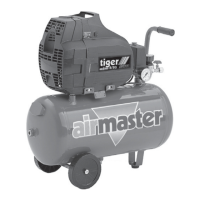
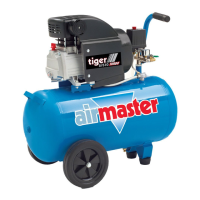
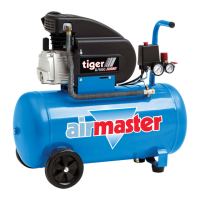
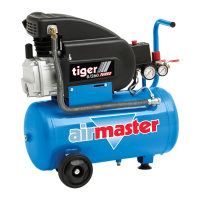
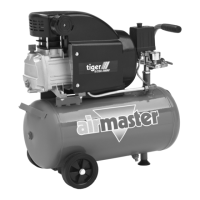
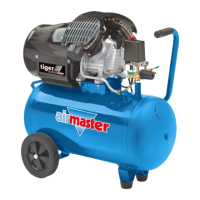
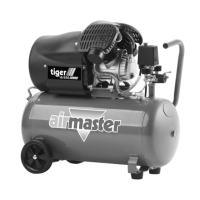
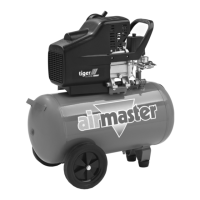
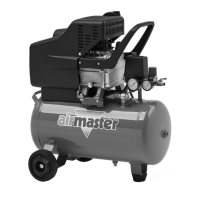
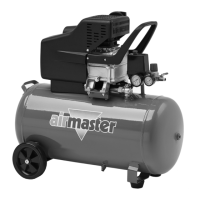
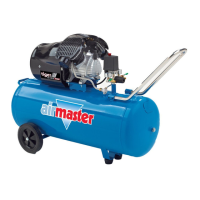
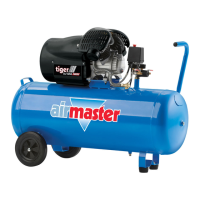
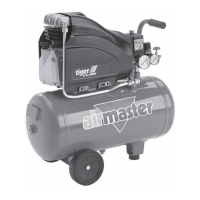
The document describes the Airmaster TIGER 8/44 Air Compressor, a portable air compressor designed for various applications.
Function Description:
The Airmaster TIGER 8/44 is an air compressor that takes in ambient air, compresses it, and stores it in a 24-litre receiver tank. This compressed air can then be used to power various air tools and attachments. The compressor is designed for both DIY and professional use, providing a reliable source of compressed air. It features an automatic shut-off when the tank reaches maximum pressure and restarts when the pressure drops, ensuring consistent air supply.
Important Technical Specifications:
- Electrical Supply: 230 V, 1 Phase 50Hz
- Max. Operating Pressure: 8 bar (116 lbf/in²)
- Motor Rating: 2 HP
- Air Displacement: 7.8 cuft/min (185 l/m)
- Air Receiver: 24 litre
- Net Weight: 21kg
- Dimensions (L x W x H): 585 x 285 x 595 mm
- Duty Cycle: 20% (The machine may not be run for more than 2 minutes in any 10-minute period)
- Part No.: 2225325
- Sound Level: 94 dBLWA (Measured), 95 dBLWA (Guaranteed)
- Operating Temperature Range: 0°C to 25°C
Usage Features:
The compressor is designed for ease of use and safety.
- Assembly: It requires minimal assembly, primarily attaching the transportation wheels and the rubber foot.
- Portability: Equipped with transportation wheels and a handle, it can be easily moved. Users are advised to use the handle and seek assistance due to its weight (21 kg).
- Placement: The compressor should be positioned on a stable, flat surface with a maximum inclination of 15 degrees, ensuring good all-round ventilation and at least 50cm from any obstacles.
- On/Off Switch: A red button serves as the On/Off switch. Lifting it turns the compressor ON, and pressing it down turns it OFF.
- Automatic Operation: The compressor automatically charges the main tank to 8 bar (116 psi) and switches off. It restarts automatically when the pressure falls below approximately 6 bar (87 psi).
- Pressure Regulation: An output pressure regulator allows users to adjust the working pressure for different air tools. A locking ring secures the chosen pressure setting. It is crucial never to exceed the rated pressure of the attached tools.
- Safety Valve: A safety valve is incorporated to release excess pressure. Users are instructed to check its operation daily by pulling the ring; air should be released and stop when the ring is released. It is explicitly stated not to remove or adjust the safety valve.
- Thermal Overload Device: The compressor includes a thermal overload cutout that automatically cuts power if the motor overheats, protecting it from damage. A reset button allows restarting after the motor cools down (approximately 5 minutes).
- Air Tool Connection: Air tools are connected via an air outlet tap. Before connecting any tool, users must read the tool's instructions and ensure compatibility with the compressor and hose specifications. The pressure regulator must be used to adjust output pressure if the tool's rating is less than 8 bar.
- Draining the Reservoir: After use and before storage, the reservoir must be drained of condensate by opening the drain valve. This is a critical step for maintenance and safety.
- Safety Precautions: The manual emphasizes numerous safety precautions, including wearing eye and ear protection, avoiding contact with hot or moving parts, ensuring adequate ventilation, not operating in damp conditions or near flammable substances, and disconnecting from the mains before maintenance. It also warns against inhaling compressed air and directing the air stream at people or animals.
Maintenance Features:
Regular maintenance is crucial for the compressor's longevity and safe operation.
- Daily Maintenance:
- Check Oil: Ensure the oil level is between the min and max marks on the dipstick. Top up with Clarke SAE40 compressor oil if necessary.
- Drain the Tank: After each use, open the drain valve to remove any condensed liquid.
- Monthly Maintenance:
- Clean Air Intake Filter: Inspect the air intake filter (sponge element) monthly, or more often in dusty conditions. Clean the sponge and inner housing with a soft brush. The sponge filter can be gently washed in warm soapy water, rinsed, and thoroughly dried before refitting.
- Every Six Months Maintenance:
- Tighten Bolts: Ensure all bolts are securely tightened.
- Clean External Parts: Clean all external parts of the compressor.
- Oil Replacement: Replace the oil completely after the first 100 hours of use, and then every 500 hours of operation or every 6 months. To empty the oil, remove the oil drain plug from the crankcase cover.
- Non-Return Valve Inspection: Examine the non-return valve and replace the gasket and valve if necessary.
The manual also includes a troubleshooting guide for common issues like the compressor not starting, not reaching set pressure, air leaks, or unusual noise, advising users to contact Machine Mart for repairs if necessary. It explicitly states that users should not attempt repairs or adjustments if uncertain.


 To Next Page
 General