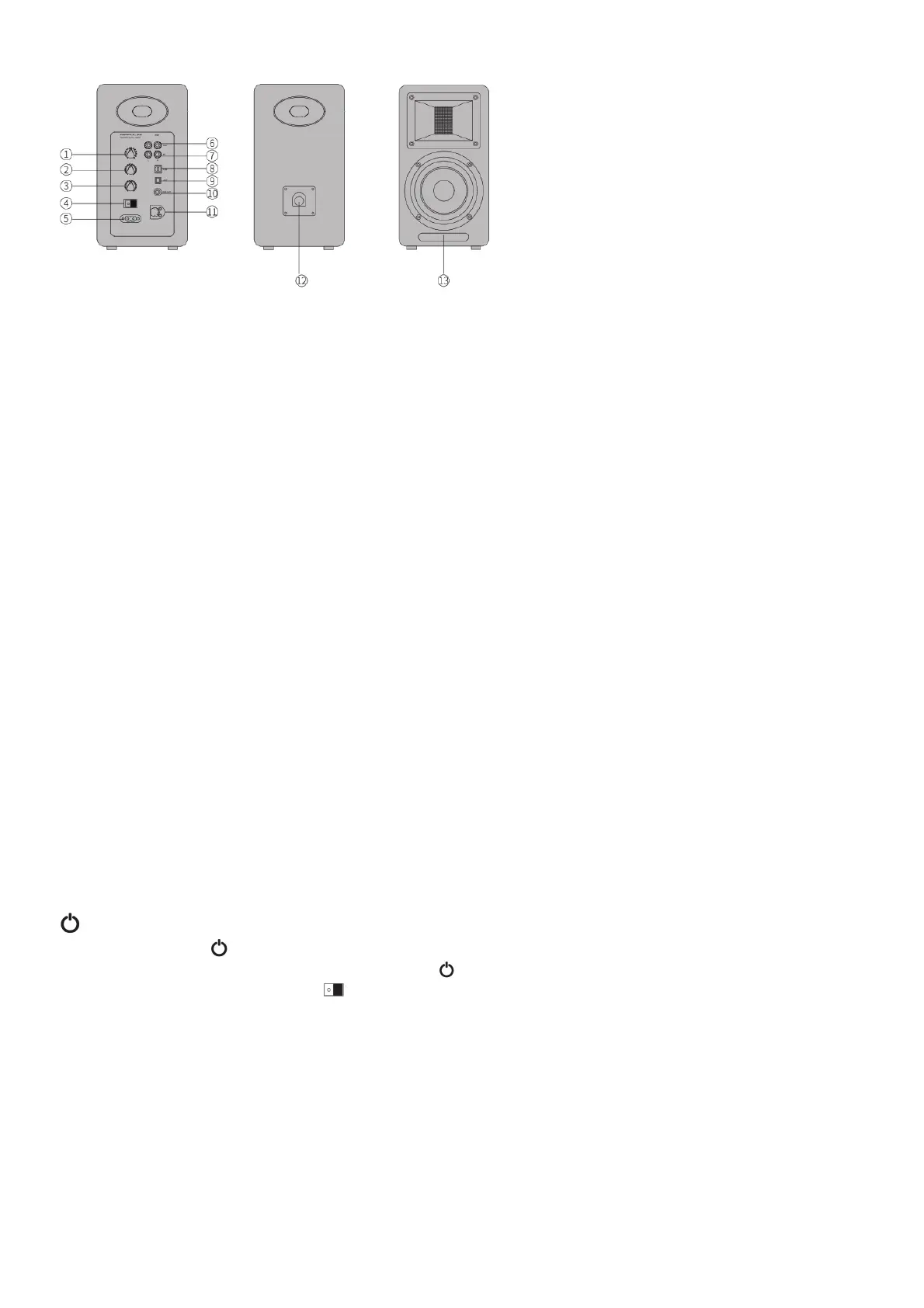
Speaker Illustration
1. Volume control/input selection
Volume control
Rotate clockwise to increase volume; rotate counter clockwise to reduce volume. When reaching maximum volume level, continue to rotate volume control
will not change volume.
Input selection
Press to switch between PC–AUX–USB–Optical–Bluetooth modes. (As DSP will be reconfigured when input mode is switched, it is recommended to press
after the current mode indicator flashes once.)
Standby control
Press and hold to alternate between Power on and Stand by mode.
2. Bass level adjustment
Room acoustics may dictate which type of adjustment you need to make to retain the proper frequency response from the speaker. Turn from “0” to left to
reduce low frequencies; Turn from “0” to right to increase low frequencies.
3. Treble level adjustment
Room acoustics may dictate which type of adjustment you need to make to retain the proper frequency response from the speaker. Turn from “0” to left to
reduce high frequencies; Turn from “0” to right to increase high frequencies.
4. Power switch
Turn on/off speaker power.
5. AC input socket
Connect to plug of power cord.
6. Auxiliary input port
Connect to audio source devices with RCA output port using RCA audio cable.
7. PC input port
Connect to PC using 3.5mm to RCA audio cable, or connect to audio source devices with RCA output port using RCA audio cable.
8. USB B type port
Connect to audio source devices with USB output port using USB connecting cable.
9. Optical input port
Connect to audio source devices with optical output port using fiber optic input audio cable.
10. Subwoofer output port
Connect to audio input port of subwoofer using RCA audio cable.
11. Passive speaker connector
Connect to passive speaker using speaker connecting cable.
12. Active speaker connector
Connect to active speaker using speaker connecting cable.
13. LED indicator/remote control receiving window
Indicates current input mode based on audio sources and input selection.
Remote Control Illustration
①Infrared emission window
② Standby button
When powered on, press the “ ” button to let the speaker enter standby mode. Displayed value of remote control receiving window on the active speaker
will disappear but internal power is still being connected. Re-press the “ ” button or press the “VOLUME/INPUT” knob on the rear panel of the active
speaker to power on the speaker again. Press the “ ” button on the rear panel to turn on/off the main power.



 To Next Page