Maintenance
8-8 2021 Classic
Refer to the following table for wheel specications.
Wheel Specications
Size/Center Size
In Inches
Lug Pattern Model
16 x 6 / 5.5 6 All
All wheels have zero offset.
Updating TPMS Monitor and CZone©
Any time you physically move a tire to a different
position, such as changing or rotating tires, you will
also need to move the sensor conguration on the
monitor and CZone.
Updating TPMS Monitor
• Press “SET” button until the display beeps and then
release.
• Press and release the (+) button 7 times until Tire
appears. Press “SET”.
• Use the (+) or (-) buttons to select the tire sensor
code you want to swap.
• Press “SET” and then select the tire you want to
swap the code to using the (+) or (-) buttons.
• Push “SET” to move the sensor code to the new tire.
• Push the back button twice to get into the Main
Screen�
Updating CZone©
• Locate the TST Gateway transmitter wired to
C-Zone backbone. In the 30’ Classic it is located
in compartment below wardrobe closet. In the 33’
Classic it is located by removing drawer below the
convection oven�
• On the TPMS display screen, press and hold the
“Go” button for approximately 3 seconds until screen
changes to “ACC EPT”.
• Then press the “+” button 5 times until “SEnd” is
displayed.
• Bring TPMS display over to the Gateway. Press
the button on the Gateway (this is the button that
is actually a red blinking light) 5 times rapidly. The
Gateway will then “beep.”
• Place the TPMS display close to the Gateway and
press “Set” button once quickly.
Lug Nut Torquing
Trailer wheels must carry much higher loads per wheel
than passenger car or truck wheels. Each wheel may
carry 1000 pounds and higher. Furthermore, wheels on
tandem axle trailers do not steer, and are subjected to
very high side load stress whenever the trailer makes
a tight turn. When going around corners, especially on
slow, tight turns, the wheels are subject to very strong
side loads. This tends to ex the wheel and gradually
loosen the wheel nuts. Although the materials and
manufacturing methods are maximized for this kind of
service, these extra loads can cause stress, which can
result in exing and loosening of wheel nuts.
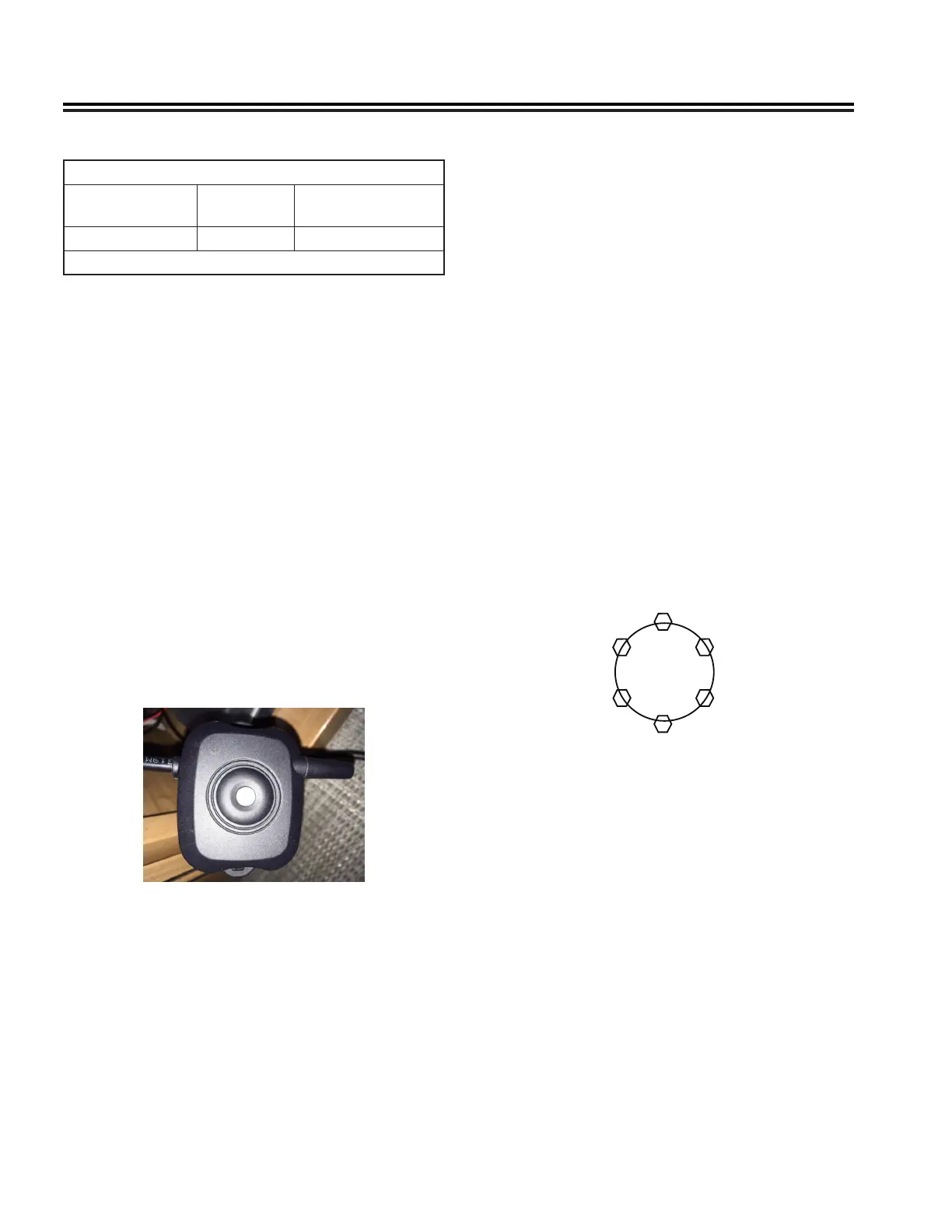
Before each trip and any time a wheel is replaced, be
sure to tighten the wheel nuts, following the lug-pattern
sequence shown below. If the wheel was replaced,
check the torque every 10, 25, and 50 miles.
1
2
3
4
6
5
If you notice wheel wobbling, or hear a rattling sound
coming from a wheel, especially at low speeds, a
wheel lug nut may have come loose. This problem is
usually caused by improper tightening, or by faulty or
damaged lug bolt threads.
If suspicious of a loose lug nut, safely stop vehicle as
soon as possible. Put up warning devices. Remove the
lug caps and check the tightness of all the lug nuts.
Tighten all lug nuts to the specied torque, using a
torque wrench. If stud threads are damaged or faulty,
get professional service help.
NOTE
Use a torque wrench to tighten lug nuts.
Tightening by hand or with an impact wrench is not
recommended. Torque Aluminum Wheels to 110 ft.
lbs and Steel Wheels to 100 ft. lbs.











 To Next Page