12
2.6.3 Travelling using the Esprit wheels in motorised mode
The wheels of the Esprit must be engaged for motorised operation.
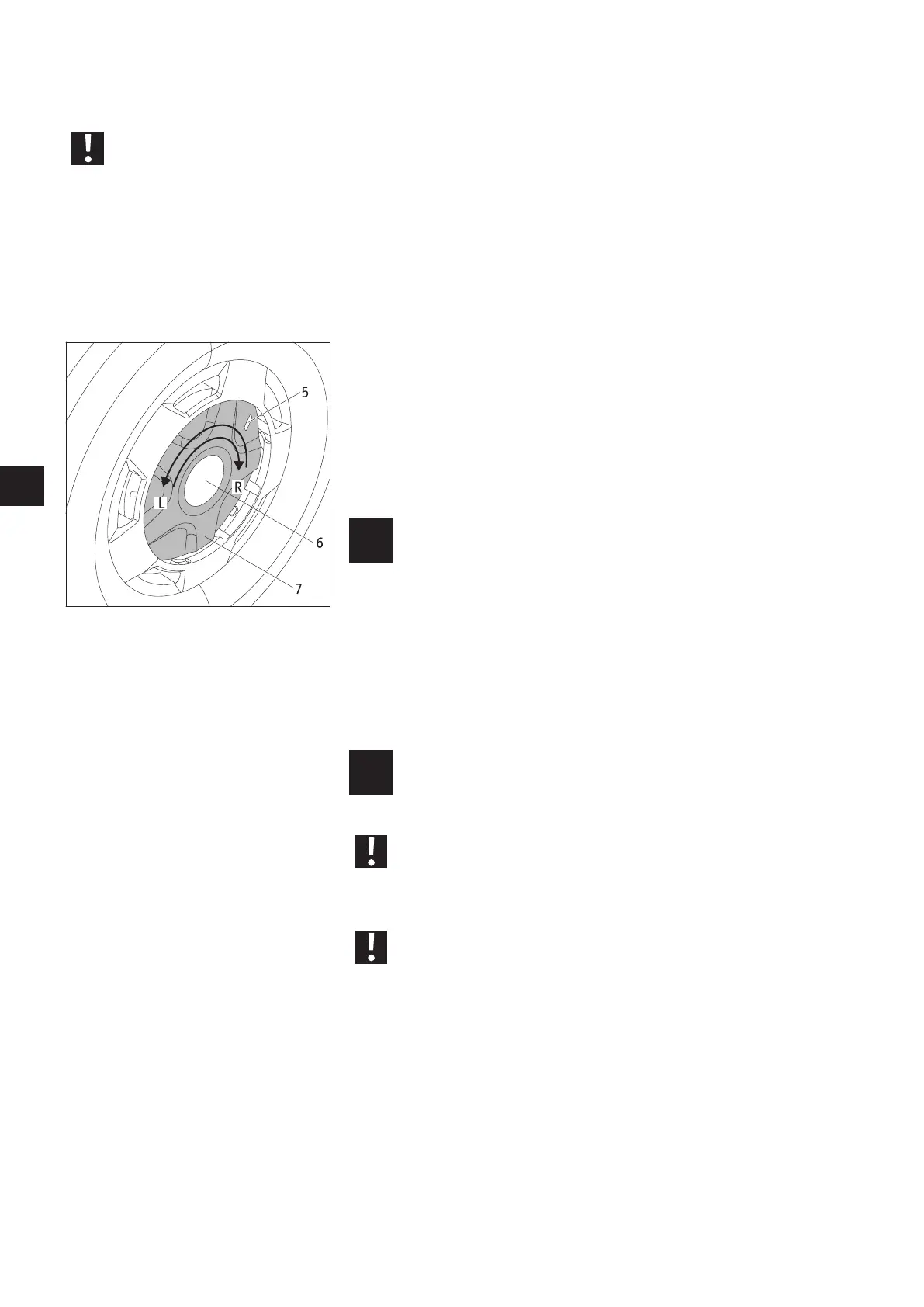
• Turn the coupling ring [7] on the left-hand wheel towards the front (L), turn the
right-hand wheel towards the rear (R) to the stop; the release mechanism [6] must
not, under any circumstances, be pressed in the process. A green mark is now vis-
ible in the viewing panel [5].
• Switch on the system (see chapter 5.2.1). The Esprit is now again ready for motorised
operation.
When travelling downhill, power is fed back into the battery pack
from the drive wheels to increase the range. If you are travelling
downhill with a fully charged or almost fully charged battery pack
and the battery pack cannot take up any more power, this is indic-
ated by a warning in the control unit display (see table in chapter
6). If power continues to be fed into the battery pack, the elec-
tronic system automatically reduces the speed by 50 percent.
If power consumption increases (if, for example you are travelling
on level ground or uphill), the Esprit can accelerate to the selected
maximum speed.
As soon as the charging process has finished, this behaviour can
also occur for a short time when travelling on level ground.
The Esprit cannot be pushed manually in motorised operation.
The Esprit must only be used at temperatures between -25 °C and
+50 °C. Therefore, do not expose the Esprit to any heat sources
(such as intense sunlight) as this may cause surfaces to reach high
temperatures.
When not in use, do not expose the Esprit to strong sunlight for
long periods of time. This could cause the motor to heat up and, in
extreme cases, prevent it from operating at full power. Plastic parts
also age quicker under intense sunlight.
2.6.4 Range
For every Esprit user, the range of the system is one of the areas of greatest interest. In
general, it is possible to say that this is roughly 15 km. These are ideal values and relate
to flat, paved terrain. Deviations may occur due to topographical conditions, the ambient
temperature, the road surface, the tyre pressure of the front wheels, the frame geometry,
the weight of the wheelchair, the weight of the user and the size of the wheels (14 inch).
For reasons of safety, the drive wheels must only be disengaged from motorised mode and set to push mode
while stationary and on a flat surface. The drive wheel must be load-free when being disengaged. To do so,
switch off the Esprit at the control unit. Actuating the clutch with a load or while travelling can damage the
internal mechanics and is therefore not covered by the warranty.
Disengaging on an incline can lead to a dangerous situation as the Esprit either switches directly or subsequently
to freewheeling mode and, in the worst case, could therefore start moving in an uncontrolled manner, i.e. it could
rotate and/or roll downhill. Disengagement should only be performed on an incline in case of emergency and
only if an accompanying person is present and capable of securing the wheelchair manually.


 To Next Page