150
170
Concrete wall or roof 50 100 120
Brick wall or roof 30 100 120
Table 2: Insulation thickness for the part of the system that passes through wall or roof
First of all, it is necessary to provide PERFECT CIRCULATION of air (draught) in the flue pipe which must be free of
any obstacles such as narrowing or angles. Any shifts of the axis must have one path inclined with a maximum angle
of 45 degrees from the vertical, and the best solution is 30 degrees. These shifts should be best performed near the
wind resistant top of the chimney.
In accordance with regulations (the wind resistant top of the chimney, distances and stove placing), the
distances shown in Table 3 must be met:
Roof
inclination
Distance between the roof ridge cover and the
chimney
Minimum height of the chimney measured at
the upper opening (at the chimney outlet)
α Distance in meters Height in meters
15
0
More than 1.85 m
0.50 above the roof ridge cover
1.00 meter from roof pitch
30
0
Less than 1.50 m
More than 1.50 m
0.50 above the roof ridge cover
1.30 meters from the roof pitch
45
0
Less than 1.30 m
More than1.30 m
0.50 above the roof ridge cover
2.00 meters from the roof pitch
60
0
Less than 1.20 m
More than 1.20 m
0.50 above the roof ridge cover
2.60 meters from the roof pitch
Table 3
However, it is obligatory to provide an initial vertical extension (elongation) of 1.5 m (minimum) in order to
provide a proper smoke discharge.
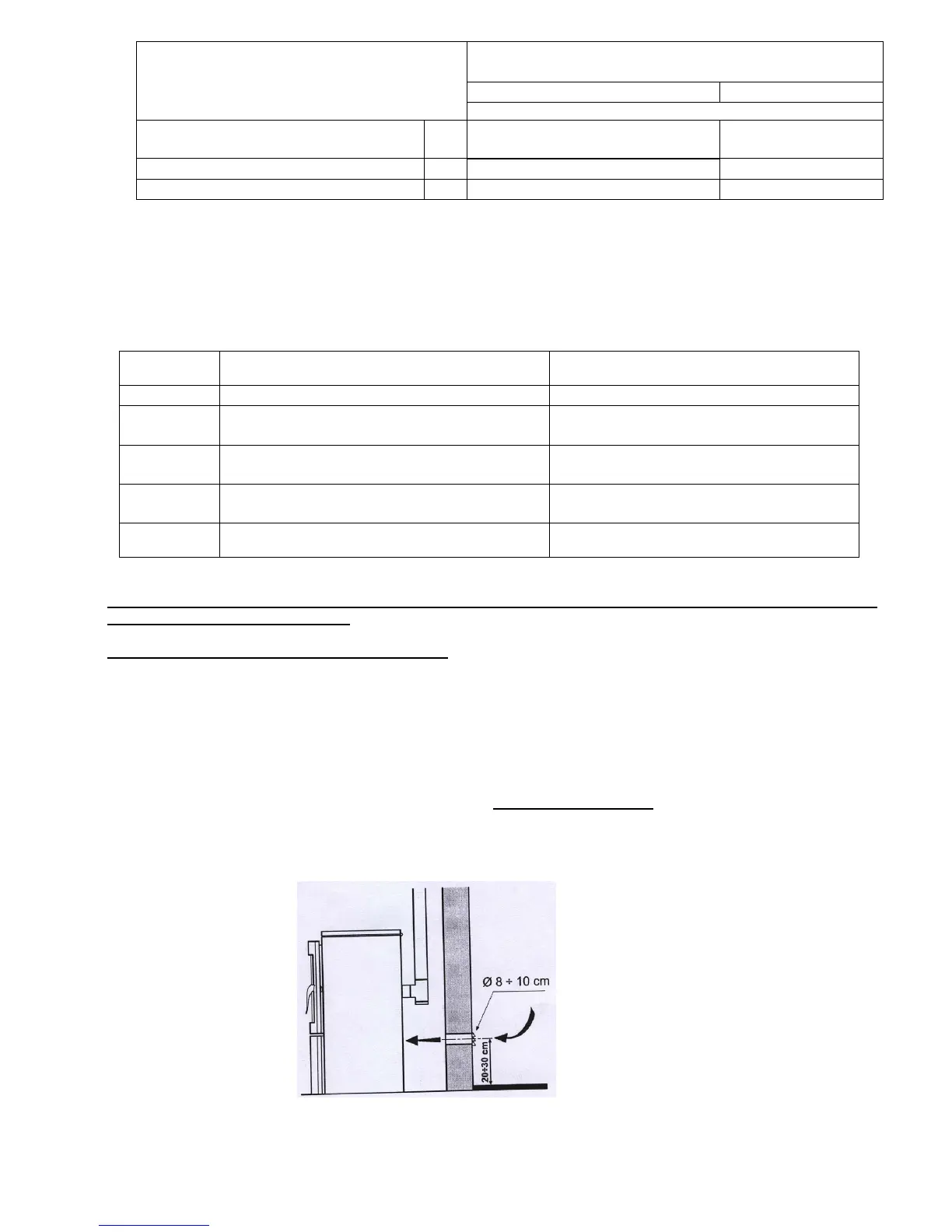
3.4 THE INTAKE OF COMBUSTION AIR (Figure 8)
The air necessary for combustion, taken from the surroundings, must be regenerated through a ventilation grid located
on the wall of the room and turned outwards. This will provide a better combustion and a lower consumption of biofuel
pellets. It is not recommendable that external air is sucked directly through the pipe, because it would decrease the
efficiency i.e. performance of combustion. On its external side, the ventilation opening must be equipped with a
ventilation grid as protection against rain, wind and insects.
This opening must be made on the external wall of the room in which the stove is located.
The intake, i.e. supply of combustion air from garages, warehouses for combustible materials or fire hazard
rooms, is prohibited.
The hole, i.e. opening for external input combustion air must not be connected with the use of pipes.
If the room also has any other heating equipment, the intake of combustion air must provide the amount of air
necessary for the proper operation of all the devices.
Figure 8. Minimum distances for the installation of the ventilation grid


 To Next Page