Need help?
Do you have a question about the Alinco DR-MD520T and is the answer not in the manual?
Operator awareness of transceiver hazards.
Avoiding interference with nearby radio stations.
Antenna system dependency and external antenna requirement.
Safety precautions during thunderstorms.
Warning against water, dust, and explosive environments.
Internal GPS receiver for T(FCC) and E(CE) models.
ALINCO, Inc. Electronics Division address.
Dealer programming and technical assistance.
FCC Warning regarding RF energy and modifications.
Equipment tested for Class B digital device limits.
Transceiver generates RF EME, potential thermal effects.
FCC OET Bulletin 65, ANSI standards for RF exposure.
Guidelines for operating transceiver safely regarding RF exposure.
Potential interference from RF energy.
Use in situations where users are aware of RF hazards.
Explains danger, alert, caution, warning, and instruction symbols.
Warnings about proximity to devices, children, liquids, prohibited areas, and travel.
Manufacturer liability for product failure and accessory use.
Precautions for headset use, opening unit, wet conditions, conductive materials, and heatsinks.
Guidelines for safe power supply connection and usage.
Actions to take in case of strange sounds, damage, or liquid penetration.
Do not open unit, consult dealer for service.
Precautions for proximity to TV/radio, humid/dusty places, unstable positions, heat sources, and batteries.
Connecting specified devices, power source removal, and cleaning.
Using reliable power supplies and ensuring proper connections.
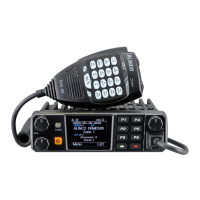
Lists items found in the package.
Notes on accessory variations, dealer responsibility, and antenna requirements.
Instructions for mounting the transceiver in a vehicle.
Connecting the DC power cable in a vehicle.
Requirement for a separate 13.8V DC power supply.
Connecting to a regulated DC power supply.
Procedures and considerations for replacing fuses.
Importance of antenna installation and impedance matching.
Connecting the speaker microphone.
Connecting external speakers for single or dual use.
Identification and function of front panel controls and indicators.
Identification and function of rear panel connectors and components.
Assigning functions to programmable keys (P1-P6, PA-PD).
Details on programmed key functions (GPS Info, Monitor, etc.).
Setting up hot keys via radio menu or PC software.
Using MENU key with number keys for programmed functions.
Detailed description of speaker mic keys and indicators.
Procedure to reset transceiver to factory default settings.
How to send DTMF signals using the microphone.
Switching between main and sub bands.
Procedure for powering on the transceiver.
Procedure for powering off the transceiver.
Adjusting audio levels for channels A and B.
Switching between main and sub channels.
Switching between VFO and channel modes.
Setting VFO frequency using keyboard or channel selector.
Selecting channels by switch or keyboard input.
How the radio indicates reception.
Steps for transmitting using the PTT key.
Creating and saving new channels.
Deleting the current channel.
Digital mode call reception and response.
Procedures for making digital calls.
Monitoring weak signals or signals with unmatched IDs.
Activating the emergency alarm function.
Accessing private call features via contact list or manual dial.
Configuring advanced features for private calls.
Sending call alerts and receiving status messages.
Remotely monitoring radio activity.
Sending GPS position to another radio.
Checking radio availability and status.
Remotely disabling the radio.
Remotely reactivating a disabled radio.
Detecting distance and direction to another radio.
Managing talk groups, contacts, and aliases.
Creating, sending, and managing SMS messages.
Viewing and managing call history.
Switching, adding, or deleting defined zones.
Manually enabling/disabling scanning and managing scan lists.
Manually initiating a one-time roam.
Setting active roaming zones and auto roaming configurations.
Options for starting timed or repeater-dependent roaming.
Checking repeater status and configuring out-of-range alerts.
Adjusting the time the radio stays on a found repeater.
Configuring beep, speaker mode, mic settings, backlight, and channel name.
Manual/auto key lock and automatic power-off timer.
Limiting transmission time and setting maximum volume levels.
Adjusting audio pitch and fan operation.
Selecting display language and menu timeout.
Configuring startup display and standby background.
Setting font color for standby display.
Setting display colors for channels and zones.
Setting main channel and enabling/disabling sub-channel.
Configuring SMS notifications and call prompts.
Setting frequency step values and analog squelch level.
Selecting TBST frequencies and configuring scan behavior.
Adjusting microphone gain and DTMF encode speed.
Enabling AM/FM radio and monitoring functions.
Setting a password for startup.
Enabling auto-repeater function for VFO A/B.
Programming keys for various functions.
Turning weather alarm and channel functions on/off.
Configuring cross-band repeater operation.
Setup for analog-to-analog cross-band repeat.
Setup for analog-to-digital cross-band repeat.
Setup for digital-to-digital cross-band repeat.
SMS text communication for Motorola/Hytera DMR.
Squelch Tail Eliminate setting with CTCSS.
Normal Squelch Tail Eliminate setting.
Setting for different microphone use.
Setting the local time zone.
Setting date and time manually or via GPS.
Digital channel settings menu.
Creating and saving new channels.
Deleting the current channel.
Setting channel type (Analog, Digital, Mixed).
Setting transmit power for a channel.
Adjusting offset frequency.
Setting band width (narrow band for digital).
Inputting receive frequency.
Inputting transmit frequency.
Using repeater channels as simplex.
Resetting channel name.
Configuring transmit permissions based on channel conditions.
Enabling or disabling transmit on a channel.
Displaying and editing radio ID for digital/analog channels.
Setting digital color codes for communication.
Setting slot 1 or 2 for a channel.
Configuring digital encryption for confidential communication.
Editing and assigning RX Group Lists.
Setting up work alone function and alarms.
Automatic ranging for private calls to display location.
Displaying location of other radios when receiving.
Selecting simplex, repeater, or double slot modes.
Allowing supervisor to override transmission.
Analog channel specific settings menu.
Setting CTCSS/DCS code for TX.
Setting CTCSS/DCS code for RX.
Setting CTCSS/DCS codes for both TX and RX.
Setting DTMF/5TONE/2TONE encode/decode.
Setting RX conditions based on carrier, CTCSS/DCS, or signaling.
Choosing wide or narrow band for analog channels.
Reversing RX/TX frequencies and CTCSS/DCS.
Reducing background noise and enhancing audio clarity.
Enabling analog voice inversion scrambler for privacy.
Preventing transmission when channel is busy.
Checking radio ID number.
Setting DTMF ID for call and transmitting it.
Setting 2Tone as default call ID.
Setting 5Tone as default call ID.
Sending 5Tone encode ID on PTT press.
Sending 5Tone encode ID on PTT release.
Receiving analog APRS information.
Displaying radio identification and version information.
Turning voice recording on or off.
Viewing and playing recorded files.
Deleting all recorded files.
Manually starting, playing, or sending recordings.
Manually turning GPS on/off and checking GPS info.
Sending GPS info to contacts or manual dial.
Configuring APRS upload type and analog APRS transmit settings.
Checking received analog APRS logs.
Transmitting DMR APRS.
Turning Digital Monitor on/off and selecting slot mode.
Monitoring based on color code or ID.
Holding slots when monitoring double slot TS1 and TS2.
Responding to unmatched ID calls and saving new channels.
Step-by-step instructions to reset the radio to factory defaults.
General specifications including frequency range, channels, voltage, temperature, dimensions, and weight.
Transmitter specifications like RF power output, channel spacing, and modulation.
Receiver specifications like sensitivity, hum & noise, audio distortion, and output.
Device compliance with FCC rules and interference guidelines.
Radio usage subject to FCC rules and country regulations.
Warnings against opening the case or altering settings.
 General
| Brand | Alinco |
|---|---|
| Model | DR-MD520T |
| Category | Transceiver |
| Language | English |

 To Next Page