
 Need help?
Do you have a question about the Allied Telesis x510 Series and is the answer not in the manual?
Explains document conventions, including notes, cautions, and warnings for clarity.
Provides contact information and support resources for Allied Telesis products.
Details the key features and models within the x510 Series switches.
Describes the specifications and capabilities of the twisted pair Ethernet ports.
Explains the Power over Ethernet (PoE) capabilities supported by the switches.
Outlines the supported SFP transceivers and their features for the AT-x510-28GSX.
Details the features and supported transceivers for the SFP+ slots on the switches.
Explains the use of SFP+ slots for stacking switches and supported stacking transceivers.
Describes the function of various LEDs on the switches for status indication.
Presents the available options for installing the x510 Series switches.
Details the MAC address table capacity, entries, and learning behavior.
Lists the available software and interfaces for managing the switches.
Describes the various methods supported for managing the x510 Series switches.
Details the functionality and use of the USB port on the switches.
Explains the console port for direct management and initial setup.
Covers the power supply units and their specifications for the switches.
Highlights essential safety precautions to follow before starting the installation.
Provides guidance on selecting an optimal location for switch installation.
Instructions on safely unpacking the switch and checking its contents.
Step-by-step guide for installing the switch in a non-rack environment.
Detailed instructions for mounting the switch within a standard equipment rack.
Instructions for connecting network cables to the twisted pair ports.
Procedures for inserting SFP and SFP+ transceivers into the switch's module slots.
Specific guide for installing SFP modules in the AT-x510-28GSX model.
General instructions for installing SFP and SFP+ modules into the switch.
Detailed steps on how to safely power on the x510 Series switch.
Guidance on observing the switch's startup sequence and initialization.
Steps to configure the switch for operation as an independent unit.
Instructions for establishing a management connection via the console port.
Procedure for deactivating the Virtual Chassis Stacking (VCStack) functionality.
How to check the current operational status of the VCStack feature.
Guidance on using the CLI to define port configurations for standalone switches.
Provides physical dimensions, weight, and mounting information for the switches.
Details the operating and storage environment requirements for the switches.
Lists the power input voltages, consumption, and budget details.
Outlines the compliance certifications achieved by the x510 Series switches.
Diagrams showing the pin assignments for the RJ-45 twisted pair ports.
Diagrams illustrating the pin assignments for the RJ-45 serial console port.
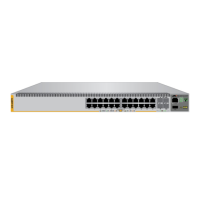
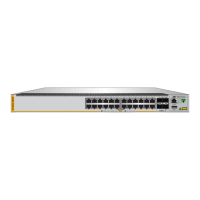
The Allied Telesis x510 Series are Gigabit Ethernet switches designed for stand-alone operation, offering a range of features for network connectivity, power delivery, and management. This series includes models such as the AT-x510-28GTX, AT-x510-28GPX, AT-x510-28GSX, AT-x510-52GTX, and AT-x510-52GPX, catering to various network requirements.
The primary function of the x510 Series switches is to provide Layer 2+ and Basic Layer 3 Gigabit Ethernet switching capabilities. They facilitate high-speed data transmission across a network, connecting various devices such as computers, servers, and other network equipment. Depending on the model, these switches offer a combination of 10/100/1000 Mbps twisted pair ports, SFP slots, and SFP+ slots, allowing for flexible network configurations using copper or fiber optic cabling.
Certain models, specifically the AT-x510-28GPX and AT-x510-52GPX, integrate Power over Ethernet (PoE) functionality. This feature allows the switches to deliver electrical power along with data over the same Ethernet cable to compatible powered devices (PDs), such as IP phones, wireless access points, and security cameras. This eliminates the need for separate power supplies for these devices, simplifying installation and reducing cabling complexity.
The switches are also capable of Virtual Chassis Stacking (VCStack™), a feature that allows multiple switches to operate as a single logical unit, enhancing network resilience and simplifying management. However, this particular guide focuses on their installation and operation as stand-alone units, where the VCStack feature would typically be disabled to utilize all available SFP+ slots for standard transceivers.
The x510 Series switches are designed for ease of use and flexibility in various network environments.
The x510 Series switches are designed with considerations for ease of maintenance and troubleshooting.
By combining robust networking capabilities with flexible installation, comprehensive management options, and dedicated support, the Allied Telesis x510 Series switches offer a reliable and efficient solution for various network infrastructure needs.
 General
| Series | x510 Series |
|---|---|
| Category | Switch |
| Operating Temperature | 0°C to 50°C (32°F to 122°F) |
| MAC Address Table Size | 16K entries |
| VLANs | 4094 |
| Jumbo Frames | 9KB |
| Power Supply | Internal power supply, 100-240V AC, 50/60Hz |
| Stacking | Up to 8 units |
| Layer | Layer 2 |
| Power over Ethernet (PoE) | Available on some models |
| Management | Web-based, CLI, SNMP |
| Security Features | Access Control Lists (ACLs), 802.1X authentication, port security |
| Weight | Varies by model |
| Ports | Varies by model (e.g., 24, 48) |
| Dimensions (W x D x H) | 440 x 260 x 44 mm (x510-52GP), 440 x 260 x 44 mm (x510-28GP) |







 To Next Page
