
 Need help?
Do you have a question about the Allied Telesis x530 Series and is the answer not in the manual?
Explains document formatting and warning symbols.
Provides contact information and support services.
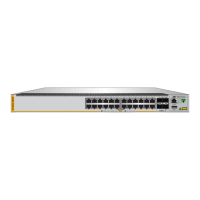
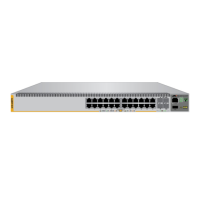
Details the physical layout and components of switch panels.
Lists the main features and capabilities of the x530 Series switches.
Identifies the components on the switch's management interface.
Details the capabilities and features of the RJ-45 copper ports.
Explains PoE standards and power delivery capabilities.
Describes the eco-friendly button's role in managing LEDs.
Explains the status indications provided by port and system LEDs.
Details the benefits and functionality of Virtual Chassis Stacking.
Describes the uses of the switch's USB port for file management.
Explains how to establish a local management session via the console port.
Provides details on the switch's AC power supply units.
Lists compatibility between software and hardware versions for stacking.
Explains the concept and benefits of connecting switches into a virtual unit.
Outlines the general rules for building a VCStack of x530 switches.
Details available ports for creating stack trunks across switch models.
Illustrates common configurations that result in invalid stack trunks.
Defines the functions and selection process for master and member switches.
Explains the importance and display of unique ID numbers for stack switches.
Covers the use and requirements of feature licenses in stacked configurations.
Explains procedures and requirements for stacking different x530 series.
Lists factors to consider when planning a switch stack configuration.
Provides steps for configuring mixed-mode VCStacking with licenses.
Describes the worksheet for documenting stack configuration details.
Highlights essential safety warnings before installation.
Provides requirements for choosing a suitable location for the switch.
Details the items included in the switch shipping box.
Instructions for installing rubber feet on specific switch models.
Procedure for attaching bumper feet to x530-10GHXm and x530-18GHXm models.
Guidance on positioning the switch securely on a flat surface.
Lists required items and switch orientations for rack mounting.
Step-by-step instructions for installing the switch in a 19-inch equipment rack.
Describes correct positioning of switches on a wall.
Provides requirements and tools for wall mounting switches.
Details how to prepare a plywood base for wall mounting.
Steps for securely attaching the plywood base to wall studs.
Instructions for attaching the switch to a prepared plywood base.
Procedure for mounting the switch directly onto a concrete wall.
Explains using default SFP+ ports for stack trunking.
Procedure to control switch ID assignment by powering on sequentially.
Procedure for automatic switch ID assignment via simultaneous power-on.
Methods for establishing a management connection to the switch.
Steps to confirm the successful formation and status of the switch stack.
Procedure to expand stack trunk capacity using additional SFP+ ports.
Detailed steps for connecting and powering on individual switches.
Explains using Gigabit/5G ports for stack trunking.
Lists and describes commands for master/member switch configuration.
Procedures for designating and configuring the master switch for stacking.
Steps for assigning IDs and configuring trunk ports on member switches.
Procedure for powering on the entire stack after configuration.
Confirms the successful operation and status of the assembled switch stack.
Guidelines for connecting standard RJ-45 copper network cables.
Instructions for inserting and connecting fiber optic transceivers.
Procedure for connecting direct attach twinax cables for 10Gbps links.
Details product dimensions and weight for each switch model.
Lists operating temperature, humidity, and altitude requirements.
Provides maximum power draw and input voltage specifications.
Diagrams and tables showing pin signals for copper network ports.
Pinout information for the RJ-45 serial console port.
Details the pinout and signal assignments for the USB port.
 General
| Series | x530 |
|---|---|
| Layer | Layer 3 |
| MAC Address Table Size | 16K |
| Jumbo Frames | 9216 bytes |
| Type | Managed |
| Category | Switch |
| Ports | 24 / 48 |
| Power Supply | Internal power supply |
| Management | Web-based, CLI, SNMP |
| PoE Support | Yes |
| Switching Capacity | 176 Gbps |
| Weight | 3.5 kg |
| Operating Temperature | 0°C to 50°C |
| Storage Temperature | -40°C to 70°C |
| Features | IPv4/IPv6, QoS |
| VLANs | 4094 |
| Humidity | 10% to 90% non-condensing |







 To Next Page
