508155-01Issue 2108Page 28 of 49
When checking piping connections for gas leaks, use
preferred means. Kitchen detergents can cause harmful
corrosion on various metals used in gas piping. Use of a
specialty Gas Leak Detector is strongly recommended.
Do not use matches, candles, ame or any other
source of ignition to check for gas leaks.
Testing Gas Supply Pressure
An inlet post located on the gas valve provides access to
the supply pressure. See Figure 17. Back out the 3/32 hex
screw one turn, connect a piece of 5/16 tubing and connect
to a manometer to measure supply pressure. See Table 20
for supply line pressure.
Check Manifold Pressure
After line pressure has been checked and adjusted,
check manifold pressure. Move pressure gauge to outlet
pressure tap located on unit gas valve (GV1). Checks
of manifold pressure are made as verication of proper
regulator adjustment. Manifold pressure for the A80US2V
can be measured at any time the gas valve is open and
is supplying gas to the unit. See Table 20 for operating
manifold pressure.
For safety, shut unit o and remove manometer as soon
as an accurate reading has been obtained. Take care to
replace pressure tap plug.
IMPORTANT
The gas valve is factory set and should not require
adjustment. All gas valves are factory regulated.
Manifold Adjustment Procedure
NOTE: Pressure test adapter kit (10L34) is available from
Allied Air to facilitate manifold pressure measurement.
1. Connect test gauge to manifold pressure post (Figure
17) on gas valve.
2. Ignite unit on low re and let run for 5 minutes to allow
for steady state conditions.
3. After allowing unit to stabilize for 5 minutes, record
manifold pressure and compare to value given in
Table 20.
4. If necessary, make adjustments. Figure 17 shows
location of high re and low re adjustment screw.
5. Repeat steps 2, 3 and 4 on high re.
6. Shut unit o and remove manometer as soon as an
accurate reading has been obtained. Take care to
replace pressure tap plug.
7. Start unit and perform leak check. Seal leaks if found.
Heating System Service Checks
CSA Certication
All units are CSA design certied without modications.
Refer to the A80US2V Installation Instruction.
Gas Piping
If a exible gas connector is required or allowed by
the authority that has jurisdiction, black iron pipe shall
be installed at the gas valve and extend outside the
furnace cabinet.
CAUTION
Do not over torque (800 in-lbs) or under torque (350
in-lbs) when attaching the gas piping to the gas valve.
WARNING
Gas supply piping should not allow more than 0.5”W.C.
drop in pressure between gas meter and unit. Supply gas
pipe must not be smaller than unit gas connection.
Compounds used on gas piping threaded joints should be
resistant to action of liqueed petroleum gases.
Testing Gas Piping
In case emergency shutdown is required, turn o the
main shut-o valve and disconnect the main power to
unit. These controls should be properly labeled by the
installer.
IMPORTANT
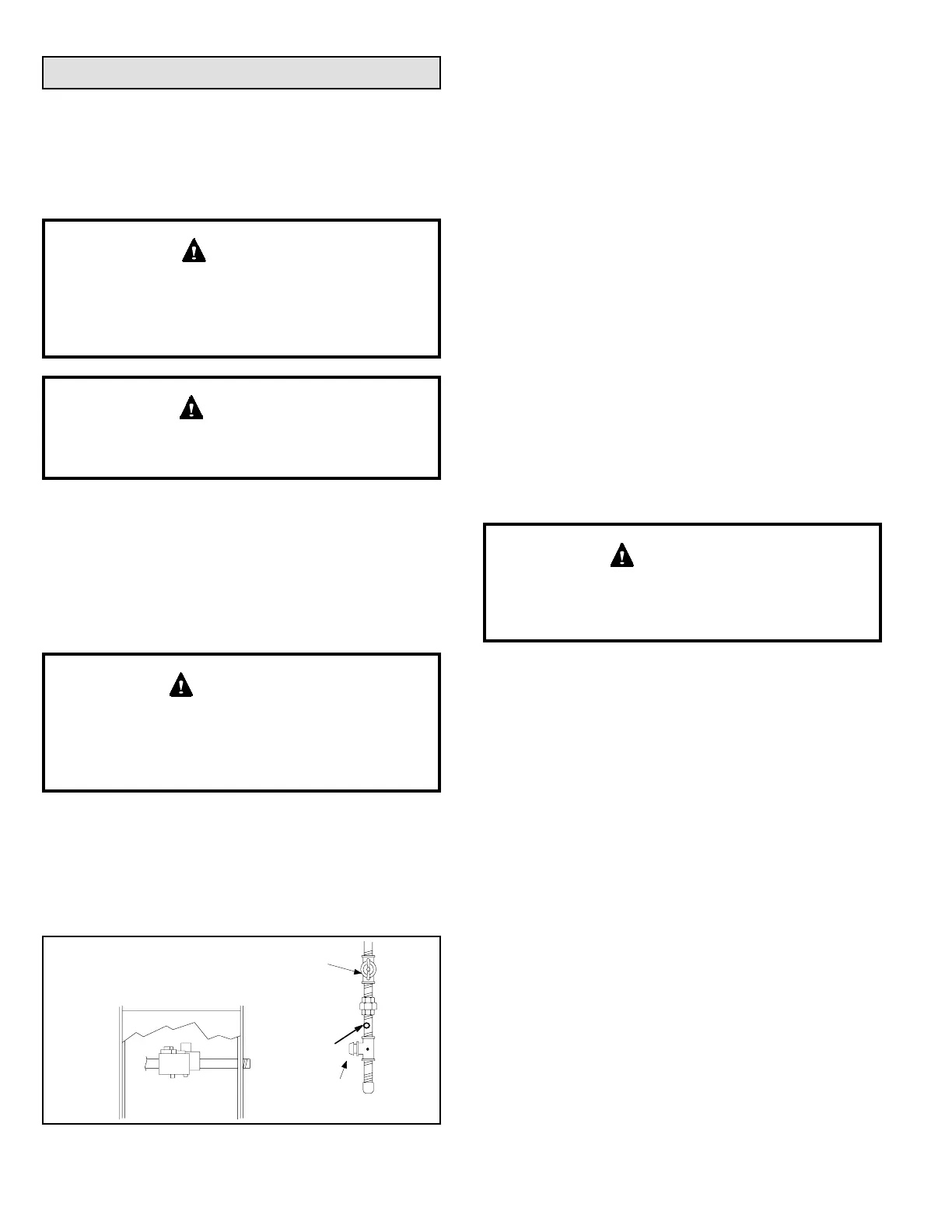
When pressure testing gas lines, the gas valve must be
disconnected and isolated. Gas valves can be damaged
if subjected to more than 0.5psig (14” W.C.). See Figure
18. If the pressure is greater than 0.5psig (14” W.C.), use
the manual shut-o valve before pressure testing to isolate
furnace from gas supply.
MANUAL MAIN SHUT-OFF VALVE
WILL NOT HOLD TEST PRESSURE
IN EXCESS OF 0.5 PSIG (14”W.C.)
GAS VALVE
CAP
1/8 NPT PLUG
Figure 18.


 To Next Page